

9.6 Topological Optimization with Maximized Stiffness and Heat Transfer
367
9.6.5.1 Topological Optimization of a Composite Made from Two
Competing Materials
We consider the elementary cell composed of two competitive materials in the ratio
1:1 (γ = 0.5), i.e. Young’s modulus is greater in one material than in the second
material, whereas in the second material, the heat transfer coefficient is larger than
the first one. Let us take E 1 = 1, k 1 = 5 (E 2 = 5, k 2 = 1) for the first (second)
material. The computations were carried out by FEM and the elementary cell was
divided into 2500 elements. In order to solve the optimization problem, the method
of moving asymptotes (MMA) introduced by Svanberg [54] was employed.
The MMA is based on a special type of convex approximation and it handles
element sizes as design variables, shape variables and material orientation angles. In
each step of the iterative process, convex approximating subproblems are generated
and solved. The latter are controlled by the so-called “moving asymptotes” stabilizing
and improving the process convergence.
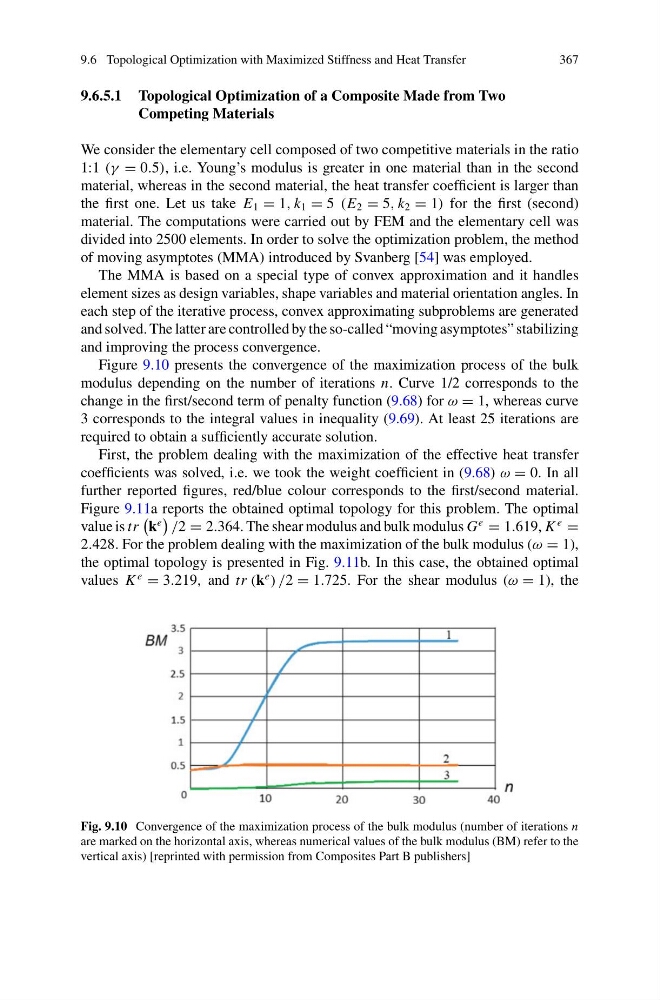
Figure 9.10 presents the convergence of the maximization process of the bulk
modulus depending on the number of iterations n. Curve 1/2 corresponds to the
change in the first/second term of penalty function (9.68) for ω = 1, whereas curve
3 corresponds to the integral values in inequality (9.69). At least 25 iterations are
required to obtain a sufficiently accurate solution.
First, the problem dealing with the maximization of the effective heat transfer
coefficients was solved, i.e. we took the weight coefficient in (9.68) ω = 0. In all
further reported figures, red/blue colour corresponds to the first/second material.
Figure 9.11a reports the obtained optimal topology for this problem. The optimal
value is tr
k
e
/2 = 2.364. The shear modulus and bulk modulus G
e
= 1.619, K
e
=
2.428. For the problem dealing with the maximization of the bulk modulus (ω = 1),
the optimal topology is presented in Fig. 9.11b. In this case, the obtained optimal
values K
e
= 3.219, and tr (k
e
) /2 = 1.725. For the shear modulus (ω = 1), the
Fig. 9.10 Convergence of the maximization process of the bulk modulus (number of iterations n
are marked on the horizontal axis, whereas numerical values of the bulk modulus (BM) refer to the
vertical axis) [reprinted with permission from Composites Part B publishers]
367
9.6.5.1 Topological Optimization of a Composite Made from Two
Competing Materials
We consider the elementary cell composed of two competitive materials in the ratio
1:1 (γ = 0.5), i.e. Young’s modulus is greater in one material than in the second
material, whereas in the second material, the heat transfer coefficient is larger than
the first one. Let us take E 1 = 1, k 1 = 5 (E 2 = 5, k 2 = 1) for the first (second)
material. The computations were carried out by FEM and the elementary cell was
divided into 2500 elements. In order to solve the optimization problem, the method
of moving asymptotes (MMA) introduced by Svanberg [54] was employed.
The MMA is based on a special type of convex approximation and it handles
element sizes as design variables, shape variables and material orientation angles. In
each step of the iterative process, convex approximating subproblems are generated
and solved. The latter are controlled by the so-called “moving asymptotes” stabilizing
and improving the process convergence.
Figure 9.10 presents the convergence of the maximization process of the bulk
modulus depending on the number of iterations n. Curve 1/2 corresponds to the
change in the first/second term of penalty function (9.68) for ω = 1, whereas curve
3 corresponds to the integral values in inequality (9.69). At least 25 iterations are
required to obtain a sufficiently accurate solution.
First, the problem dealing with the maximization of the effective heat transfer
coefficients was solved, i.e. we took the weight coefficient in (9.68) ω = 0. In all
further reported figures, red/blue colour corresponds to the first/second material.
Figure 9.11a reports the obtained optimal topology for this problem. The optimal
value is tr
k
e
/2 = 2.364. The shear modulus and bulk modulus G
e
= 1.619, K
e
=
2.428. For the problem dealing with the maximization of the bulk modulus (ω = 1),
the optimal topology is presented in Fig. 9.11b. In this case, the obtained optimal
values K
e
= 3.219, and tr (k
e
) /2 = 1.725. For the shear modulus (ω = 1), the
Fig. 9.10 Convergence of the maximization process of the bulk modulus (number of iterations n
are marked on the horizontal axis, whereas numerical values of the bulk modulus (BM) refer to the
vertical axis) [reprinted with permission from Composites Part B publishers]