

366
9 Topologic Optimization of Vibrations of Size-Dependent Beams
Let M
e denote one of the mechanical quantities, i.e. the effective bulk modulus
K
e or the effective shear modulus G
e . The target function is defined as follows:
min
⎧
⎨
⎩
(q − 1)
ωM
e
M b
+
(1 − ω)tr(k
e
)
k b
+ q
h 0 h max
A
Y
|∇ρ(y)|
2 dY
⎫
⎬
⎭
, (9.68)
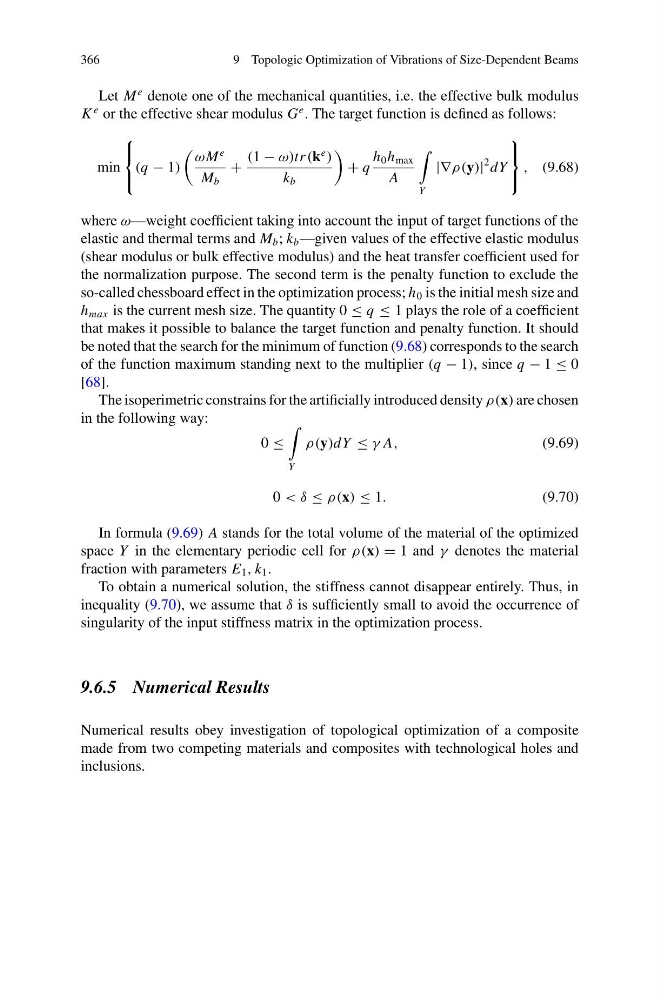
where ω—weight coefficient taking into account the input of target functions of the
elastic and thermal terms and M b ; k b —given values of the effective elastic modulus
(shear modulus or bulk effective modulus) and the heat transfer coefficient used for
the normalization purpose. The second term is the penalty function to exclude the
so-called chessboard effect in the optimization process; h 0 is the initial mesh size and
h max is the current mesh size. The quantity 0 ≤ q ≤ 1 plays the role of a coefficient
that makes it possible to balance the target function and penalty function. It should
be noted that the search for the minimum of function (9.68) corresponds to the search
of the function maximum standing next to the multiplier (q − 1), since q − 1 ≤ 0
[68].
The isoperimetric constrains for the artificially introduced density ρ(x) are chosen
in the following way:
0 ≤
Y
ρ(y)dY ≤ γ A,
(9.69)
0 < δ ≤ ρ(x) ≤ 1.
(9.70)
In formula (9.69) A stands for the total volume of the material of the optimized
space Y in the elementary periodic cell for ρ(x) = 1 and γ denotes the material
fraction with parameters E 1 , k 1 .
To obtain a numerical solution, the stiffness cannot disappear entirely. Thus, in
inequality (9.70), we assume that δ is sufficiently small to avoid the occurrence of
singularity of the input stiffness matrix in the optimization process.
9.6.5 Numerical Results
Numerical results obey investigation of topological optimization of a composite
made from two competing materials and composites with technological holes and
inclusions.
9 Topologic Optimization of Vibrations of Size-Dependent Beams
Let M
e denote one of the mechanical quantities, i.e. the effective bulk modulus
K
e or the effective shear modulus G
e . The target function is defined as follows:
min
⎧
⎨
⎩
(q − 1)
ωM
e
M b
+
(1 − ω)tr(k
e
)
k b
+ q
h 0 h max
A
Y
|∇ρ(y)|
2 dY
⎫
⎬
⎭
, (9.68)
where ω—weight coefficient taking into account the input of target functions of the
elastic and thermal terms and M b ; k b —given values of the effective elastic modulus
(shear modulus or bulk effective modulus) and the heat transfer coefficient used for
the normalization purpose. The second term is the penalty function to exclude the
so-called chessboard effect in the optimization process; h 0 is the initial mesh size and
h max is the current mesh size. The quantity 0 ≤ q ≤ 1 plays the role of a coefficient
that makes it possible to balance the target function and penalty function. It should
be noted that the search for the minimum of function (9.68) corresponds to the search
of the function maximum standing next to the multiplier (q − 1), since q − 1 ≤ 0
[68].
The isoperimetric constrains for the artificially introduced density ρ(x) are chosen
in the following way:
0 ≤
Y
ρ(y)dY ≤ γ A,
(9.69)
0 < δ ≤ ρ(x) ≤ 1.
(9.70)
In formula (9.69) A stands for the total volume of the material of the optimized
space Y in the elementary periodic cell for ρ(x) = 1 and γ denotes the material
fraction with parameters E 1 , k 1 .
To obtain a numerical solution, the stiffness cannot disappear entirely. Thus, in
inequality (9.70), we assume that δ is sufficiently small to avoid the occurrence of
singularity of the input stiffness matrix in the optimization process.
9.6.5 Numerical Results
Numerical results obey investigation of topological optimization of a composite
made from two competing materials and composites with technological holes and
inclusions.