

9.6 Topological Optimization with Maximized Stiffness and Heat Transfer
363
C
e
1111 =
1
|Y |
Y
C 1111 − C 1111 ε
∗(11)
11
− C 1122 ε
∗(11)
22
dY.
(9.58)
Taking into account initial stresses ε
0 in the direction (ε
0
11 = 0, ε
0
12 = 0, ε
0
22 = 1),
one gets
C
e
1111 =
1
|Y |
Y
C 1122 − C 1111 ε
∗(22)
11
− C 1122 ε
∗(22)
22
dY.
(9.59)
If we consider shear initial stresses ε
0 (ε
0
11 = 0, ε
0
12 = 0.5, ε
0
22 = 0), then formula
(9.56) yields
C
e
1212 =
1
|Y |
Y
C 1212 − 2C 1212 ε
∗(12)
12
dY.
(9.60)
Now, from (9.57)–(9.60) we obtain
K
e
=
C
e
1111 + C
e
1122
/2,
G
e
= G
e
1212 /2,
(9.61)
where K
e
/G
e is the effective bulk/shear model.
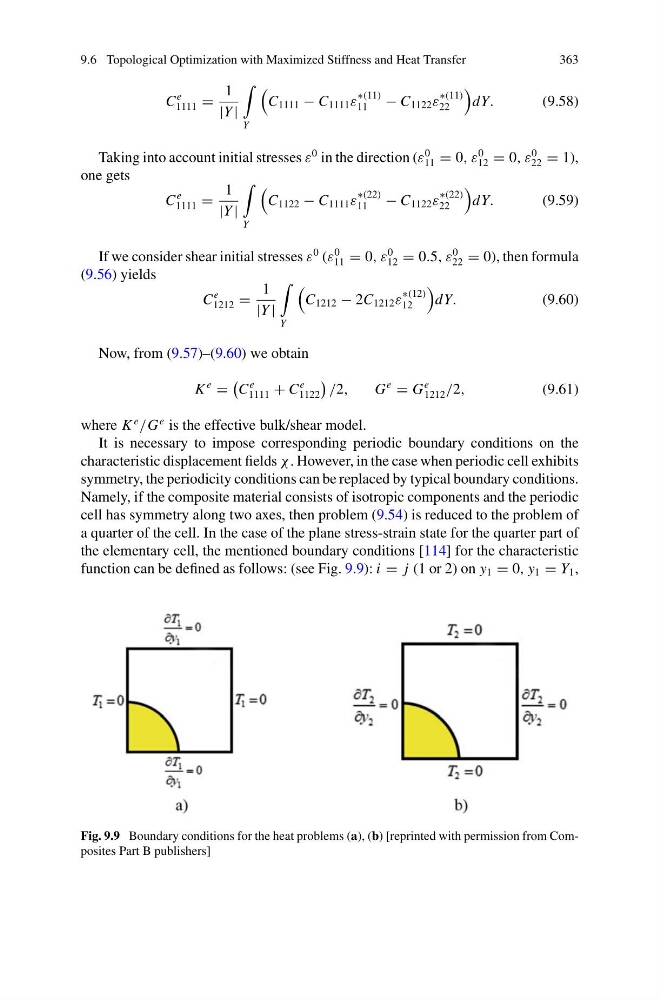
It is necessary to impose corresponding periodic boundary conditions on the
characteristic displacement fields χ . However, in the case when periodic cell exhibits
symmetry, the periodicity conditions can be replaced by typical boundary conditions.
Namely, if the composite material consists of isotropic components and the periodic
cell has symmetry along two axes, then problem (9.54) is reduced to the problem of
a quarter of the cell. In the case of the plane stress-strain state for the quarter part of
the elementary cell, the mentioned boundary conditions [114] for the characteristic
function can be defined as follows: (see Fig. 9.9): i = j (1 or 2) on y 1 = 0, y 1 = Y 1 ,
Fig. 9.9 Boundary conditions for the heat problems (a), (b) [reprinted with permission from Composites Part B publishers]
363
C
e
1111 =
1
|Y |
Y
C 1111 − C 1111 ε
∗(11)
11
− C 1122 ε
∗(11)
22
dY.
(9.58)
Taking into account initial stresses ε
0 in the direction (ε
0
11 = 0, ε
0
12 = 0, ε
0
22 = 1),
one gets
C
e
1111 =
1
|Y |
Y
C 1122 − C 1111 ε
∗(22)
11
− C 1122 ε
∗(22)
22
dY.
(9.59)
If we consider shear initial stresses ε
0 (ε
0
11 = 0, ε
0
12 = 0.5, ε
0
22 = 0), then formula
(9.56) yields
C
e
1212 =
1
|Y |
Y
C 1212 − 2C 1212 ε
∗(12)
12
dY.
(9.60)
Now, from (9.57)–(9.60) we obtain
K
e
=
C
e
1111 + C
e
1122
/2,
G
e
= G
e
1212 /2,
(9.61)
where K
e
/G
e is the effective bulk/shear model.
It is necessary to impose corresponding periodic boundary conditions on the
characteristic displacement fields χ . However, in the case when periodic cell exhibits
symmetry, the periodicity conditions can be replaced by typical boundary conditions.
Namely, if the composite material consists of isotropic components and the periodic
cell has symmetry along two axes, then problem (9.54) is reduced to the problem of
a quarter of the cell. In the case of the plane stress-strain state for the quarter part of
the elementary cell, the mentioned boundary conditions [114] for the characteristic
function can be defined as follows: (see Fig. 9.9): i = j (1 or 2) on y 1 = 0, y 1 = Y 1 ,
Fig. 9.9 Boundary conditions for the heat problems (a), (b) [reprinted with permission from Composites Part B publishers]