

344
9 Topologic Optimization of Vibrations of Size-Dependent Beams
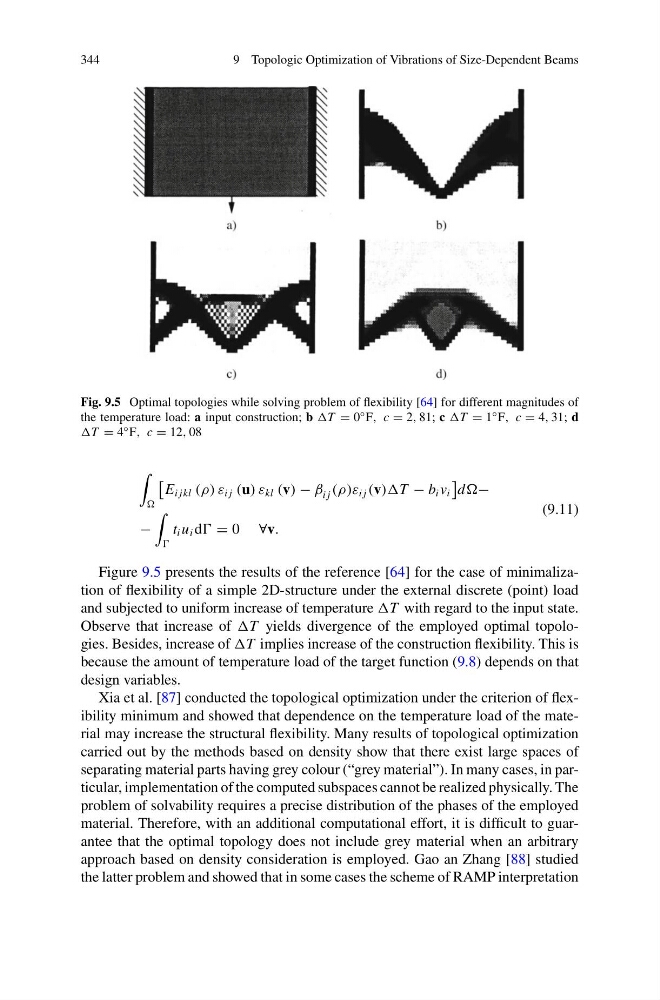
Fig. 9.5 Optimal topologies while solving problem of flexibility [64] for different magnitudes of
the temperature load: a input construction; b T = 0 ◦ F, c = 2, 81; c T = 1 ◦ F, c = 4, 31; d
T = 4 ◦ F, c = 12, 08
E i jkl (ρ) ε i j (u) ε kl (v) − β i j (ρ)ε i j (v))T − b i v i
d−
−
t i u i d = 0 ∀v.
(9.11)
Figure 9.5 presents the results of the reference [64] for the case of minimalization of flexibility of a simple 2D-structure under the external discrete (point) load
and subjected to uniform increase of temperature T with regard to the input state.
Observe that increase of T yields divergence of the employed optimal topologies. Besides, increase of T implies increase of the construction flexibility. This is
because the amount of temperature load of the target function (9.8) depends on that
design variables.
Xia et al. [87] conducted the topological optimization under the criterion of flexibility minimum and showed that dependence on the temperature load of the material may increase the structural flexibility. Many results of topological optimization
carried out by the methods based on density show that there exist large spaces of
separating material parts having grey colour (“grey material”). In many cases, in particular, implementation of the computed subspaces cannot be realized physically. The
problem of solvability requires a precise distribution of the phases of the employed
material. Therefore, with an additional computational effort, it is difficult to guarantee that the optimal topology does not include grey material when an arbitrary
approach based on density consideration is employed. Gao an Zhang [88] studied
the latter problem and showed that in some cases the scheme of RAMP interpretation
9 Topologic Optimization of Vibrations of Size-Dependent Beams
Fig. 9.5 Optimal topologies while solving problem of flexibility [64] for different magnitudes of
the temperature load: a input construction; b T = 0 ◦ F, c = 2, 81; c T = 1 ◦ F, c = 4, 31; d
T = 4 ◦ F, c = 12, 08
E i jkl (ρ) ε i j (u) ε kl (v) − β i j (ρ)ε i j (v))T − b i v i
d−
−
t i u i d = 0 ∀v.
(9.11)
Figure 9.5 presents the results of the reference [64] for the case of minimalization of flexibility of a simple 2D-structure under the external discrete (point) load
and subjected to uniform increase of temperature T with regard to the input state.
Observe that increase of T yields divergence of the employed optimal topologies. Besides, increase of T implies increase of the construction flexibility. This is
because the amount of temperature load of the target function (9.8) depends on that
design variables.
Xia et al. [87] conducted the topological optimization under the criterion of flexibility minimum and showed that dependence on the temperature load of the material may increase the structural flexibility. Many results of topological optimization
carried out by the methods based on density show that there exist large spaces of
separating material parts having grey colour (“grey material”). In many cases, in particular, implementation of the computed subspaces cannot be realized physically. The
problem of solvability requires a precise distribution of the phases of the employed
material. Therefore, with an additional computational effort, it is difficult to guarantee that the optimal topology does not include grey material when an arbitrary
approach based on density consideration is employed. Gao an Zhang [88] studied
the latter problem and showed that in some cases the scheme of RAMP interpretation