

9.4 Applying Topological Cell Optimization
343
takes the form of (9.1). An overview of the available literature implies that the latter
problem is dealt with over 85% of works devoted to topological optimization. This
wide popularity of the method can be explained through two characteristic features
of the target function based on flexibility: it is self-adjoint and its sensitivity to that
material inclusion is negative. The mentioned two characteristics of the method allow
for its simple implementation and for getting fast and reliable results, and hence it is
widely used in the commercial engineering-oriented programs.
9.4.2 Thermoelastic Structures
In majority cases of realization of topological optimization under criterion of minimum flexibility and with an account of volume forces in (9.7), the problem is reduced
to finding an optimal solution depending only on the boundary loads which depend
only on design variables. Rodrigues and Fernandes [64] are the first researchers who
solved the problem employing material based model and included the temperature
influence into the flexibility form. The novel optimization is realized on minimalization through a global measurement of general displacement estimated by structure
flexibility with isoparametric constraints put onto the general volume. Flexibility
defined as virtual work of the given load and the generated displacement is equal to
the squared energetic norm of the general displacement multiplied by two. Basing
on the introduced assumptions and defining the material coefficient β i j = E i jkl α kl ,
where α kl are coefficients of the linear heat expansion, the problem of topological
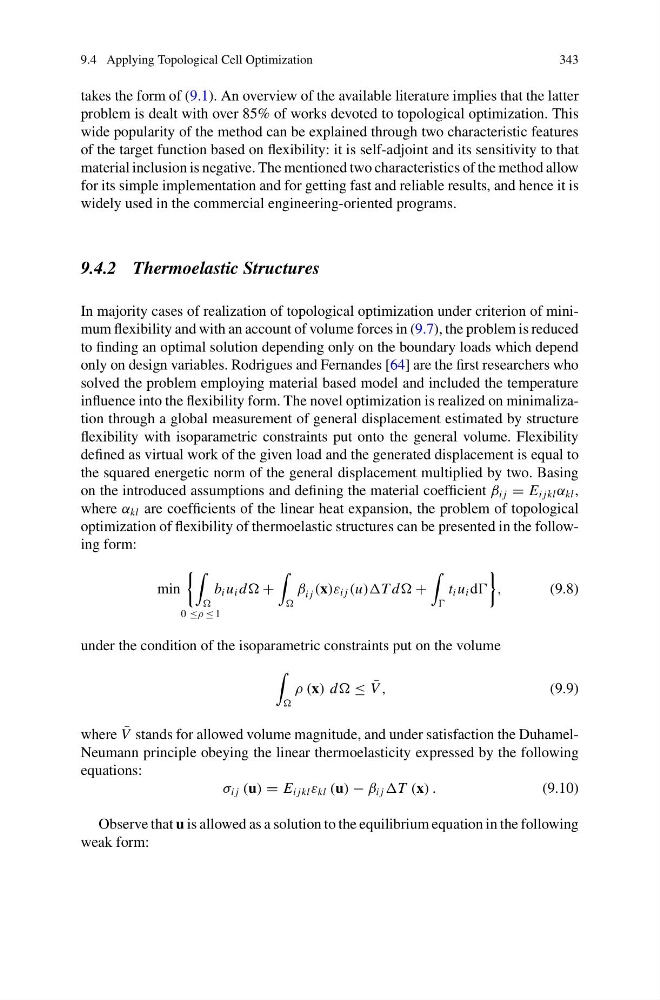
optimization of flexibility of thermoelastic structures can be presented in the following form:
min
b i u i d +
β i j (x)ε i j (u))T d +
t i u i d
0 ≤ρ ≤ 1
,
(9.8)
under the condition of the isoparametric constraints put on the volume
ρ (x) d ≤ ¯
V ,
(9.9)
where ¯
V stands for allowed volume magnitude, and under satisfaction the DuhamelNeumann principle obeying the linear thermoelasticity expressed by the following
equations:
σ i j (u) = E i jkl ε kl (u) − β i j T (x) .
(9.10)
Observe that u is allowed as a solution to the equilibrium equation in the following
weak form:
343
takes the form of (9.1). An overview of the available literature implies that the latter
problem is dealt with over 85% of works devoted to topological optimization. This
wide popularity of the method can be explained through two characteristic features
of the target function based on flexibility: it is self-adjoint and its sensitivity to that
material inclusion is negative. The mentioned two characteristics of the method allow
for its simple implementation and for getting fast and reliable results, and hence it is
widely used in the commercial engineering-oriented programs.
9.4.2 Thermoelastic Structures
In majority cases of realization of topological optimization under criterion of minimum flexibility and with an account of volume forces in (9.7), the problem is reduced
to finding an optimal solution depending only on the boundary loads which depend
only on design variables. Rodrigues and Fernandes [64] are the first researchers who
solved the problem employing material based model and included the temperature
influence into the flexibility form. The novel optimization is realized on minimalization through a global measurement of general displacement estimated by structure
flexibility with isoparametric constraints put onto the general volume. Flexibility
defined as virtual work of the given load and the generated displacement is equal to
the squared energetic norm of the general displacement multiplied by two. Basing
on the introduced assumptions and defining the material coefficient β i j = E i jkl α kl ,
where α kl are coefficients of the linear heat expansion, the problem of topological
optimization of flexibility of thermoelastic structures can be presented in the following form:
min
b i u i d +
β i j (x)ε i j (u))T d +
t i u i d
0 ≤ρ ≤ 1
,
(9.8)
under the condition of the isoparametric constraints put on the volume
ρ (x) d ≤ ¯
V ,
(9.9)
where ¯
V stands for allowed volume magnitude, and under satisfaction the DuhamelNeumann principle obeying the linear thermoelasticity expressed by the following
equations:
σ i j (u) = E i jkl ε kl (u) − β i j T (x) .
(9.10)
Observe that u is allowed as a solution to the equilibrium equation in the following
weak form: