

342
9 Topologic Optimization of Vibrations of Size-Dependent Beams
9.4 Applying Topological Cell Optimization
The topological optimization used for solving majority of application-oriented problems is restricted to design of mechanical constructions based on stiffness criteria
[85, 86].
9.4.1 Flexibility Minimization
The methods of topological optimization work efficiently when a target function is
defined as an integral with respect to design space. In the case of purely structural
problems, a target function serves flexibility of construction with a constraint put on
its volume. This requirement, in the case of linear structures, corresponds to defining
an optimal stiffness tensor E i jkl (x), which is treated as variable quality in the space
of optimization [72].
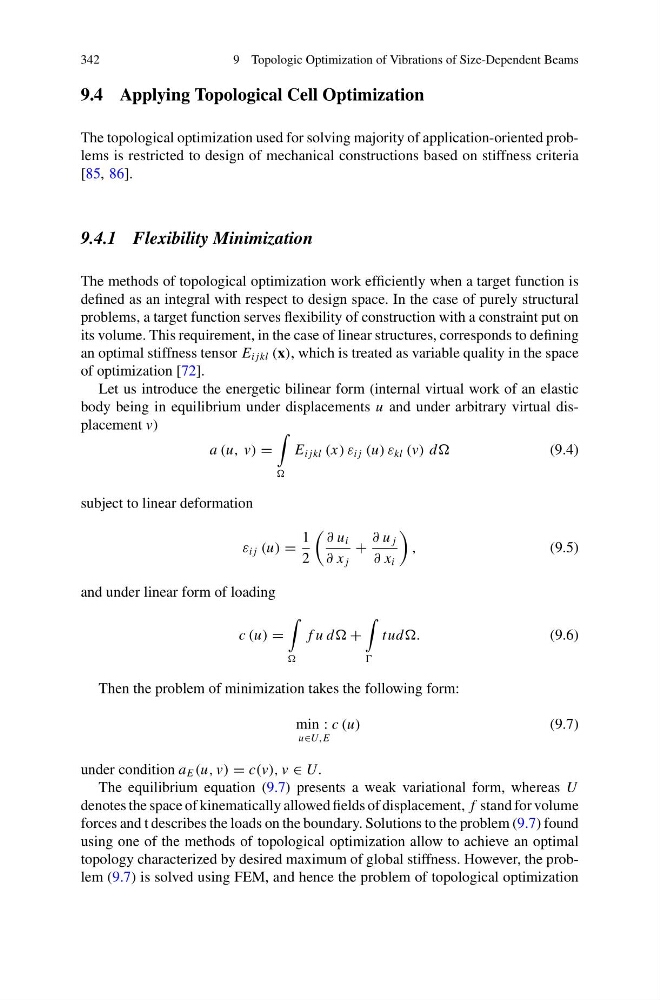
Let us introduce the energetic bilinear form (internal virtual work of an elastic
body being in equilibrium under displacements u and under arbitrary virtual displacement v)
a (u, v) =
E i jkl (x) ε i j (u) ε kl (v) d
(9.4)
subject to linear deformation
ε i j (u) =
1
2
∂ u i
∂ x j
+
∂ u j
∂ x i
,
(9.5)
and under linear form of loading
c (u) =
f u d +
tud.
(9.6)
Then the problem of minimization takes the following form:
min : c (u)
u∈U,E
(9.7)
under condition a E (u, v) = c(v), v ∈ U.
The equilibrium equation (9.7) presents a weak variational form, whereas U
denotes the space of kinematically allowed fields of displacement, f stand for volume
forces and t describes the loads on the boundary. Solutions to the problem (9.7) found
using one of the methods of topological optimization allow to achieve an optimal
topology characterized by desired maximum of global stiffness. However, the problem (9.7) is solved using FEM, and hence the problem of topological optimization
9 Topologic Optimization of Vibrations of Size-Dependent Beams
9.4 Applying Topological Cell Optimization
The topological optimization used for solving majority of application-oriented problems is restricted to design of mechanical constructions based on stiffness criteria
[85, 86].
9.4.1 Flexibility Minimization
The methods of topological optimization work efficiently when a target function is
defined as an integral with respect to design space. In the case of purely structural
problems, a target function serves flexibility of construction with a constraint put on
its volume. This requirement, in the case of linear structures, corresponds to defining
an optimal stiffness tensor E i jkl (x), which is treated as variable quality in the space
of optimization [72].
Let us introduce the energetic bilinear form (internal virtual work of an elastic
body being in equilibrium under displacements u and under arbitrary virtual displacement v)
a (u, v) =
E i jkl (x) ε i j (u) ε kl (v) d
(9.4)
subject to linear deformation
ε i j (u) =
1
2
∂ u i
∂ x j
+
∂ u j
∂ x i
,
(9.5)
and under linear form of loading
c (u) =
f u d +
tud.
(9.6)
Then the problem of minimization takes the following form:
min : c (u)
u∈U,E
(9.7)
under condition a E (u, v) = c(v), v ∈ U.
The equilibrium equation (9.7) presents a weak variational form, whereas U
denotes the space of kinematically allowed fields of displacement, f stand for volume
forces and t describes the loads on the boundary. Solutions to the problem (9.7) found
using one of the methods of topological optimization allow to achieve an optimal
topology characterized by desired maximum of global stiffness. However, the problem (9.7) is solved using FEM, and hence the problem of topological optimization