

9.3 Topological Optimization Problem
341
Fig. 9.3 Optimal topology versus the chosen mesh with dimensions of cells: a 60 × 20, b 90 ×
30, c 150 × 50, d 300 × 100
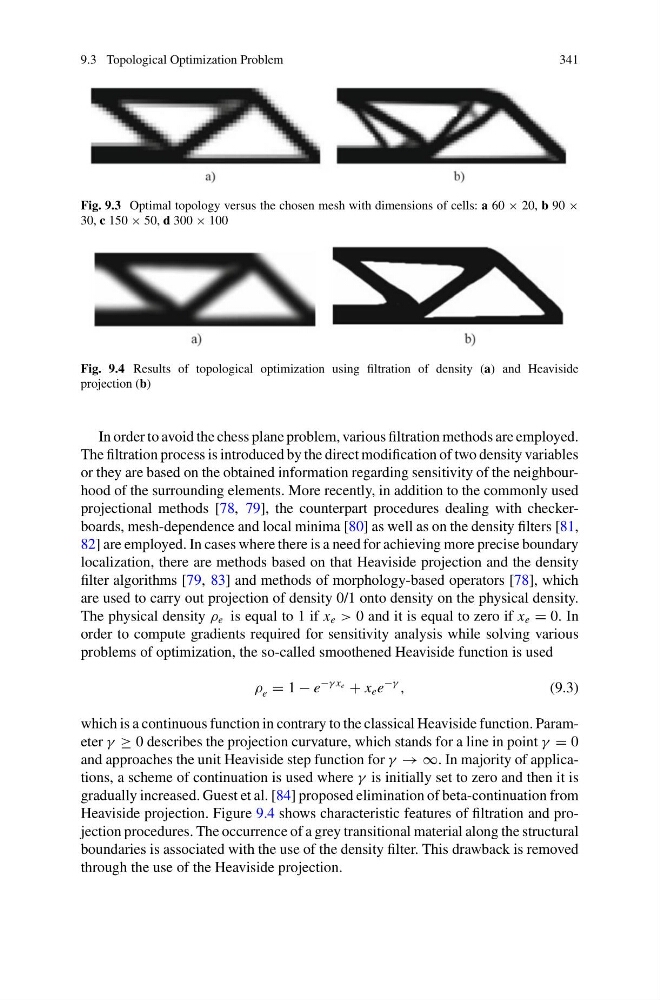
Fig. 9.4 Results of topological optimization using filtration of density (a) and Heaviside
projection (b)
In order to avoid the chess plane problem, various filtration methods are employed.
The filtration process is introduced by the direct modification of two density variables
or they are based on the obtained information regarding sensitivity of the neighbourhood of the surrounding elements. More recently, in addition to the commonly used
projectional methods [78, 79], the counterpart procedures dealing with checkerboards, mesh-dependence and local minima [80] as well as on the density filters [81,
82] are employed. In cases where there is a need for achieving more precise boundary
localization, there are methods based on that Heaviside projection and the density
filter algorithms [79, 83] and methods of morphology-based operators [78], which
are used to carry out projection of density 0/1 onto density on the physical density.
The physical density ρ e is equal to 1 if x e > 0 and it is equal to zero if x e = 0. In
order to compute gradients required for sensitivity analysis while solving various
problems of optimization, the so-called smoothened Heaviside function is used
ρ e = 1 − e
−γ x e + x e e
−γ
,
(9.3)
which is a continuous function in contrary to the classical Heaviside function. Parameter γ ≥ 0 describes the projection curvature, which stands for a line in point γ = 0
and approaches the unit Heaviside step function for γ → ∞. In majority of applications, a scheme of continuation is used where γ is initially set to zero and then it is
gradually increased. Guest et al. [84] proposed elimination of beta-continuation from
Heaviside projection. Figure 9.4 shows characteristic features of filtration and projection procedures. The occurrence of a grey transitional material along the structural
boundaries is associated with the use of the density filter. This drawback is removed
through the use of the Heaviside projection.
341
Fig. 9.3 Optimal topology versus the chosen mesh with dimensions of cells: a 60 × 20, b 90 ×
30, c 150 × 50, d 300 × 100
Fig. 9.4 Results of topological optimization using filtration of density (a) and Heaviside
projection (b)
In order to avoid the chess plane problem, various filtration methods are employed.
The filtration process is introduced by the direct modification of two density variables
or they are based on the obtained information regarding sensitivity of the neighbourhood of the surrounding elements. More recently, in addition to the commonly used
projectional methods [78, 79], the counterpart procedures dealing with checkerboards, mesh-dependence and local minima [80] as well as on the density filters [81,
82] are employed. In cases where there is a need for achieving more precise boundary
localization, there are methods based on that Heaviside projection and the density
filter algorithms [79, 83] and methods of morphology-based operators [78], which
are used to carry out projection of density 0/1 onto density on the physical density.
The physical density ρ e is equal to 1 if x e > 0 and it is equal to zero if x e = 0. In
order to compute gradients required for sensitivity analysis while solving various
problems of optimization, the so-called smoothened Heaviside function is used
ρ e = 1 − e
−γ x e + x e e
−γ
,
(9.3)
which is a continuous function in contrary to the classical Heaviside function. Parameter γ ≥ 0 describes the projection curvature, which stands for a line in point γ = 0
and approaches the unit Heaviside step function for γ → ∞. In majority of applications, a scheme of continuation is used where γ is initially set to zero and then it is
gradually increased. Guest et al. [84] proposed elimination of beta-continuation from
Heaviside projection. Figure 9.4 shows characteristic features of filtration and projection procedures. The occurrence of a grey transitional material along the structural
boundaries is associated with the use of the density filter. This drawback is removed
through the use of the Heaviside projection.