

340
9 Topologic Optimization of Vibrations of Size-Dependent Beams
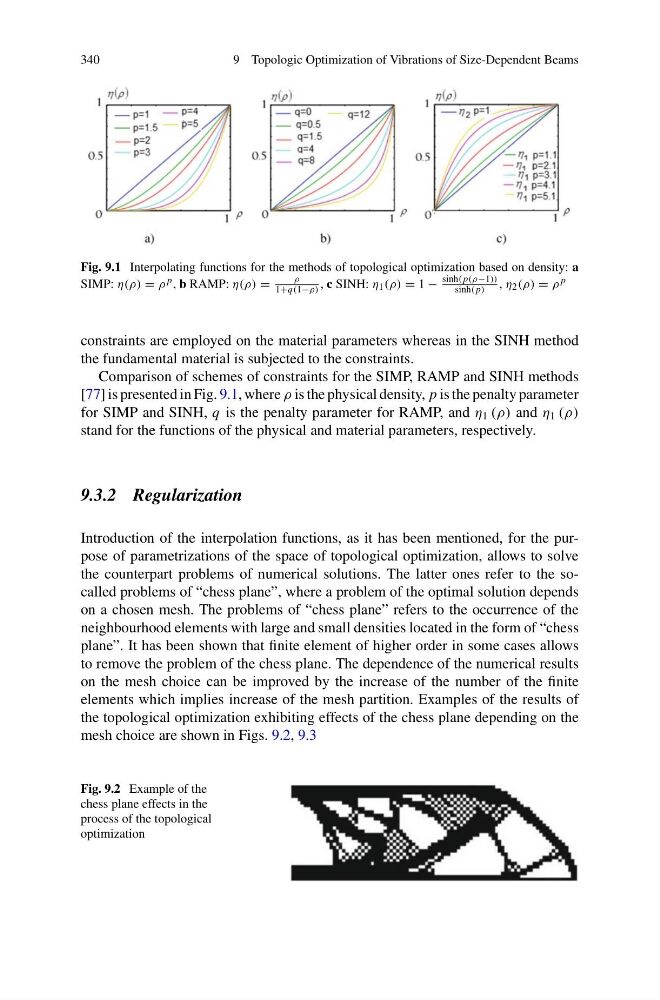
Fig. 9.1 Interpolating functions for the methods of topological optimization based on density: a
SIMP: η(ρ) = ρ p , b RAMP: η(ρ) =
ρ
1+q(1−ρ) , c SINH: η 1 (ρ) = 1 −
sinh( p(ρ−1))
sinh( p)
, η 2 (ρ) = ρ p
constraints are employed on the material parameters whereas in the SINH method
the fundamental material is subjected to the constraints.
Comparison of schemes of constraints for the SIMP, RAMP and SINH methods
[77] is presented in Fig. 9.1, where ρ is the physical density, p is the penalty parameter
for SIMP and SINH, q is the penalty parameter for RAMP, and η 1 (ρ) and η 1 (ρ)
stand for the functions of the physical and material parameters, respectively.
9.3.2 Regularization
Introduction of the interpolation functions, as it has been mentioned, for the purpose of parametrizations of the space of topological optimization, allows to solve
the counterpart problems of numerical solutions. The latter ones refer to the socalled problems of “chess plane”, where a problem of the optimal solution depends
on a chosen mesh. The problems of “chess plane” refers to the occurrence of the
neighbourhood elements with large and small densities located in the form of “chess
plane”. It has been shown that finite element of higher order in some cases allows
to remove the problem of the chess plane. The dependence of the numerical results
on the mesh choice can be improved by the increase of the number of the finite
elements which implies increase of the mesh partition. Examples of the results of
the topological optimization exhibiting effects of the chess plane depending on the
mesh choice are shown in Figs. 9.2, 9.3
Fig. 9.2 Example of the
chess plane effects in the
process of the topological
optimization
9 Topologic Optimization of Vibrations of Size-Dependent Beams
Fig. 9.1 Interpolating functions for the methods of topological optimization based on density: a
SIMP: η(ρ) = ρ p , b RAMP: η(ρ) =
ρ
1+q(1−ρ) , c SINH: η 1 (ρ) = 1 −
sinh( p(ρ−1))
sinh( p)
, η 2 (ρ) = ρ p
constraints are employed on the material parameters whereas in the SINH method
the fundamental material is subjected to the constraints.
Comparison of schemes of constraints for the SIMP, RAMP and SINH methods
[77] is presented in Fig. 9.1, where ρ is the physical density, p is the penalty parameter
for SIMP and SINH, q is the penalty parameter for RAMP, and η 1 (ρ) and η 1 (ρ)
stand for the functions of the physical and material parameters, respectively.
9.3.2 Regularization
Introduction of the interpolation functions, as it has been mentioned, for the purpose of parametrizations of the space of topological optimization, allows to solve
the counterpart problems of numerical solutions. The latter ones refer to the socalled problems of “chess plane”, where a problem of the optimal solution depends
on a chosen mesh. The problems of “chess plane” refers to the occurrence of the
neighbourhood elements with large and small densities located in the form of “chess
plane”. It has been shown that finite element of higher order in some cases allows
to remove the problem of the chess plane. The dependence of the numerical results
on the mesh choice can be improved by the increase of the number of the finite
elements which implies increase of the mesh partition. Examples of the results of
the topological optimization exhibiting effects of the chess plane depending on the
mesh choice are shown in Figs. 9.2, 9.3
Fig. 9.2 Example of the
chess plane effects in the
process of the topological
optimization