

9.4 Applying Topological Cell Optimization
345
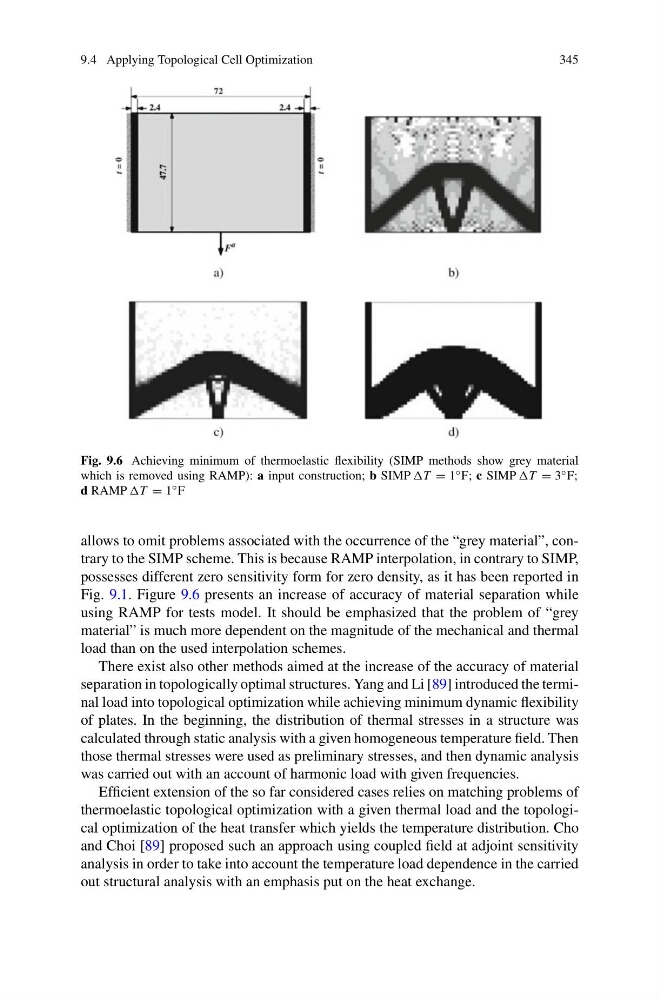
Fig. 9.6 Achieving minimum of thermoelastic flexibility (SIMP methods show grey material
which is removed using RAMP): a input construction; b SIMP T = 1 ◦ F; c SIMP T = 3 ◦ F;
d RAMP T = 1 ◦ F
allows to omit problems associated with the occurrence of the “grey material”, contrary to the SIMP scheme. This is because RAMP interpolation, in contrary to SIMP,
possesses different zero sensitivity form for zero density, as it has been reported in
Fig. 9.1. Figure 9.6 presents an increase of accuracy of material separation while
using RAMP for tests model. It should be emphasized that the problem of “grey
material” is much more dependent on the magnitude of the mechanical and thermal
load than on the used interpolation schemes.
There exist also other methods aimed at the increase of the accuracy of material
separation in topologically optimal structures. Yang and Li [89] introduced the terminal load into topological optimization while achieving minimum dynamic flexibility
of plates. In the beginning, the distribution of thermal stresses in a structure was
calculated through static analysis with a given homogeneous temperature field. Then
those thermal stresses were used as preliminary stresses, and then dynamic analysis
was carried out with an account of harmonic load with given frequencies.
Efficient extension of the so far considered cases relies on matching problems of
thermoelastic topological optimization with a given thermal load and the topological optimization of the heat transfer which yields the temperature distribution. Cho
and Choi [89] proposed such an approach using coupled field at adjoint sensitivity
analysis in order to take into account the temperature load dependence in the carried
out structural analysis with an emphasis put on the heat exchange.
345
Fig. 9.6 Achieving minimum of thermoelastic flexibility (SIMP methods show grey material
which is removed using RAMP): a input construction; b SIMP T = 1 ◦ F; c SIMP T = 3 ◦ F;
d RAMP T = 1 ◦ F
allows to omit problems associated with the occurrence of the “grey material”, contrary to the SIMP scheme. This is because RAMP interpolation, in contrary to SIMP,
possesses different zero sensitivity form for zero density, as it has been reported in
Fig. 9.1. Figure 9.6 presents an increase of accuracy of material separation while
using RAMP for tests model. It should be emphasized that the problem of “grey
material” is much more dependent on the magnitude of the mechanical and thermal
load than on the used interpolation schemes.
There exist also other methods aimed at the increase of the accuracy of material
separation in topologically optimal structures. Yang and Li [89] introduced the terminal load into topological optimization while achieving minimum dynamic flexibility
of plates. In the beginning, the distribution of thermal stresses in a structure was
calculated through static analysis with a given homogeneous temperature field. Then
those thermal stresses were used as preliminary stresses, and then dynamic analysis
was carried out with an account of harmonic load with given frequencies.
Efficient extension of the so far considered cases relies on matching problems of
thermoelastic topological optimization with a given thermal load and the topological optimization of the heat transfer which yields the temperature distribution. Cho
and Choi [89] proposed such an approach using coupled field at adjoint sensitivity
analysis in order to take into account the temperature load dependence in the carried
out structural analysis with an emphasis put on the heat exchange.