

324
8 Thermoelastic Vibrations of Timoshenko Microbeams
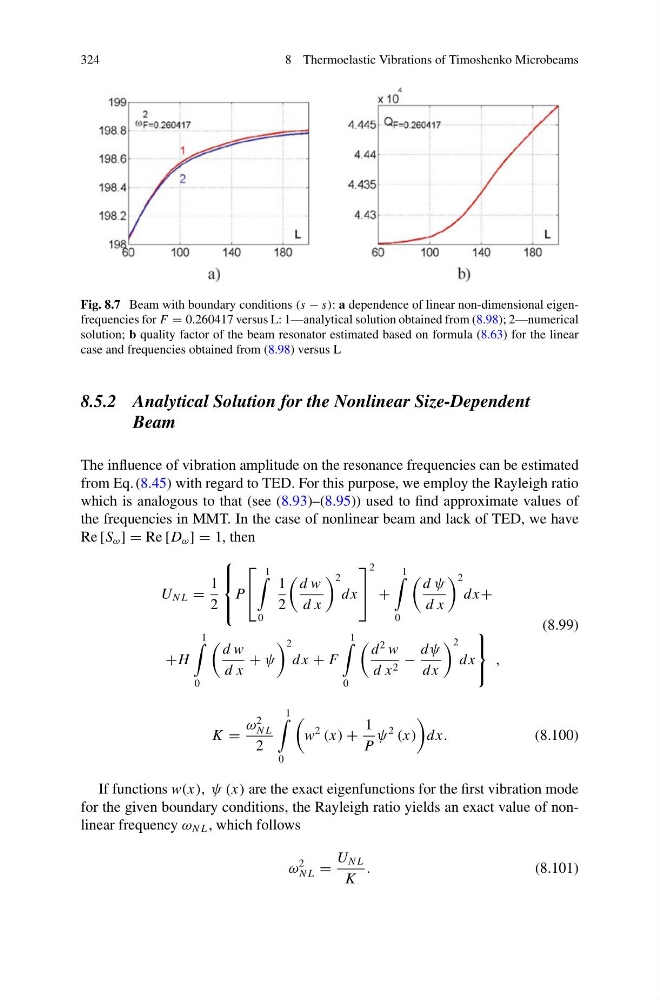
Fig. 8.7 Beam with boundary conditions (s − s): a dependence of linear non-dimensional eigenfrequencies for F = 0.260417 versus L: 1—analytical solution obtained from (8.98); 2—numerical
solution; b quality factor of the beam resonator estimated based on formula (8.63) for the linear
case and frequencies obtained from (8.98) versus L
8.5.2 Analytical Solution for the Nonlinear Size-Dependent
Beam
The influence of vibration amplitude on the resonance frequencies can be estimated
from Eq. (8.45) with regard to TED. For this purpose, we employ the Rayleigh ratio
which is analogous to that (see (8.93)–(8.95)) used to find approximate values of
the frequencies in MMT. In the case of nonlinear beam and lack of TED, we have
Re [S ω ] = Re [D ω ] = 1, then
U N L =
1
2
⎧
⎪ ⎨
⎪ ⎩
P
⎡
⎣
1
0
1
2
d w
d x
2
dx
⎤
⎦
2
+
1
0
d ψ
d x
2
dx+
+H
1
0
d w
d x
+ ψ
2
dx + F
1
0
d
2 w
d x 2 −
dψ
dx
2
dx
⎫
⎬
⎭
,
(8.99)
K =
ω
2
N L
2
1
0
w
2
(x) +
1
P
ψ
2
(x)
dx.
(8.100)
If functions w(x), ψ (x) are the exact eigenfunctions for the first vibration mode
for the given boundary conditions, the Rayleigh ratio yields an exact value of nonlinear frequency ω N L , which follows
ω
2
N L =
U N L
K
.
(8.101)
8 Thermoelastic Vibrations of Timoshenko Microbeams
Fig. 8.7 Beam with boundary conditions (s − s): a dependence of linear non-dimensional eigenfrequencies for F = 0.260417 versus L: 1—analytical solution obtained from (8.98); 2—numerical
solution; b quality factor of the beam resonator estimated based on formula (8.63) for the linear
case and frequencies obtained from (8.98) versus L
8.5.2 Analytical Solution for the Nonlinear Size-Dependent
Beam
The influence of vibration amplitude on the resonance frequencies can be estimated
from Eq. (8.45) with regard to TED. For this purpose, we employ the Rayleigh ratio
which is analogous to that (see (8.93)–(8.95)) used to find approximate values of
the frequencies in MMT. In the case of nonlinear beam and lack of TED, we have
Re [S ω ] = Re [D ω ] = 1, then
U N L =
1
2
⎧
⎪ ⎨
⎪ ⎩
P
⎡
⎣
1
0
1
2
d w
d x
2
dx
⎤
⎦
2
+
1
0
d ψ
d x
2
dx+
+H
1
0
d w
d x
+ ψ
2
dx + F
1
0
d
2 w
d x 2 −
dψ
dx
2
dx
⎫
⎬
⎭
,
(8.99)
K =
ω
2
N L
2
1
0
w
2
(x) +
1
P
ψ
2
(x)
dx.
(8.100)
If functions w(x), ψ (x) are the exact eigenfunctions for the first vibration mode
for the given boundary conditions, the Rayleigh ratio yields an exact value of nonlinear frequency ω N L , which follows
ω
2
N L =
U N L
K
.
(8.101)