

8.5 Numerical and Analytical Results for a Rectangular Cross-Sectional Beam Resonator 323
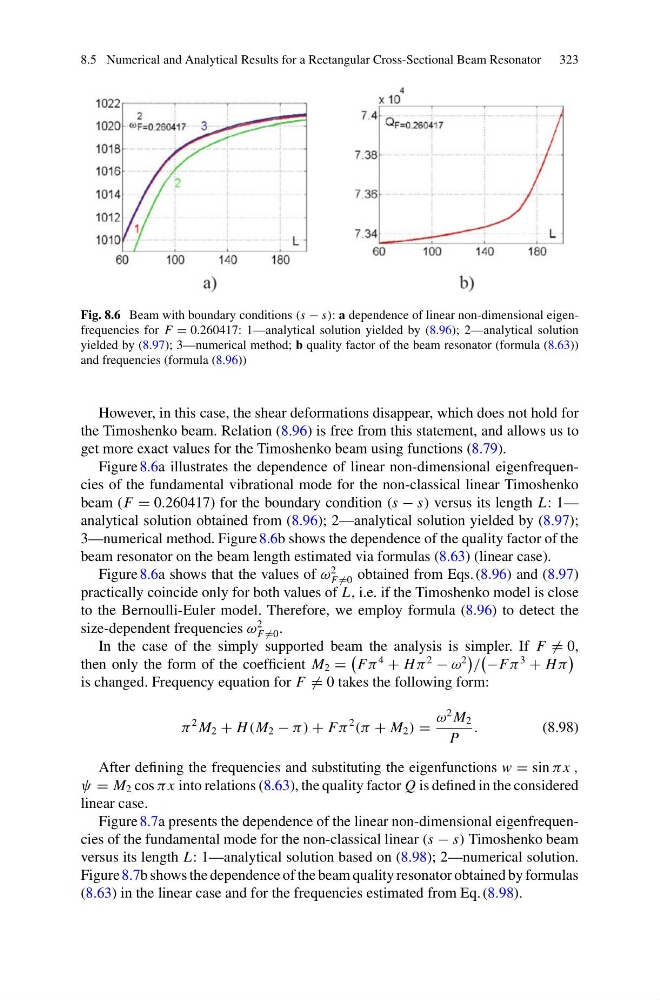
Fig. 8.6 Beam with boundary conditions (s − s): a dependence of linear non-dimensional eigenfrequencies for F = 0.260417: 1—analytical solution yielded by (8.96); 2—analytical solution
yielded by (8.97); 3—numerical method; b quality factor of the beam resonator (formula (8.63))
and frequencies (formula (8.96))
However, in this case, the shear deformations disappear, which does not hold for
the Timoshenko beam. Relation (8.96) is free from this statement, and allows us to
get more exact values for the Timoshenko beam using functions (8.79).
Figure 8.6a illustrates the dependence of linear non-dimensional eigenfrequencies of the fundamental vibrational mode for the non-classical linear Timoshenko
beam (F = 0.260417) for the boundary condition (s − s) versus its length L: 1—
analytical solution obtained from (8.96); 2—analytical solution yielded by (8.97);
3—numerical method. Figure 8.6b shows the dependence of the quality factor of the
beam resonator on the beam length estimated via formulas (8.63) (linear case).
Figure 8.6a shows that the values of ω
2
F =0 obtained from Eqs. (8.96) and (8.97)
practically coincide only for both values of L, i.e. if the Timoshenko model is close
to the Bernoulli-Euler model. Therefore, we employ formula (8.96) to detect the
size-dependent frequencies ω
2
F =0 .
In the case of the simply supported beam the analysis is simpler. If F = 0,
then only the form of the coefficient M 2 =
Fπ
4
+ H π
2
− ω
2
/
−Fπ
3
+ H π
is changed. Frequency equation for F = 0 takes the following form:
π
2 M 2 + H (M 2 − π) + Fπ
2
(π + M 2 ) =
ω
2 M 2
P
.
(8.98)
After defining the frequencies and substituting the eigenfunctions w = sin π x ,
ψ = M 2 cos π x into relations (8.63), the quality factor Q is defined in the considered
linear case.
Figure 8.7a presents the dependence of the linear non-dimensional eigenfrequencies of the fundamental mode for the non-classical linear (s − s) Timoshenko beam
versus its length L: 1—analytical solution based on (8.98); 2—numerical solution.
Figure 8.7b shows the dependence of the beam quality resonator obtained by formulas
(8.63) in the linear case and for the frequencies estimated from Eq. (8.98).
Fig. 8.6 Beam with boundary conditions (s − s): a dependence of linear non-dimensional eigenfrequencies for F = 0.260417: 1—analytical solution yielded by (8.96); 2—analytical solution
yielded by (8.97); 3—numerical method; b quality factor of the beam resonator (formula (8.63))
and frequencies (formula (8.96))
However, in this case, the shear deformations disappear, which does not hold for
the Timoshenko beam. Relation (8.96) is free from this statement, and allows us to
get more exact values for the Timoshenko beam using functions (8.79).
Figure 8.6a illustrates the dependence of linear non-dimensional eigenfrequencies of the fundamental vibrational mode for the non-classical linear Timoshenko
beam (F = 0.260417) for the boundary condition (s − s) versus its length L: 1—
analytical solution obtained from (8.96); 2—analytical solution yielded by (8.97);
3—numerical method. Figure 8.6b shows the dependence of the quality factor of the
beam resonator on the beam length estimated via formulas (8.63) (linear case).
Figure 8.6a shows that the values of ω
2
F =0 obtained from Eqs. (8.96) and (8.97)
practically coincide only for both values of L, i.e. if the Timoshenko model is close
to the Bernoulli-Euler model. Therefore, we employ formula (8.96) to detect the
size-dependent frequencies ω
2
F =0 .
In the case of the simply supported beam the analysis is simpler. If F = 0,
then only the form of the coefficient M 2 =
Fπ
4
+ H π
2
− ω
2
/
−Fπ
3
+ H π
is changed. Frequency equation for F = 0 takes the following form:
π
2 M 2 + H (M 2 − π) + Fπ
2
(π + M 2 ) =
ω
2 M 2
P
.
(8.98)
After defining the frequencies and substituting the eigenfunctions w = sin π x ,
ψ = M 2 cos π x into relations (8.63), the quality factor Q is defined in the considered
linear case.
Figure 8.7a presents the dependence of the linear non-dimensional eigenfrequencies of the fundamental mode for the non-classical linear (s − s) Timoshenko beam
versus its length L: 1—analytical solution based on (8.98); 2—numerical solution.
Figure 8.7b shows the dependence of the beam quality resonator obtained by formulas
(8.63) in the linear case and for the frequencies estimated from Eq. (8.98).