

8.5 Numerical and Analytical Results for a Rectangular Cross-Sectional Beam Resonator 325
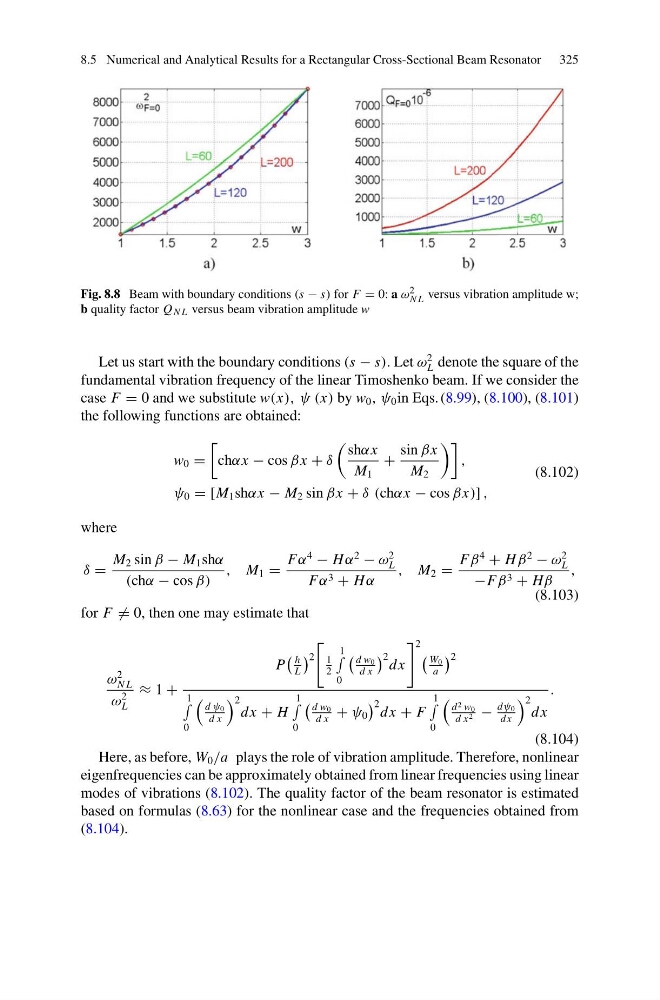
Fig. 8.8 Beam with boundary conditions (s − s) for F = 0: a ω 2
N L versus vibration amplitude w;
b quality factor Q N L versus beam vibration amplitude w
Let us start with the boundary conditions (s − s). Let ω
2
L denote the square of the
fundamental vibration frequency of the linear Timoshenko beam. If we consider the
case F = 0 and we substitute w(x), ψ (x) by w 0 , ψ 0 in Eqs. (8.99), (8.100), (8.101)
the following functions are obtained:
w 0 =
chαx − cos βx + δ
shαx
M 1
+
sin βx
M 2
,
ψ 0 = [M 1 shαx − M 2 sin βx + δ (chαx − cos βx)] ,
(8.102)
where
δ =
M 2 sin β − M 1 shα
(chα − cos β)
, M 1 =
Fα
4
− H α
2
− ω
2
L
Fα 3 + H α
, M 2 =
Fβ
4
+ H β
2
− ω
2
L
−Fβ 3 + Hβ
,
(8.103)
for F = 0, then one may estimate that
ω
2
N L
ω
2
L
≈ 1 +
P
h
L
2
1
2
1
0
d w 0
d x
2 dx
2 W 0
a
2
1
0
d ψ 0
d x
2
dx + H
1
0
d w 0
d x
+ ψ 0
2 dx + F
1
0
d 2 w 0
d x 2 −
dψ 0
dx
2
dx
.
(8.104)
Here, as before, W 0 /a plays the role of vibration amplitude. Therefore, nonlinear
eigenfrequencies can be approximately obtained from linear frequencies using linear
modes of vibrations (8.102). The quality factor of the beam resonator is estimated
based on formulas (8.63) for the nonlinear case and the frequencies obtained from
(8.104).
Fig. 8.8 Beam with boundary conditions (s − s) for F = 0: a ω 2
N L versus vibration amplitude w;
b quality factor Q N L versus beam vibration amplitude w
Let us start with the boundary conditions (s − s). Let ω
2
L denote the square of the
fundamental vibration frequency of the linear Timoshenko beam. If we consider the
case F = 0 and we substitute w(x), ψ (x) by w 0 , ψ 0 in Eqs. (8.99), (8.100), (8.101)
the following functions are obtained:
w 0 =
chαx − cos βx + δ
shαx
M 1
+
sin βx
M 2
,
ψ 0 = [M 1 shαx − M 2 sin βx + δ (chαx − cos βx)] ,
(8.102)
where
δ =
M 2 sin β − M 1 shα
(chα − cos β)
, M 1 =
Fα
4
− H α
2
− ω
2
L
Fα 3 + H α
, M 2 =
Fβ
4
+ H β
2
− ω
2
L
−Fβ 3 + Hβ
,
(8.103)
for F = 0, then one may estimate that
ω
2
N L
ω
2
L
≈ 1 +
P
h
L
2
1
2
1
0
d w 0
d x
2 dx
2 W 0
a
2
1
0
d ψ 0
d x
2
dx + H
1
0
d w 0
d x
+ ψ 0
2 dx + F
1
0
d 2 w 0
d x 2 −
dψ 0
dx
2
dx
.
(8.104)
Here, as before, W 0 /a plays the role of vibration amplitude. Therefore, nonlinear
eigenfrequencies can be approximately obtained from linear frequencies using linear
modes of vibrations (8.102). The quality factor of the beam resonator is estimated
based on formulas (8.63) for the nonlinear case and the frequencies obtained from
(8.104).