

320
8 Thermoelastic Vibrations of Timoshenko Microbeams
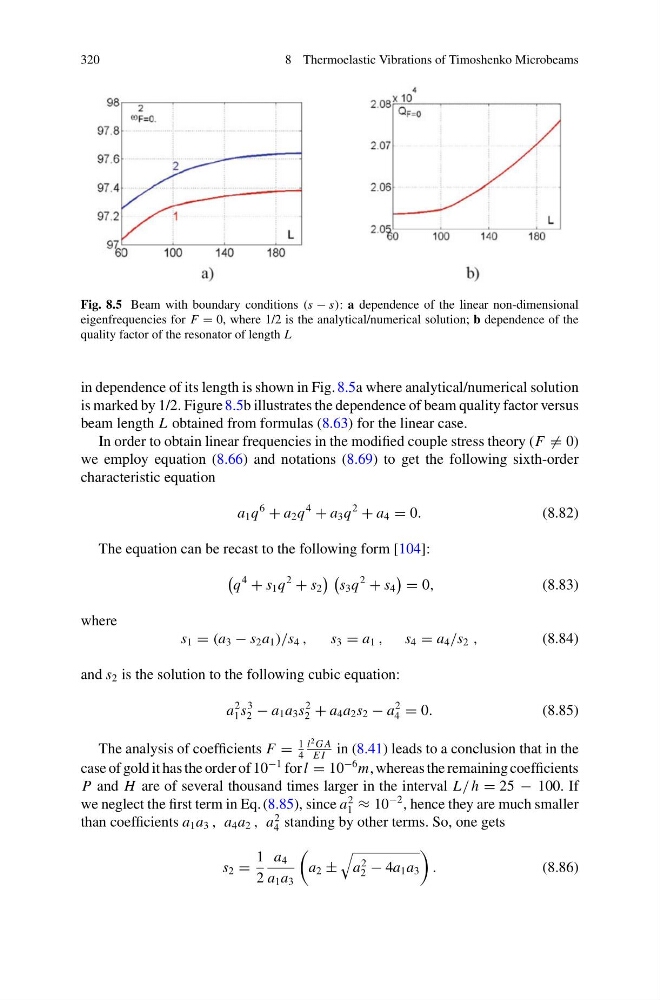
Fig. 8.5 Beam with boundary conditions (s − s): a dependence of the linear non-dimensional
eigenfrequencies for F = 0, where 1/2 is the analytical/numerical solution; b dependence of the
quality factor of the resonator of length L
in dependence of its length is shown in Fig. 8.5a where analytical/numerical solution
is marked by 1/2. Figure 8.5b illustrates the dependence of beam quality factor versus
beam length L obtained from formulas (8.63) for the linear case.
In order to obtain linear frequencies in the modified couple stress theory (F = 0)
we employ equation (8.66) and notations (8.69) to get the following sixth-order
characteristic equation
a 1 q
6
+ a 2 q
4
+ a 3 q
2
+ a 4 = 0.
(8.82)
The equation can be recast to the following form [104]:
q
4
+ s 1 q
2
+ s 2
s 3 q
2
+ s 4
= 0,
(8.83)
where
s 1 = (a 3 − s 2 a 1 )/s 4 ,
s 3 = a 1 , s 4 = a 4 /s 2 ,
(8.84)
and s 2 is the solution to the following cubic equation:
a
2
1 s
3
2 − a 1 a 3 s
2
2 + a 4 a 2 s 2 − a
2
4 = 0.
(8.85)
The analysis of coefficients F =
1
4
l
2 G A
E I
in (8.41) leads to a conclusion that in the
case of gold it has the order of 10
−1 for l = 10
−6 m, whereas the remaining coefficients
P and H are of several thousand times larger in the interval L/ h = 25 − 100. If
we neglect the first term in Eq. (8.85), since a
2
1 ≈ 10
−2 , hence they are much smaller
than coefficients a 1 a 3 , a 4 a 2 , a
2
4 standing by other terms. So, one gets
s 2 =
1
2
a 4
a 1 a 3
a 2 ±
a
2
2 − 4a 1 a 3
.
(8.86)
8 Thermoelastic Vibrations of Timoshenko Microbeams
Fig. 8.5 Beam with boundary conditions (s − s): a dependence of the linear non-dimensional
eigenfrequencies for F = 0, where 1/2 is the analytical/numerical solution; b dependence of the
quality factor of the resonator of length L
in dependence of its length is shown in Fig. 8.5a where analytical/numerical solution
is marked by 1/2. Figure 8.5b illustrates the dependence of beam quality factor versus
beam length L obtained from formulas (8.63) for the linear case.
In order to obtain linear frequencies in the modified couple stress theory (F = 0)
we employ equation (8.66) and notations (8.69) to get the following sixth-order
characteristic equation
a 1 q
6
+ a 2 q
4
+ a 3 q
2
+ a 4 = 0.
(8.82)
The equation can be recast to the following form [104]:
q
4
+ s 1 q
2
+ s 2
s 3 q
2
+ s 4
= 0,
(8.83)
where
s 1 = (a 3 − s 2 a 1 )/s 4 ,
s 3 = a 1 , s 4 = a 4 /s 2 ,
(8.84)
and s 2 is the solution to the following cubic equation:
a
2
1 s
3
2 − a 1 a 3 s
2
2 + a 4 a 2 s 2 − a
2
4 = 0.
(8.85)
The analysis of coefficients F =
1
4
l
2 G A
E I
in (8.41) leads to a conclusion that in the
case of gold it has the order of 10
−1 for l = 10
−6 m, whereas the remaining coefficients
P and H are of several thousand times larger in the interval L/ h = 25 − 100. If
we neglect the first term in Eq. (8.85), since a
2
1 ≈ 10
−2 , hence they are much smaller
than coefficients a 1 a 3 , a 4 a 2 , a
2
4 standing by other terms. So, one gets
s 2 =
1
2
a 4
a 1 a 3
a 2 ±
a
2
2 − 4a 1 a 3
.
(8.86)