

8.5 Numerical and Analytical Results for a Rectangular Cross-Sectional Beam Resonator 321
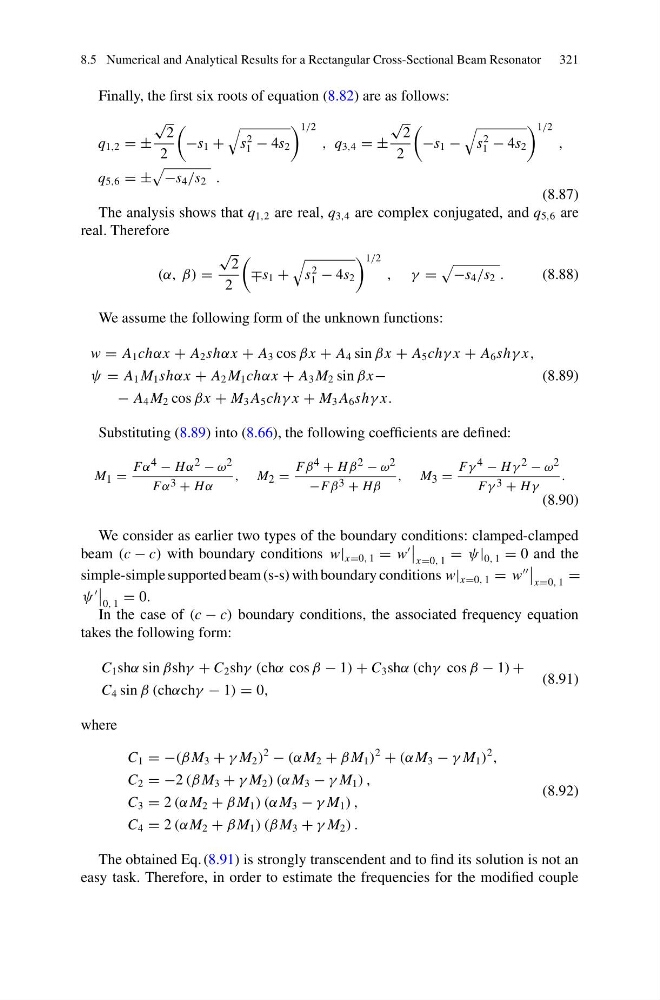
Finally, the first six roots of equation (8.82) are as follows:
q 1,2 = ±
√
2
2
−s 1 +
s
2
1 − 4s 2
1/2
, q 3,4 = ±
√
2
2
−s 1 −
s
2
1 − 4s 2
1/2
,
q 5,6 = ±
−s 4 /s 2 .
(8.87)
The analysis shows that q 1,2 are real, q 3,4 are complex conjugated, and q 5,6 are
real. Therefore
(α, β) =
√
2
2
∓s 1 +
s
2
1 − 4s 2
1/2
, γ =
−s 4 /s 2 .
(8.88)
We assume the following form of the unknown functions:
w = A 1 chαx + A 2 shαx + A 3 cos βx + A 4 sin βx + A 5 chγ x + A 6 shγ x,
ψ = A 1 M 1 shαx + A 2 M 1 chαx + A 3 M 2 sin βx−
− A 4 M 2 cos βx + M 3 A 5 chγ x + M 3 A 6 shγ x.
(8.89)
Substituting (8.89) into (8.66), the following coefficients are defined:
M 1 =
Fα 4 − H α 2 − ω 2
Fα 3 + H α
, M 2 =
Fβ 4 + H β 2 − ω 2
−Fβ 3 + Hβ
, M 3 =
Fγ 4 − H γ 2 − ω 2
Fγ 3 + H γ
.
(8.90)
We consider as earlier two types of the boundary conditions: clamped-clamped
beam (c − c) with boundary conditions w| x=0, 1 = w
x=0, 1
= ψ| 0, 1 = 0 and the
simple-simple supported beam (s-s) with boundary conditions w| x=0, 1 = w
x=0, 1
=
ψ
0, 1
= 0.
In the case of (c − c) boundary conditions, the associated frequency equation
takes the following form:
C 1 shα sin βshγ + C 2 shγ (chα cos β − 1) + C 3 shα (chγ cos β − 1) +
C 4 sin β (chαchγ − 1) = 0,
(8.91)
where
C 1 = −(β M 3 + γ M 2 )
2
− (α M 2 + β M 1 )
2
+ (α M 3 − γ M 1 )
2
,
C 2 = −2 (β M 3 + γ M 2 ) (α M 3 − γ M 1 ) ,
C 3 = 2 (α M 2 + β M 1 ) (α M 3 − γ M 1 ) ,
C 4 = 2 (α M 2 + β M 1 ) (β M 3 + γ M 2 ) .
(8.92)
The obtained Eq. (8.91) is strongly transcendent and to find its solution is not an
easy task. Therefore, in order to estimate the frequencies for the modified couple
Finally, the first six roots of equation (8.82) are as follows:
q 1,2 = ±
√
2
2
−s 1 +
s
2
1 − 4s 2
1/2
, q 3,4 = ±
√
2
2
−s 1 −
s
2
1 − 4s 2
1/2
,
q 5,6 = ±
−s 4 /s 2 .
(8.87)
The analysis shows that q 1,2 are real, q 3,4 are complex conjugated, and q 5,6 are
real. Therefore
(α, β) =
√
2
2
∓s 1 +
s
2
1 − 4s 2
1/2
, γ =
−s 4 /s 2 .
(8.88)
We assume the following form of the unknown functions:
w = A 1 chαx + A 2 shαx + A 3 cos βx + A 4 sin βx + A 5 chγ x + A 6 shγ x,
ψ = A 1 M 1 shαx + A 2 M 1 chαx + A 3 M 2 sin βx−
− A 4 M 2 cos βx + M 3 A 5 chγ x + M 3 A 6 shγ x.
(8.89)
Substituting (8.89) into (8.66), the following coefficients are defined:
M 1 =
Fα 4 − H α 2 − ω 2
Fα 3 + H α
, M 2 =
Fβ 4 + H β 2 − ω 2
−Fβ 3 + Hβ
, M 3 =
Fγ 4 − H γ 2 − ω 2
Fγ 3 + H γ
.
(8.90)
We consider as earlier two types of the boundary conditions: clamped-clamped
beam (c − c) with boundary conditions w| x=0, 1 = w
x=0, 1
= ψ| 0, 1 = 0 and the
simple-simple supported beam (s-s) with boundary conditions w| x=0, 1 = w
x=0, 1
=
ψ
0, 1
= 0.
In the case of (c − c) boundary conditions, the associated frequency equation
takes the following form:
C 1 shα sin βshγ + C 2 shγ (chα cos β − 1) + C 3 shα (chγ cos β − 1) +
C 4 sin β (chαchγ − 1) = 0,
(8.91)
where
C 1 = −(β M 3 + γ M 2 )
2
− (α M 2 + β M 1 )
2
+ (α M 3 − γ M 1 )
2
,
C 2 = −2 (β M 3 + γ M 2 ) (α M 3 − γ M 1 ) ,
C 3 = 2 (α M 2 + β M 1 ) (α M 3 − γ M 1 ) ,
C 4 = 2 (α M 2 + β M 1 ) (β M 3 + γ M 2 ) .
(8.92)
The obtained Eq. (8.91) is strongly transcendent and to find its solution is not an
easy task. Therefore, in order to estimate the frequencies for the modified couple