

8.5 Numerical and Analytical Results for a Rectangular Cross-Sectional Beam Resonator 319
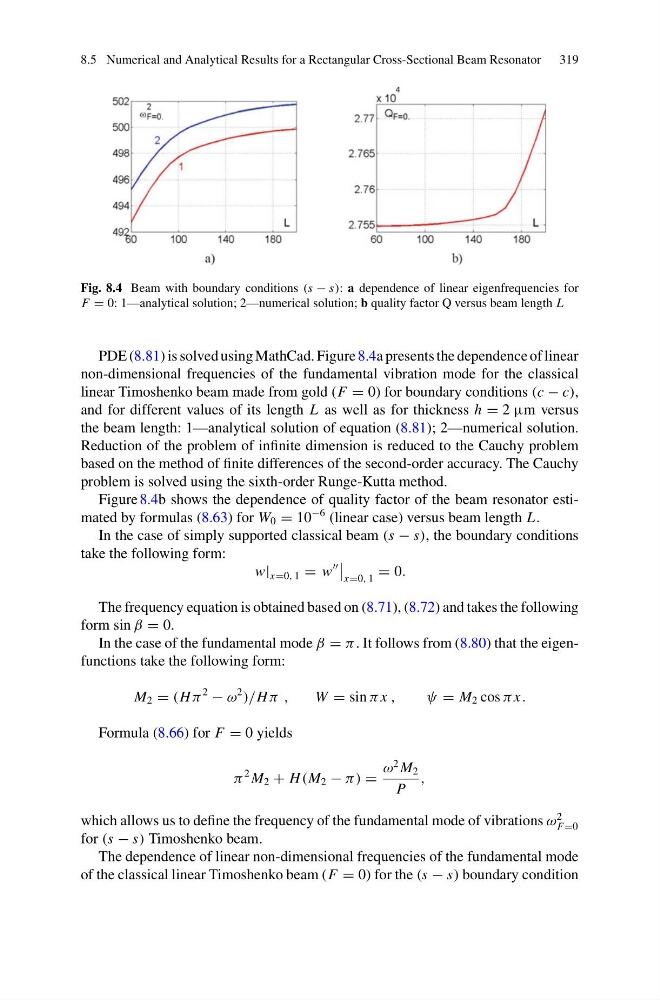
Fig. 8.4 Beam with boundary conditions (s − s): a dependence of linear eigenfrequencies for
F = 0: 1—analytical solution; 2—numerical solution; b quality factor Q versus beam length L
PDE (8.81) is solved using MathCad. Figure 8.4a presents the dependence of linear
non-dimensional frequencies of the fundamental vibration mode for the classical
linear Timoshenko beam made from gold (F = 0) for boundary conditions (c − c),
and for different values of its length L as well as for thickness h = 2 µm versus
the beam length: 1—analytical solution of equation (8.81); 2—numerical solution.
Reduction of the problem of infinite dimension is reduced to the Cauchy problem
based on the method of finite differences of the second-order accuracy. The Cauchy
problem is solved using the sixth-order Runge-Kutta method.
Figure 8.4b shows the dependence of quality factor of the beam resonator estimated by formulas (8.63) for W 0 = 10
−6 (linear case) versus beam length L.
In the case of simply supported classical beam (s − s), the boundary conditions
take the following form:
w| x=0, 1 = w
x=0, 1
= 0.
The frequency equation is obtained based on (8.71), (8.72) and takes the following
form sin β = 0.
In the case of the fundamental mode β = π . It follows from (8.80) that the eigenfunctions take the following form:
M 2 = (H π
2
− ω
2
)/H π ,
W = sin π x ,
ψ = M 2 cos π x.
Formula (8.66) for F = 0 yields
π
2 M 2 + H (M 2 − π) =
ω
2 M 2
P
,
which allows us to define the frequency of the fundamental mode of vibrations ω
2
F=0
for (s − s) Timoshenko beam.
The dependence of linear non-dimensional frequencies of the fundamental mode
of the classical linear Timoshenko beam (F = 0) for the (s − s) boundary condition
Fig. 8.4 Beam with boundary conditions (s − s): a dependence of linear eigenfrequencies for
F = 0: 1—analytical solution; 2—numerical solution; b quality factor Q versus beam length L
PDE (8.81) is solved using MathCad. Figure 8.4a presents the dependence of linear
non-dimensional frequencies of the fundamental vibration mode for the classical
linear Timoshenko beam made from gold (F = 0) for boundary conditions (c − c),
and for different values of its length L as well as for thickness h = 2 µm versus
the beam length: 1—analytical solution of equation (8.81); 2—numerical solution.
Reduction of the problem of infinite dimension is reduced to the Cauchy problem
based on the method of finite differences of the second-order accuracy. The Cauchy
problem is solved using the sixth-order Runge-Kutta method.
Figure 8.4b shows the dependence of quality factor of the beam resonator estimated by formulas (8.63) for W 0 = 10
−6 (linear case) versus beam length L.
In the case of simply supported classical beam (s − s), the boundary conditions
take the following form:
w| x=0, 1 = w
x=0, 1
= 0.
The frequency equation is obtained based on (8.71), (8.72) and takes the following
form sin β = 0.
In the case of the fundamental mode β = π . It follows from (8.80) that the eigenfunctions take the following form:
M 2 = (H π
2
− ω
2
)/H π ,
W = sin π x ,
ψ = M 2 cos π x.
Formula (8.66) for F = 0 yields
π
2 M 2 + H (M 2 − π) =
ω
2 M 2
P
,
which allows us to define the frequency of the fundamental mode of vibrations ω
2
F=0
for (s − s) Timoshenko beam.
The dependence of linear non-dimensional frequencies of the fundamental mode
of the classical linear Timoshenko beam (F = 0) for the (s − s) boundary condition