

8.5 Numerical and Analytical Results for a Rectangular Cross-Sectional Beam Resonator 315
It follows from the definition of f 1 (z) that the constant can be chosen arbitrarily, and
hence it is allowed to take f 1 (z) = 1.
Therefore, we obtain the values of coefficients in Eq. (8.43)
G 1 = 1, G 2 = 0.
(8.64)
In the case of function f 2 (z) describing the change in the temperature field generated by the bending deformation, which is odd, for the rectangular cross section
one gets
f 2 (z) = z −
4z
3
3
, G 3 =
1
15
, G 4 =
2
3
.
(8.65)
Temperature profile f 2 (z) along beam thickness is described by the following
formula [20]:
f 2 (z) = z +
1
2π
sin (2π z)
and
G 3 =
π
2
+ 3
24π 2 ≈
2
37
, G 4 = 1.
In further computations we take into account (8.65).
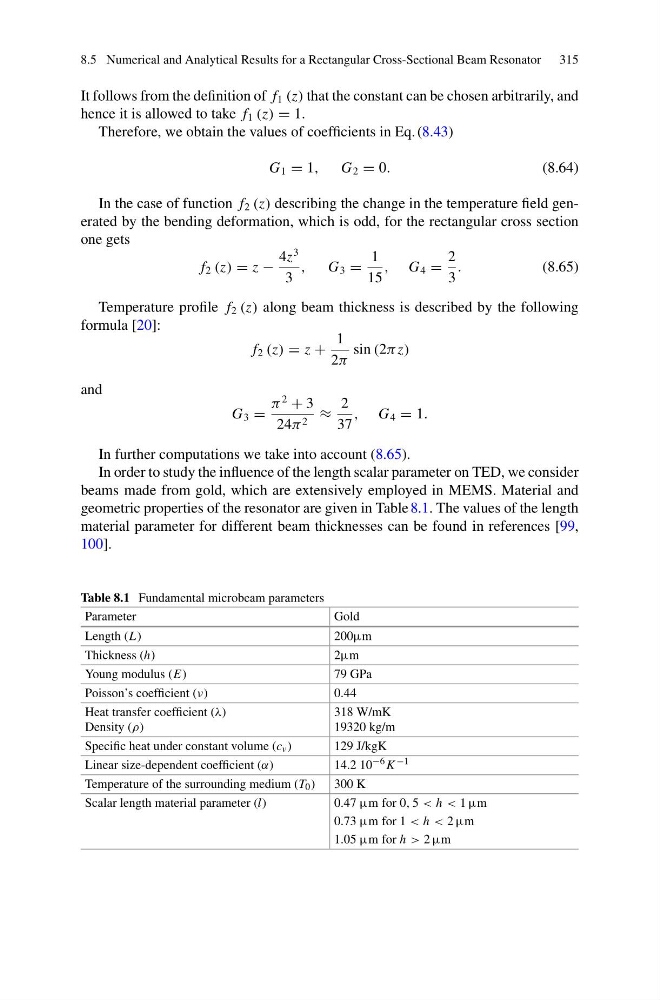
In order to study the influence of the length scalar parameter on TED, we consider
beams made from gold, which are extensively employed in MEMS. Material and
geometric properties of the resonator are given in Table 8.1. The values of the length
material parameter for different beam thicknesses can be found in references [99,
100].
Table 8.1 Fundamental microbeam parameters
Parameter
Gold
Length (L)
200µm
Thickness (h)
2µm
Young modulus (E)
79 GPa
Poisson’s coefficient (ν)
0.44
Heat transfer coefficient (λ)
Density (ρ)
318 W/mK
19320 kg/m
Specific heat under constant volume (c v )
129 J/kgK
Linear size-dependent coefficient (α)
14.2 10 −6 K −1
Temperature of the surrounding medium (T 0 ) 300 K
Scalar length material parameter (l)
0.47 µm for 0, 5 < h < 1 µm
0.73 µm for 1 < h < 2 µm
1.05 µm for h > 2 µm
It follows from the definition of f 1 (z) that the constant can be chosen arbitrarily, and
hence it is allowed to take f 1 (z) = 1.
Therefore, we obtain the values of coefficients in Eq. (8.43)
G 1 = 1, G 2 = 0.
(8.64)
In the case of function f 2 (z) describing the change in the temperature field generated by the bending deformation, which is odd, for the rectangular cross section
one gets
f 2 (z) = z −
4z
3
3
, G 3 =
1
15
, G 4 =
2
3
.
(8.65)
Temperature profile f 2 (z) along beam thickness is described by the following
formula [20]:
f 2 (z) = z +
1
2π
sin (2π z)
and
G 3 =
π
2
+ 3
24π 2 ≈
2
37
, G 4 = 1.
In further computations we take into account (8.65).
In order to study the influence of the length scalar parameter on TED, we consider
beams made from gold, which are extensively employed in MEMS. Material and
geometric properties of the resonator are given in Table 8.1. The values of the length
material parameter for different beam thicknesses can be found in references [99,
100].
Table 8.1 Fundamental microbeam parameters
Parameter
Gold
Length (L)
200µm
Thickness (h)
2µm
Young modulus (E)
79 GPa
Poisson’s coefficient (ν)
0.44
Heat transfer coefficient (λ)
Density (ρ)
318 W/mK
19320 kg/m
Specific heat under constant volume (c v )
129 J/kgK
Linear size-dependent coefficient (α)
14.2 10 −6 K −1
Temperature of the surrounding medium (T 0 ) 300 K
Scalar length material parameter (l)
0.47 µm for 0, 5 < h < 1 µm
0.73 µm for 1 < h < 2 µm
1.05 µm for h > 2 µm