

316
8 Thermoelastic Vibrations of Timoshenko Microbeams
8.5.1 Analytical Solution for the Linear Size-Dependent
Beam
We take into account undamped modes of beam vibrations as the eigenfunctions (see
[101]). It is assumed that the effect of large deflection in the vibrational regime plays
the secondary role, and therefore is not meaningful and the vibrational beam regime
can be approximated in a linear way modelled by a beam clamped from both sides
[20, 102, 103].
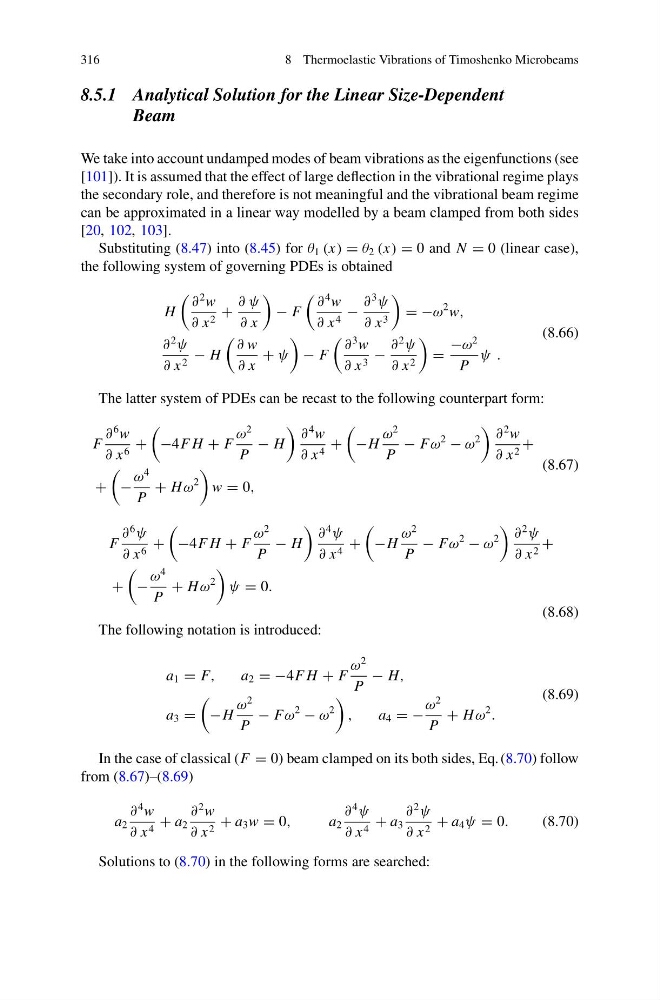
Substituting (8.47) into (8.45) for θ 1 (x) = θ 2 (x) = 0 and N = 0 (linear case),
the following system of governing PDEs is obtained
H
∂
2 w
∂ x 2 +
∂ ψ
∂ x
− F
∂
4 w
∂ x 4 −
∂
3
ψ
∂ x 3
= −ω
2 w,
∂
2
ψ
∂ x 2 − H
∂ w
∂ x
+ ψ
− F
∂
3 w
∂ x 3 −
∂
2
ψ
∂ x 2
=
−ω
2
P
ψ .
(8.66)
The latter system of PDEs can be recast to the following counterpart form:
F
∂
6 w
∂ x 6 +
−4F H + F
ω
2
P
− H
∂
4 w
∂ x 4 +
−H
ω
2
P
− Fω
2
− ω
2
∂
2 w
∂ x 2 +
+
−
ω
4
P
+ H ω
2
w = 0,
(8.67)
F
∂
6
ψ
∂ x 6 +
−4F H + F
ω
2
P
− H
∂
4
ψ
∂ x 4 +
−H
ω
2
P
− Fω
2
− ω
2
∂
2
ψ
∂ x 2 +
+
−
ω
4
P
+ H ω
2
ψ = 0.
(8.68)
The following notation is introduced:
a 1 = F,
a 2 = −4F H + F
ω
2
P
− H,
a 3 =
−H
ω
2
P
− Fω
2
− ω
2
,
a 4 = −
ω
2
P
+ H ω
2
.
(8.69)
In the case of classical (F = 0) beam clamped on its both sides, Eq. (8.70) follow
from (8.67)–(8.69)
a 2
∂
4 w
∂ x 4 + a 2
∂
2 w
∂ x 2 + a 3 w = 0,
a 2
∂
4
ψ
∂ x 4 + a 3
∂
2
ψ
∂ x 2 + a 4 ψ = 0.
(8.70)
Solutions to (8.70) in the following forms are searched:
8 Thermoelastic Vibrations of Timoshenko Microbeams
8.5.1 Analytical Solution for the Linear Size-Dependent
Beam
We take into account undamped modes of beam vibrations as the eigenfunctions (see
[101]). It is assumed that the effect of large deflection in the vibrational regime plays
the secondary role, and therefore is not meaningful and the vibrational beam regime
can be approximated in a linear way modelled by a beam clamped from both sides
[20, 102, 103].
Substituting (8.47) into (8.45) for θ 1 (x) = θ 2 (x) = 0 and N = 0 (linear case),
the following system of governing PDEs is obtained
H
∂
2 w
∂ x 2 +
∂ ψ
∂ x
− F
∂
4 w
∂ x 4 −
∂
3
ψ
∂ x 3
= −ω
2 w,
∂
2
ψ
∂ x 2 − H
∂ w
∂ x
+ ψ
− F
∂
3 w
∂ x 3 −
∂
2
ψ
∂ x 2
=
−ω
2
P
ψ .
(8.66)
The latter system of PDEs can be recast to the following counterpart form:
F
∂
6 w
∂ x 6 +
−4F H + F
ω
2
P
− H
∂
4 w
∂ x 4 +
−H
ω
2
P
− Fω
2
− ω
2
∂
2 w
∂ x 2 +
+
−
ω
4
P
+ H ω
2
w = 0,
(8.67)
F
∂
6
ψ
∂ x 6 +
−4F H + F
ω
2
P
− H
∂
4
ψ
∂ x 4 +
−H
ω
2
P
− Fω
2
− ω
2
∂
2
ψ
∂ x 2 +
+
−
ω
4
P
+ H ω
2
ψ = 0.
(8.68)
The following notation is introduced:
a 1 = F,
a 2 = −4F H + F
ω
2
P
− H,
a 3 =
−H
ω
2
P
− Fω
2
− ω
2
,
a 4 = −
ω
2
P
+ H ω
2
.
(8.69)
In the case of classical (F = 0) beam clamped on its both sides, Eq. (8.70) follow
from (8.67)–(8.69)
a 2
∂
4 w
∂ x 4 + a 2
∂
2 w
∂ x 2 + a 3 w = 0,
a 2
∂
4
ψ
∂ x 4 + a 3
∂
2
ψ
∂ x 2 + a 4 ψ = 0.
(8.70)
Solutions to (8.70) in the following forms are searched: