

314
8 Thermoelastic Vibrations of Timoshenko Microbeams
[Energy loss] bending =
1
0
2π/ω
0
M
d
dt
∂ ψ
∂ x
dtdx =
=
1
0
2π/ω
0
Re [M] Re
d
dt
∂ ψ
∂ x
dt dx = −π Im [D ω ]
1
0
d ψ 0
d x
2
dx ,
(8.61)
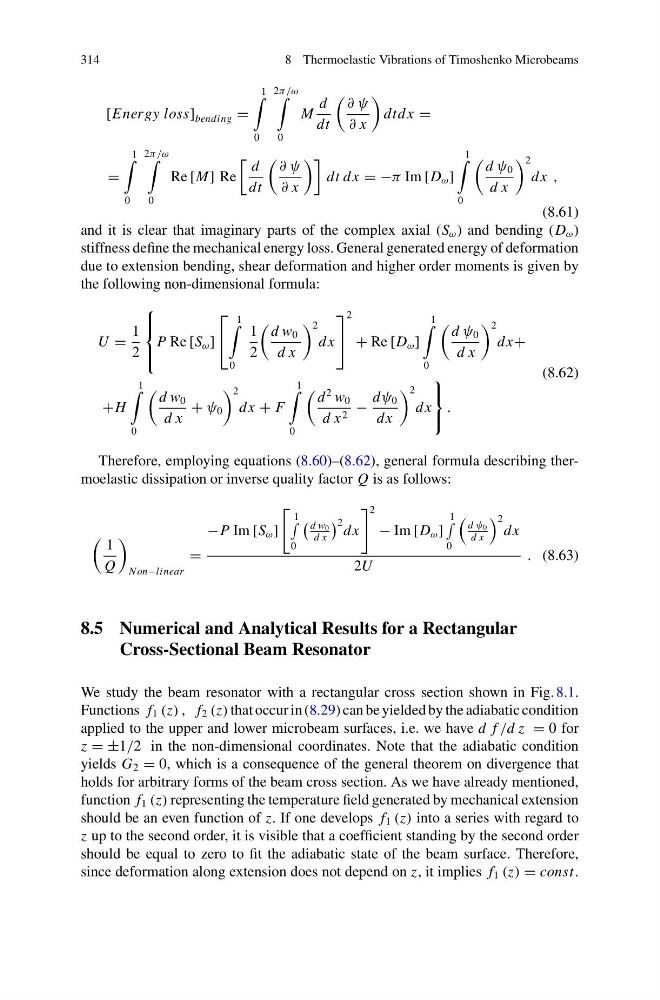
and it is clear that imaginary parts of the complex axial (S ω ) and bending (D ω )
stiffness define the mechanical energy loss. General generated energy of deformation
due to extension bending, shear deformation and higher order moments is given by
the following non-dimensional formula:
U =
1
2
⎧
⎪ ⎨
⎪ ⎩
P Re [S ω ]
⎡
⎣
1
0
1
2
d w 0
d x
2
dx
⎤
⎦
2
+ Re [D ω ]
1
0
d ψ 0
d x
2
dx+
+H
1
0
d w 0
d x
+ ψ 0
2
dx + F
1
0
d
2 w 0
d x 2 −
dψ 0
dx
2
dx
⎫
⎬
⎭
.
(8.62)
Therefore, employing equations (8.60)–(8.62), general formula describing thermoelastic dissipation or inverse quality factor Q is as follows:
1
Q
Non−linear
=
−P Im [S ω ]
1
0
d w 0
d x
2 dx
2
− Im [D ω ]
1
0
d ψ 0
d x
2
dx
2U
. (8.63)
8.5 Numerical and Analytical Results for a Rectangular
Cross-Sectional Beam Resonator
We study the beam resonator with a rectangular cross section shown in Fig. 8.1.
Functions f 1 (z) , f 2 (z) that occur in (8.29) can be yielded by the adiabatic condition
applied to the upper and lower microbeam surfaces, i.e. we have d f /d z = 0 for
z = ±1/2 in the non-dimensional coordinates. Note that the adiabatic condition
yields G 2 = 0, which is a consequence of the general theorem on divergence that
holds for arbitrary forms of the beam cross section. As we have already mentioned,
function f 1 (z) representing the temperature field generated by mechanical extension
should be an even function of z. If one develops f 1 (z) into a series with regard to
z up to the second order, it is visible that a coefficient standing by the second order
should be equal to zero to fit the adiabatic state of the beam surface. Therefore,
since deformation along extension does not depend on z, it implies f 1 (z) = const.
8 Thermoelastic Vibrations of Timoshenko Microbeams
[Energy loss] bending =
1
0
2π/ω
0
M
d
dt
∂ ψ
∂ x
dtdx =
=
1
0
2π/ω
0
Re [M] Re
d
dt
∂ ψ
∂ x
dt dx = −π Im [D ω ]
1
0
d ψ 0
d x
2
dx ,
(8.61)
and it is clear that imaginary parts of the complex axial (S ω ) and bending (D ω )
stiffness define the mechanical energy loss. General generated energy of deformation
due to extension bending, shear deformation and higher order moments is given by
the following non-dimensional formula:
U =
1
2
⎧
⎪ ⎨
⎪ ⎩
P Re [S ω ]
⎡
⎣
1
0
1
2
d w 0
d x
2
dx
⎤
⎦
2
+ Re [D ω ]
1
0
d ψ 0
d x
2
dx+
+H
1
0
d w 0
d x
+ ψ 0
2
dx + F
1
0
d
2 w 0
d x 2 −
dψ 0
dx
2
dx
⎫
⎬
⎭
.
(8.62)
Therefore, employing equations (8.60)–(8.62), general formula describing thermoelastic dissipation or inverse quality factor Q is as follows:
1
Q
Non−linear
=
−P Im [S ω ]
1
0
d w 0
d x
2 dx
2
− Im [D ω ]
1
0
d ψ 0
d x
2
dx
2U
. (8.63)
8.5 Numerical and Analytical Results for a Rectangular
Cross-Sectional Beam Resonator
We study the beam resonator with a rectangular cross section shown in Fig. 8.1.
Functions f 1 (z) , f 2 (z) that occur in (8.29) can be yielded by the adiabatic condition
applied to the upper and lower microbeam surfaces, i.e. we have d f /d z = 0 for
z = ±1/2 in the non-dimensional coordinates. Note that the adiabatic condition
yields G 2 = 0, which is a consequence of the general theorem on divergence that
holds for arbitrary forms of the beam cross section. As we have already mentioned,
function f 1 (z) representing the temperature field generated by mechanical extension
should be an even function of z. If one develops f 1 (z) into a series with regard to
z up to the second order, it is visible that a coefficient standing by the second order
should be equal to zero to fit the adiabatic state of the beam surface. Therefore,
since deformation along extension does not depend on z, it implies f 1 (z) = const.