

284
7 Mathematical Models of Functionally Graded Beams in Temperature Field
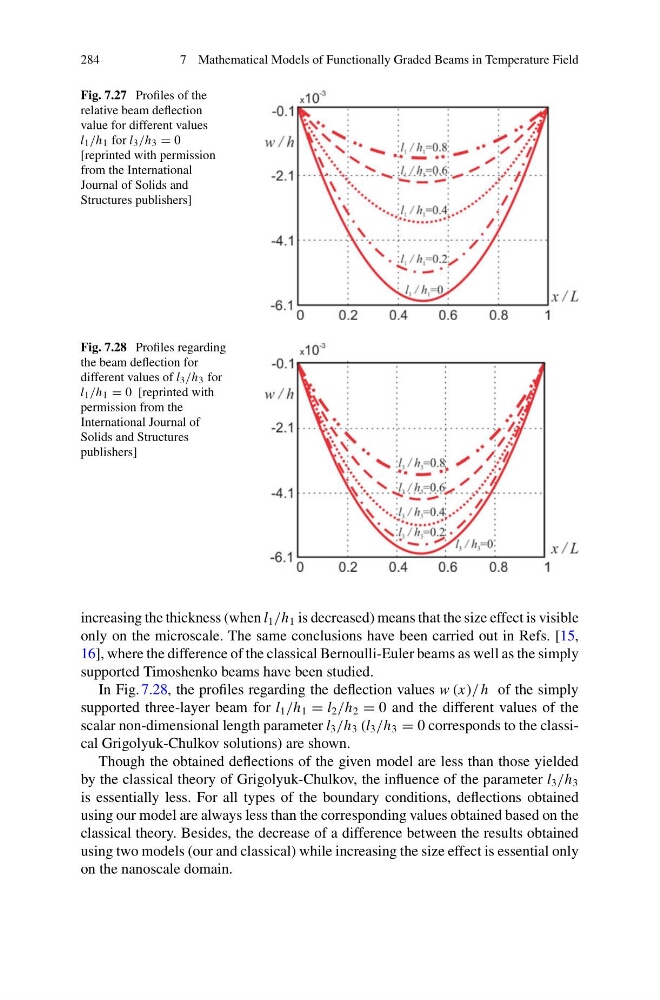
Fig. 7.27 Profiles of the
relative beam deflection
value for different values
l 1 /h 1 for l 3 /h 3 = 0
[reprinted with permission
from the International
Journal of Solids and
Structures publishers]
Fig. 7.28 Profiles regarding
the beam deflection for
different values of l 3 /h 3 for
l 1 /h 1 = 0 [reprinted with
permission from the
International Journal of
Solids and Structures
publishers]
increasing the thickness (when l 1 /h 1 is decreased) means that the size effect is visible
only on the microscale. The same conclusions have been carried out in Refs. [15,
16], where the difference of the classical Bernoulli-Euler beams as well as the simply
supported Timoshenko beams have been studied.
In Fig. 7.28, the profiles regarding the deflection values w (x)/ h of the simply
supported three-layer beam for l 1 /h 1 = l 2 /h 2 = 0 and the different values of the
scalar non-dimensional length parameter l 3 /h 3 (l 3 /h 3 = 0 corresponds to the classical Grigolyuk-Chulkov solutions) are shown.
Though the obtained deflections of the given model are less than those yielded
by the classical theory of Grigolyuk-Chulkov, the influence of the parameter l 3 /h 3
is essentially less. For all types of the boundary conditions, deflections obtained
using our model are always less than the corresponding values obtained based on the
classical theory. Besides, the decrease of a difference between the results obtained
using two models (our and classical) while increasing the size effect is essential only
on the nanoscale domain.
7 Mathematical Models of Functionally Graded Beams in Temperature Field
Fig. 7.27 Profiles of the
relative beam deflection
value for different values
l 1 /h 1 for l 3 /h 3 = 0
[reprinted with permission
from the International
Journal of Solids and
Structures publishers]
Fig. 7.28 Profiles regarding
the beam deflection for
different values of l 3 /h 3 for
l 1 /h 1 = 0 [reprinted with
permission from the
International Journal of
Solids and Structures
publishers]
increasing the thickness (when l 1 /h 1 is decreased) means that the size effect is visible
only on the microscale. The same conclusions have been carried out in Refs. [15,
16], where the difference of the classical Bernoulli-Euler beams as well as the simply
supported Timoshenko beams have been studied.
In Fig. 7.28, the profiles regarding the deflection values w (x)/ h of the simply
supported three-layer beam for l 1 /h 1 = l 2 /h 2 = 0 and the different values of the
scalar non-dimensional length parameter l 3 /h 3 (l 3 /h 3 = 0 corresponds to the classical Grigolyuk-Chulkov solutions) are shown.
Though the obtained deflections of the given model are less than those yielded
by the classical theory of Grigolyuk-Chulkov, the influence of the parameter l 3 /h 3
is essentially less. For all types of the boundary conditions, deflections obtained
using our model are always less than the corresponding values obtained based on the
classical theory. Besides, the decrease of a difference between the results obtained
using two models (our and classical) while increasing the size effect is essential only
on the nanoscale domain.