

7.7 Mathematical Model of Three-Layer Micro- and Nano-Beams
283
7.7.6.1 Static Bending
In the beginning, the deflections w
c
0 in the three layer beam centre are computed where
the simple boundary conditions are taken and the classical theory of GrigolyukChulkov is employed (l 1 = l 2 = l 3 = 0, D
h
= D). In the next step, we find the
values of the deflection w
h
0 in the beam centre, which have been obtained based on
our introduced theoretical background for the different fixed values of l 1 /h 1 = l 2 /h 2
for l 3 = 0 and l 3 = 12 · 10
−3 m.
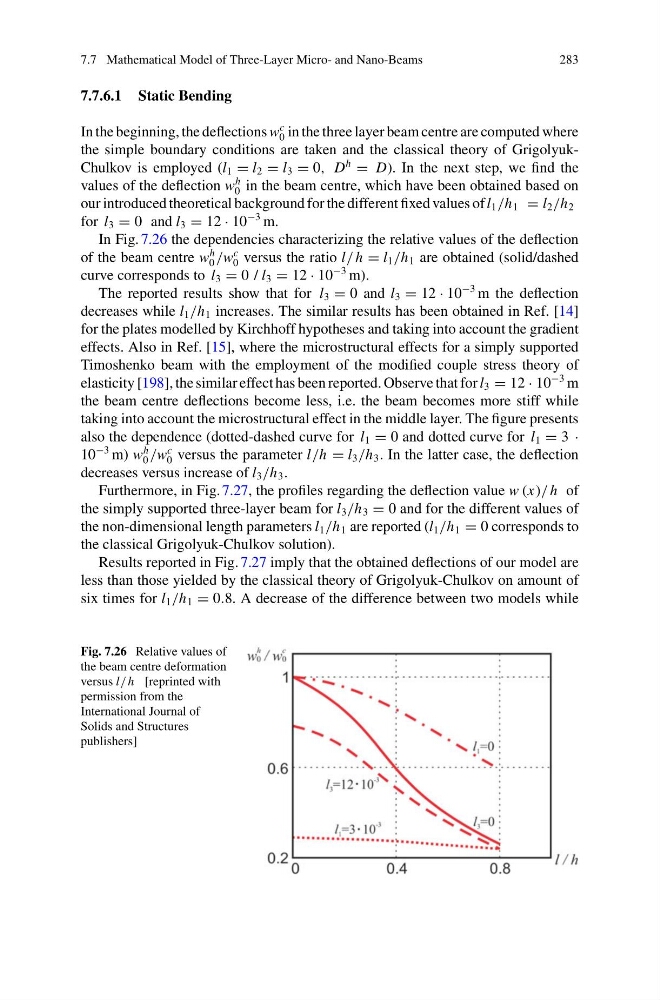
In Fig. 7.26 the dependencies characterizing the relative values of the deflection
of the beam centre w
h
0 /w
c
0 versus the ratio l/ h = l 1 /h 1 are obtained (solid/dashed
curve corresponds to l 3 = 0 / l 3 = 12 · 10
−3 m).
The reported results show that for l 3 = 0 and l 3 = 12 · 10
−3 m the deflection
decreases while l 1 /h 1 increases. The similar results has been obtained in Ref. [14]
for the plates modelled by Kirchhoff hypotheses and taking into account the gradient
effects. Also in Ref. [15], where the microstructural effects for a simply supported
Timoshenko beam with the employment of the modified couple stress theory of
elasticity [198], the similar effect has been reported. Observe that for l 3 = 12 · 10
−3 m
the beam centre deflections become less, i.e. the beam becomes more stiff while
taking into account the microstructural effect in the middle layer. The figure presents
also the dependence (dotted-dashed curve for l 1 = 0 and dotted curve for l 1 = 3 ·
10
−3 m) w
h
0 /w
c
0 versus the parameter l/h = l 3 /h 3 . In the latter case, the deflection
decreases versus increase of l 3 /h 3 .
Furthermore, in Fig. 7.27, the profiles regarding the deflection value w (x)/ h of
the simply supported three-layer beam for l 3 /h 3 = 0 and for the different values of
the non-dimensional length parameters l 1 /h 1 are reported (l 1 /h 1 = 0 corresponds to
the classical Grigolyuk-Chulkov solution).
Results reported in Fig. 7.27 imply that the obtained deflections of our model are
less than those yielded by the classical theory of Grigolyuk-Chulkov on amount of
six times for l 1 /h 1 = 0.8. A decrease of the difference between two models while
Fig. 7.26 Relative values of
the beam centre deformation
versus l/ h [reprinted with
permission from the
International Journal of
Solids and Structures
publishers]
283
7.7.6.1 Static Bending
In the beginning, the deflections w
c
0 in the three layer beam centre are computed where
the simple boundary conditions are taken and the classical theory of GrigolyukChulkov is employed (l 1 = l 2 = l 3 = 0, D
h
= D). In the next step, we find the
values of the deflection w
h
0 in the beam centre, which have been obtained based on
our introduced theoretical background for the different fixed values of l 1 /h 1 = l 2 /h 2
for l 3 = 0 and l 3 = 12 · 10
−3 m.
In Fig. 7.26 the dependencies characterizing the relative values of the deflection
of the beam centre w
h
0 /w
c
0 versus the ratio l/ h = l 1 /h 1 are obtained (solid/dashed
curve corresponds to l 3 = 0 / l 3 = 12 · 10
−3 m).
The reported results show that for l 3 = 0 and l 3 = 12 · 10
−3 m the deflection
decreases while l 1 /h 1 increases. The similar results has been obtained in Ref. [14]
for the plates modelled by Kirchhoff hypotheses and taking into account the gradient
effects. Also in Ref. [15], where the microstructural effects for a simply supported
Timoshenko beam with the employment of the modified couple stress theory of
elasticity [198], the similar effect has been reported. Observe that for l 3 = 12 · 10
−3 m
the beam centre deflections become less, i.e. the beam becomes more stiff while
taking into account the microstructural effect in the middle layer. The figure presents
also the dependence (dotted-dashed curve for l 1 = 0 and dotted curve for l 1 = 3 ·
10
−3 m) w
h
0 /w
c
0 versus the parameter l/h = l 3 /h 3 . In the latter case, the deflection
decreases versus increase of l 3 /h 3 .
Furthermore, in Fig. 7.27, the profiles regarding the deflection value w (x)/ h of
the simply supported three-layer beam for l 3 /h 3 = 0 and for the different values of
the non-dimensional length parameters l 1 /h 1 are reported (l 1 /h 1 = 0 corresponds to
the classical Grigolyuk-Chulkov solution).
Results reported in Fig. 7.27 imply that the obtained deflections of our model are
less than those yielded by the classical theory of Grigolyuk-Chulkov on amount of
six times for l 1 /h 1 = 0.8. A decrease of the difference between two models while
Fig. 7.26 Relative values of
the beam centre deformation
versus l/ h [reprinted with
permission from the
International Journal of
Solids and Structures
publishers]