

7.7 Mathematical Model of Three-Layer Micro- and Nano-Beams
285
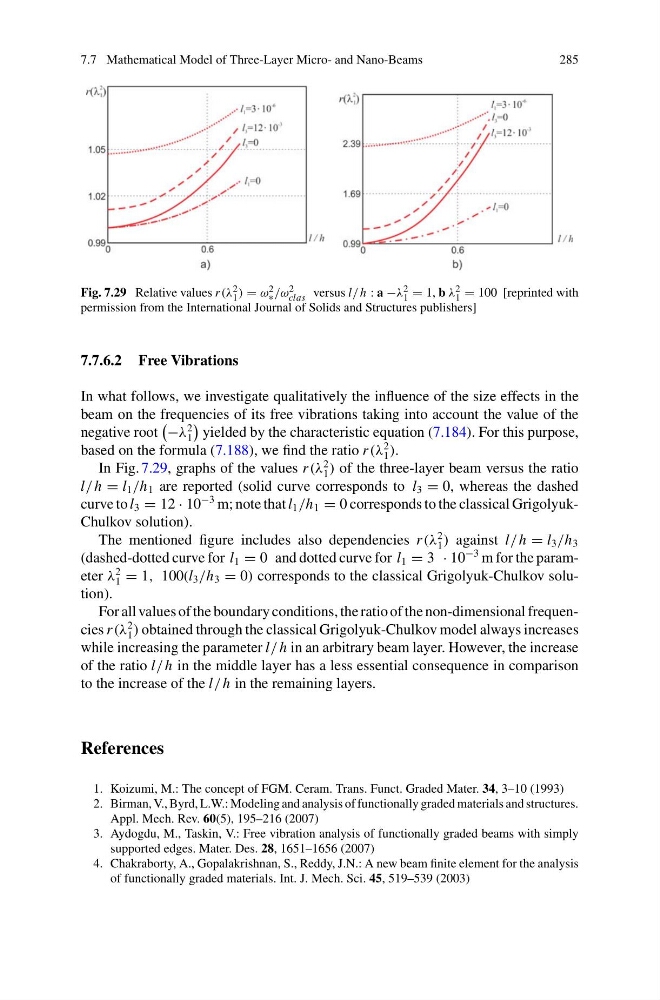
Fig. 7.29 Relative values r (λ 2
1 ) = ω 2
∗ /ω 2
clas versus l/ h : a −λ 2
1 = 1, b λ 2
1 = 100 [reprinted with
permission from the International Journal of Solids and Structures publishers]
7.7.6.2 Free Vibrations
In what follows, we investigate qualitatively the influence of the size effects in the
beam on the frequencies of its free vibrations taking into account the value of the
negative root
−λ
2
1
yielded by the characteristic equation (7.184). For this purpose,
based on the formula (7.188), we find the ratio r (λ
2
1 ).
In Fig. 7.29, graphs of the values r (λ
2
1 ) of the three-layer beam versus the ratio
l/ h = l 1 /h 1 are reported (solid curve corresponds to l 3 = 0, whereas the dashed
curve to l 3 = 12 · 10
−3 m; note that l 1 /h 1 = 0 corresponds to the classical GrigolyukChulkov solution).
The mentioned figure includes also dependencies r (λ
2
1 ) against l/ h = l 3 /h 3
(dashed-dotted curve for l 1 = 0 and dotted curve for l 1 = 3 · 10
−3 m for the parameter λ
2
1 = 1, 100(l 3 /h 3 = 0) corresponds to the classical Grigolyuk-Chulkov solution).
For all values of the boundary conditions, the ratio of the non-dimensional frequencies r (λ
2
1 ) obtained through the classical Grigolyuk-Chulkov model always increases
while increasing the parameter l/ h in an arbitrary beam layer. However, the increase
of the ratio l/ h in the middle layer has a less essential consequence in comparison
to the increase of the l/ h in the remaining layers.
References
1. Koizumi, M.: The concept of FGM. Ceram. Trans. Funct. Graded Mater. 34, 3–10 (1993)
2. Birman, V., Byrd, L.W.: Modeling and analysis of functionally graded materials and structures.
Appl. Mech. Rev. 60(5), 195–216 (2007)
3. Aydogdu, M., Taskin, V.: Free vibration analysis of functionally graded beams with simply
supported edges. Mater. Des. 28, 1651–1656 (2007)
4. Chakraborty, A., Gopalakrishnan, S., Reddy, J.N.: A new beam finite element for the analysis
of functionally graded materials. Int. J. Mech. Sci. 45, 519–539 (2003)
285
Fig. 7.29 Relative values r (λ 2
1 ) = ω 2
∗ /ω 2
clas versus l/ h : a −λ 2
1 = 1, b λ 2
1 = 100 [reprinted with
permission from the International Journal of Solids and Structures publishers]
7.7.6.2 Free Vibrations
In what follows, we investigate qualitatively the influence of the size effects in the
beam on the frequencies of its free vibrations taking into account the value of the
negative root
−λ
2
1
yielded by the characteristic equation (7.184). For this purpose,
based on the formula (7.188), we find the ratio r (λ
2
1 ).
In Fig. 7.29, graphs of the values r (λ
2
1 ) of the three-layer beam versus the ratio
l/ h = l 1 /h 1 are reported (solid curve corresponds to l 3 = 0, whereas the dashed
curve to l 3 = 12 · 10
−3 m; note that l 1 /h 1 = 0 corresponds to the classical GrigolyukChulkov solution).
The mentioned figure includes also dependencies r (λ
2
1 ) against l/ h = l 3 /h 3
(dashed-dotted curve for l 1 = 0 and dotted curve for l 1 = 3 · 10
−3 m for the parameter λ
2
1 = 1, 100(l 3 /h 3 = 0) corresponds to the classical Grigolyuk-Chulkov solution).
For all values of the boundary conditions, the ratio of the non-dimensional frequencies r (λ
2
1 ) obtained through the classical Grigolyuk-Chulkov model always increases
while increasing the parameter l/ h in an arbitrary beam layer. However, the increase
of the ratio l/ h in the middle layer has a less essential consequence in comparison
to the increase of the l/ h in the remaining layers.
References
1. Koizumi, M.: The concept of FGM. Ceram. Trans. Funct. Graded Mater. 34, 3–10 (1993)
2. Birman, V., Byrd, L.W.: Modeling and analysis of functionally graded materials and structures.
Appl. Mech. Rev. 60(5), 195–216 (2007)
3. Aydogdu, M., Taskin, V.: Free vibration analysis of functionally graded beams with simply
supported edges. Mater. Des. 28, 1651–1656 (2007)
4. Chakraborty, A., Gopalakrishnan, S., Reddy, J.N.: A new beam finite element for the analysis
of functionally graded materials. Int. J. Mech. Sci. 45, 519–539 (2003)