

7.7 Mathematical Model of Three-Layer Micro- and Nano-Beams
279
1 −
h
2
β
1 +
a h
h
2
d
2
dx 2
χ =
dχ
dx
=
d
3
χ
dx 3
x=L
x=0
= 0.
(7.167)
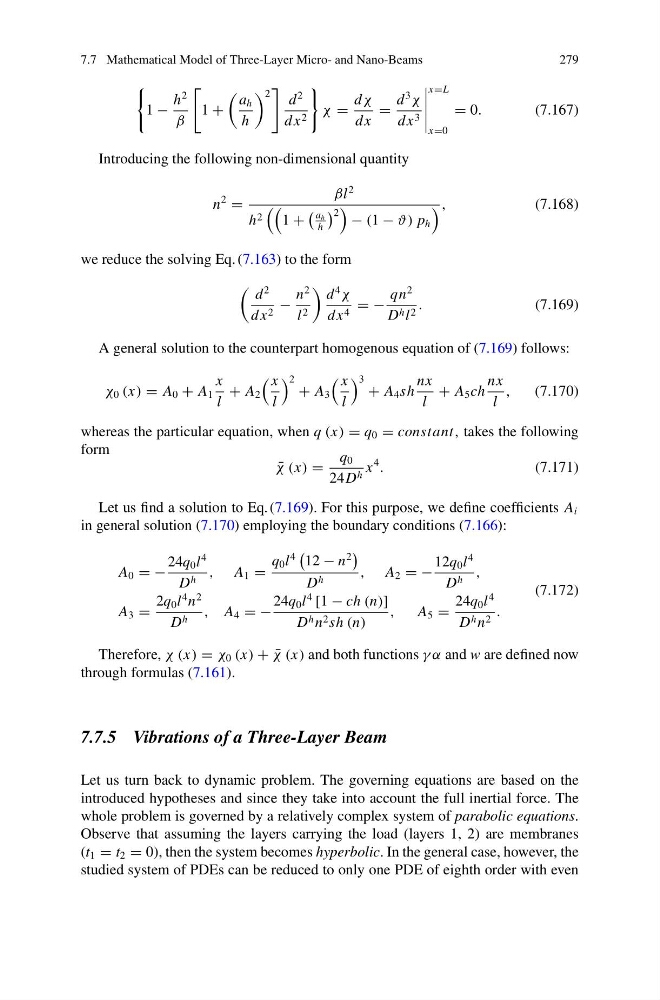
Introducing the following non-dimensional quantity
n
2
=
βl
2
h 2
1 +
a h
h
2
− (1 − ϑ) p h
,
(7.168)
we reduce the solving Eq. (7.163) to the form
d
2
dx 2 −
n
2
l 2
d
4
χ
dx 4 = −
qn
2
D h l 2 .
(7.169)
A general solution to the counterpart homogenous equation of (7.169) follows:
χ 0 (x) = A 0 + A 1
x
l
+ A 2
x
l
2 + A 3
x
l
3 + A 4 sh
nx
l
+ A 5 ch
nx
l
,
(7.170)
whereas the particular equation, when q (x) = q 0 = constant, takes the following
form
¯
χ (x) =
q 0
24D h x
4
.
(7.171)
Let us find a solution to Eq. (7.169). For this purpose, we define coefficients A i
in general solution (7.170) employing the boundary conditions (7.166):
A 0 = −
24q 0 l
4
D h , A 1 =
q 0 l
4
12 − n
2
D h
, A 2 = −
12q 0 l
4
D h ,
A 3 =
2q 0 l
4 n
2
D h , A 4 = −
24q 0 l
4 [1 − ch (n)]
D h n 2 sh (n)
,
A 5 =
24q 0 l
4
D h n 2 .
(7.172)
Therefore, χ (x) = χ 0 (x) + ¯
χ (x) and both functions γ α and w are defined now
through formulas (7.161).
7.7.5 Vibrations of a Three-Layer Beam
Let us turn back to dynamic problem. The governing equations are based on the
introduced hypotheses and since they take into account the full inertial force. The
whole problem is governed by a relatively complex system of parabolic equations.
Observe that assuming the layers carrying the load (layers 1, 2) are membranes
(t 1 = t 2 = 0), then the system becomes hyperbolic. In the general case, however, the
studied system of PDEs can be reduced to only one PDE of eighth order with even
279
1 −
h
2
β
1 +
a h
h
2
d
2
dx 2
χ =
dχ
dx
=
d
3
χ
dx 3
x=L
x=0
= 0.
(7.167)
Introducing the following non-dimensional quantity
n
2
=
βl
2
h 2
1 +
a h
h
2
− (1 − ϑ) p h
,
(7.168)
we reduce the solving Eq. (7.163) to the form
d
2
dx 2 −
n
2
l 2
d
4
χ
dx 4 = −
qn
2
D h l 2 .
(7.169)
A general solution to the counterpart homogenous equation of (7.169) follows:
χ 0 (x) = A 0 + A 1
x
l
+ A 2
x
l
2 + A 3
x
l
3 + A 4 sh
nx
l
+ A 5 ch
nx
l
,
(7.170)
whereas the particular equation, when q (x) = q 0 = constant, takes the following
form
¯
χ (x) =
q 0
24D h x
4
.
(7.171)
Let us find a solution to Eq. (7.169). For this purpose, we define coefficients A i
in general solution (7.170) employing the boundary conditions (7.166):
A 0 = −
24q 0 l
4
D h , A 1 =
q 0 l
4
12 − n
2
D h
, A 2 = −
12q 0 l
4
D h ,
A 3 =
2q 0 l
4 n
2
D h , A 4 = −
24q 0 l
4 [1 − ch (n)]
D h n 2 sh (n)
,
A 5 =
24q 0 l
4
D h n 2 .
(7.172)
Therefore, χ (x) = χ 0 (x) + ¯
χ (x) and both functions γ α and w are defined now
through formulas (7.161).
7.7.5 Vibrations of a Three-Layer Beam
Let us turn back to dynamic problem. The governing equations are based on the
introduced hypotheses and since they take into account the full inertial force. The
whole problem is governed by a relatively complex system of parabolic equations.
Observe that assuming the layers carrying the load (layers 1, 2) are membranes
(t 1 = t 2 = 0), then the system becomes hyperbolic. In the general case, however, the
studied system of PDEs can be reduced to only one PDE of eighth order with even