

7.5 Stability of the Size-Dependent Graded Curvilinear Timoshenko Beams
237
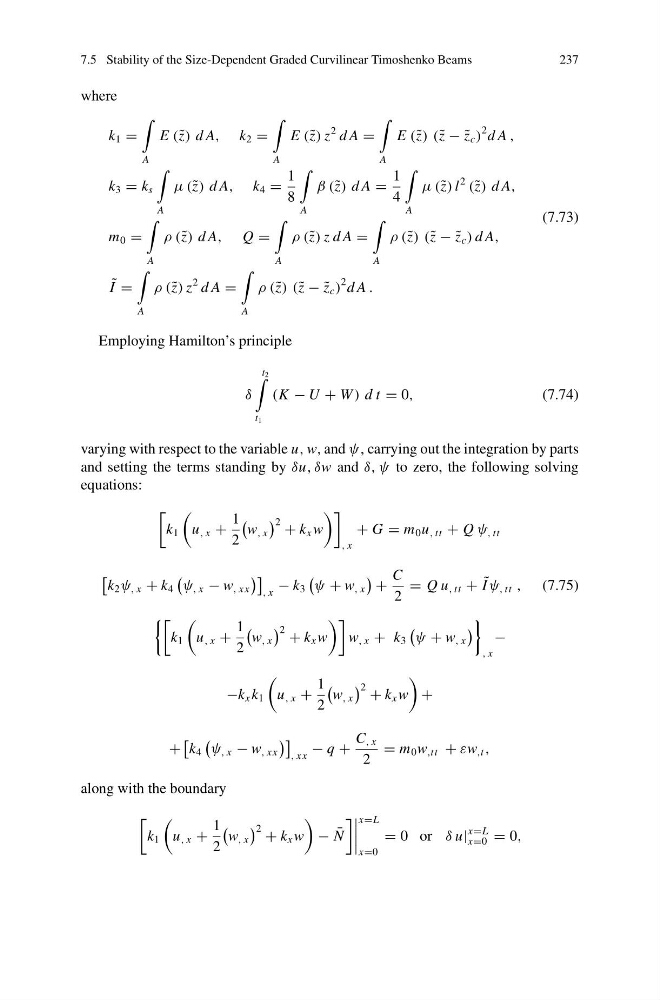
where
k 1 =
A
E (˜ z) d A, k 2 =
A
E (˜ z) z
2 d A =
A
E (˜ z) (˜ z − ˜
z c )
2 d A ,
k 3 = k s
A
μ (˜ z) d A, k 4 =
1
8
A
β (˜ z) d A =
1
4
A
μ (˜ z) l
2
(˜ z) d A,
m 0 =
A
ρ (˜ z) d A, Q =
A
ρ (˜ z) z d A =
A
ρ (˜ z) (˜ z − ˜
z c ) d A,
˜
I =
A
ρ (˜ z) z
2 d A =
A
ρ (˜ z) (˜ z − ˜
z c )
2 d A .
(7.73)
Employing Hamilton’s principle
δ
t 2
t 1
(K − U + W ) d t = 0,
(7.74)
varying with respect to the variable u, w, and ψ, carrying out the integration by parts
and setting the terms standing by δu, δw and δ, ψ to zero, the following solving
equations:
k 1
u , x +
1
2
w , x
2 + k x w
, x
+ G = m 0 u , tt + Q ψ , tt
k 2 ψ , x + k 4
ψ , x − w , xx
, x
− k 3
ψ + w , x
+
C
2
= Q u , tt + ˜
I ψ , tt , (7.75)
k 1
u , x +
1
2
w , x
2 + k x w
w , x + k 3
ψ + w , x
, x
−
−k x k 1
u , x +
1
2
w , x
2 + k x w
+
+
k 4
ψ , x − w , xx
, xx
− q +
C , x
2
= m 0 w ,tt + εw ,t ,
along with the boundary
k 1
u , x +
1
2
w , x
2 + k x w
− ¯
N
x=L
x=0
= 0 or δ u|
x=L
x=0 = 0,
237
where
k 1 =
A
E (˜ z) d A, k 2 =
A
E (˜ z) z
2 d A =
A
E (˜ z) (˜ z − ˜
z c )
2 d A ,
k 3 = k s
A
μ (˜ z) d A, k 4 =
1
8
A
β (˜ z) d A =
1
4
A
μ (˜ z) l
2
(˜ z) d A,
m 0 =
A
ρ (˜ z) d A, Q =
A
ρ (˜ z) z d A =
A
ρ (˜ z) (˜ z − ˜
z c ) d A,
˜
I =
A
ρ (˜ z) z
2 d A =
A
ρ (˜ z) (˜ z − ˜
z c )
2 d A .
(7.73)
Employing Hamilton’s principle
δ
t 2
t 1
(K − U + W ) d t = 0,
(7.74)
varying with respect to the variable u, w, and ψ, carrying out the integration by parts
and setting the terms standing by δu, δw and δ, ψ to zero, the following solving
equations:
k 1
u , x +
1
2
w , x
2 + k x w
, x
+ G = m 0 u , tt + Q ψ , tt
k 2 ψ , x + k 4
ψ , x − w , xx
, x
− k 3
ψ + w , x
+
C
2
= Q u , tt + ˜
I ψ , tt , (7.75)
k 1
u , x +
1
2
w , x
2 + k x w
w , x + k 3
ψ + w , x
, x
−
−k x k 1
u , x +
1
2
w , x
2 + k x w
+
+
k 4
ψ , x − w , xx
, xx
− q +
C , x
2
= m 0 w ,tt + εw ,t ,
along with the boundary
k 1
u , x +
1
2
w , x
2 + k x w
− ¯
N
x=L
x=0
= 0 or δ u|
x=L
x=0 = 0,