

7.4 Chaotic Dynamics of Size-Dependent Graded Timoshenko Beams
221
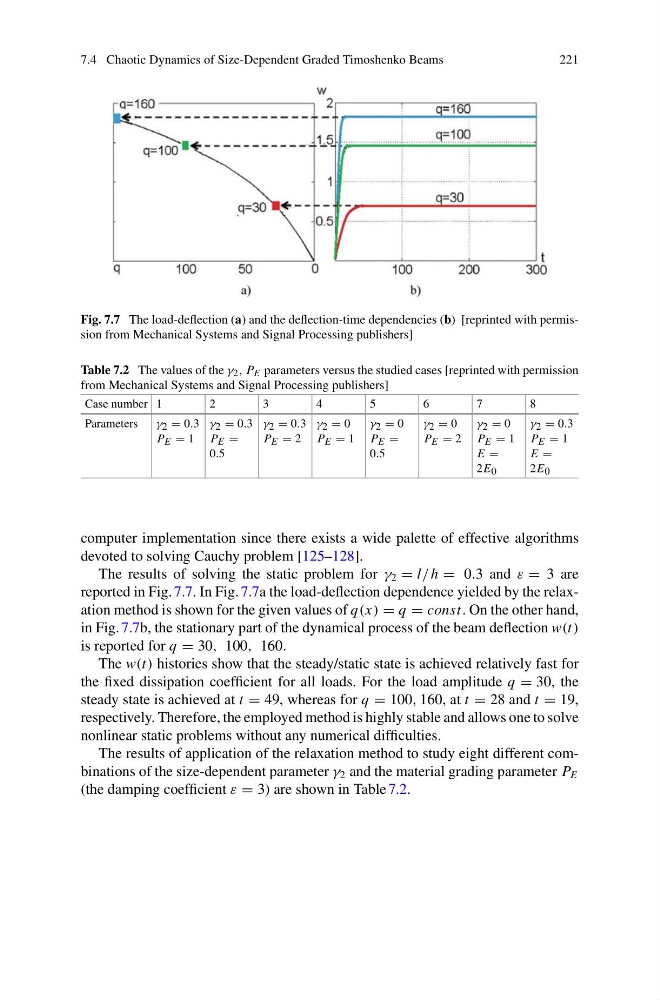
Fig. 7.7 The load-deflection (a) and the deflection-time dependencies (b) [reprinted with permission from Mechanical Systems and Signal Processing publishers]
Table 7.2 The values of the γ 2 , P E parameters versus the studied cases [reprinted with permission
from Mechanical Systems and Signal Processing publishers]
Case number 1
2
3
4
5
6
7
8
Parameters
γ 2 = 0.3
P E = 1
γ 2 = 0.3
P E =
0.5
γ 2 = 0.3
P E = 2
γ 2 = 0
P E = 1
γ 2 = 0
P E =
0.5
γ 2 = 0
P E = 2
γ 2 = 0
P E = 1
E =
2E 0
γ 2 = 0.3
P E = 1
E =
2E 0
computer implementation since there exists a wide palette of effective algorithms
devoted to solving Cauchy problem [125–128].
The results of solving the static problem for γ 2 = l/ h = 0.3 and ε = 3 are
reported in Fig. 7.7. In Fig. 7.7a the load-deflection dependence yielded by the relaxation method is shown for the given values of q(x) = q = const. On the other hand,
in Fig. 7.7b, the stationary part of the dynamical process of the beam deflection w(t)
is reported for q = 30, 100, 160.
The w(t) histories show that the steady/static state is achieved relatively fast for
the fixed dissipation coefficient for all loads. For the load amplitude q = 30, the
steady state is achieved at t = 49, whereas for q = 100, 160, at t = 28 and t = 19,
respectively. Therefore, the employed method is highly stable and allows one to solve
nonlinear static problems without any numerical difficulties.
The results of application of the relaxation method to study eight different combinations of the size-dependent parameter γ 2 and the material grading parameter P E
(the damping coefficient ε = 3) are shown in Table 7.2.
221
Fig. 7.7 The load-deflection (a) and the deflection-time dependencies (b) [reprinted with permission from Mechanical Systems and Signal Processing publishers]
Table 7.2 The values of the γ 2 , P E parameters versus the studied cases [reprinted with permission
from Mechanical Systems and Signal Processing publishers]
Case number 1
2
3
4
5
6
7
8
Parameters
γ 2 = 0.3
P E = 1
γ 2 = 0.3
P E =
0.5
γ 2 = 0.3
P E = 2
γ 2 = 0
P E = 1
γ 2 = 0
P E =
0.5
γ 2 = 0
P E = 2
γ 2 = 0
P E = 1
E =
2E 0
γ 2 = 0.3
P E = 1
E =
2E 0
computer implementation since there exists a wide palette of effective algorithms
devoted to solving Cauchy problem [125–128].
The results of solving the static problem for γ 2 = l/ h = 0.3 and ε = 3 are
reported in Fig. 7.7. In Fig. 7.7a the load-deflection dependence yielded by the relaxation method is shown for the given values of q(x) = q = const. On the other hand,
in Fig. 7.7b, the stationary part of the dynamical process of the beam deflection w(t)
is reported for q = 30, 100, 160.
The w(t) histories show that the steady/static state is achieved relatively fast for
the fixed dissipation coefficient for all loads. For the load amplitude q = 30, the
steady state is achieved at t = 49, whereas for q = 100, 160, at t = 28 and t = 19,
respectively. Therefore, the employed method is highly stable and allows one to solve
nonlinear static problems without any numerical difficulties.
The results of application of the relaxation method to study eight different combinations of the size-dependent parameter γ 2 and the material grading parameter P E
(the damping coefficient ε = 3) are shown in Table 7.2.