

220
7 Mathematical Models of Functionally Graded Beams in Temperature Field
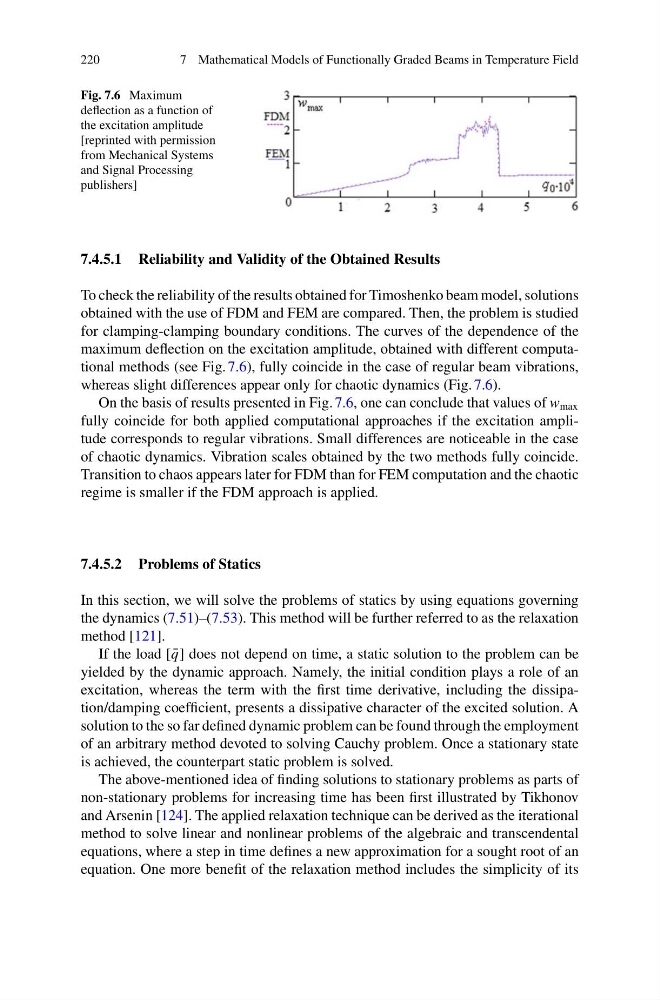
Fig. 7.6 Maximum
deflection as a function of
the excitation amplitude
[reprinted with permission
from Mechanical Systems
and Signal Processing
publishers]
7.4.5.1 Reliability and Validity of the Obtained Results
To check the reliability of the results obtained for Timoshenko beam model, solutions
obtained with the use of FDM and FEM are compared. Then, the problem is studied
for clamping-clamping boundary conditions. The curves of the dependence of the
maximum deflection on the excitation amplitude, obtained with different computational methods (see Fig. 7.6), fully coincide in the case of regular beam vibrations,
whereas slight differences appear only for chaotic dynamics (Fig. 7.6).
On the basis of results presented in Fig. 7.6, one can conclude that values of w max
fully coincide for both applied computational approaches if the excitation amplitude corresponds to regular vibrations. Small differences are noticeable in the case
of chaotic dynamics. Vibration scales obtained by the two methods fully coincide.
Transition to chaos appears later for FDM than for FEM computation and the chaotic
regime is smaller if the FDM approach is applied.
7.4.5.2 Problems of Statics
In this section, we will solve the problems of statics by using equations governing
the dynamics (7.51)–(7.53). This method will be further referred to as the relaxation
method [121].
If the load [ ¯
q] does not depend on time, a static solution to the problem can be
yielded by the dynamic approach. Namely, the initial condition plays a role of an
excitation, whereas the term with the first time derivative, including the dissipation/damping coefficient, presents a dissipative character of the excited solution. A
solution to the so far defined dynamic problem can be found through the employment
of an arbitrary method devoted to solving Cauchy problem. Once a stationary state
is achieved, the counterpart static problem is solved.
The above-mentioned idea of finding solutions to stationary problems as parts of
non-stationary problems for increasing time has been first illustrated by Tikhonov
and Arsenin [124]. The applied relaxation technique can be derived as the iterational
method to solve linear and nonlinear problems of the algebraic and transcendental
equations, where a step in time defines a new approximation for a sought root of an
equation. One more benefit of the relaxation method includes the simplicity of its
7 Mathematical Models of Functionally Graded Beams in Temperature Field
Fig. 7.6 Maximum
deflection as a function of
the excitation amplitude
[reprinted with permission
from Mechanical Systems
and Signal Processing
publishers]
7.4.5.1 Reliability and Validity of the Obtained Results
To check the reliability of the results obtained for Timoshenko beam model, solutions
obtained with the use of FDM and FEM are compared. Then, the problem is studied
for clamping-clamping boundary conditions. The curves of the dependence of the
maximum deflection on the excitation amplitude, obtained with different computational methods (see Fig. 7.6), fully coincide in the case of regular beam vibrations,
whereas slight differences appear only for chaotic dynamics (Fig. 7.6).
On the basis of results presented in Fig. 7.6, one can conclude that values of w max
fully coincide for both applied computational approaches if the excitation amplitude corresponds to regular vibrations. Small differences are noticeable in the case
of chaotic dynamics. Vibration scales obtained by the two methods fully coincide.
Transition to chaos appears later for FDM than for FEM computation and the chaotic
regime is smaller if the FDM approach is applied.
7.4.5.2 Problems of Statics
In this section, we will solve the problems of statics by using equations governing
the dynamics (7.51)–(7.53). This method will be further referred to as the relaxation
method [121].
If the load [ ¯
q] does not depend on time, a static solution to the problem can be
yielded by the dynamic approach. Namely, the initial condition plays a role of an
excitation, whereas the term with the first time derivative, including the dissipation/damping coefficient, presents a dissipative character of the excited solution. A
solution to the so far defined dynamic problem can be found through the employment
of an arbitrary method devoted to solving Cauchy problem. Once a stationary state
is achieved, the counterpart static problem is solved.
The above-mentioned idea of finding solutions to stationary problems as parts of
non-stationary problems for increasing time has been first illustrated by Tikhonov
and Arsenin [124]. The applied relaxation technique can be derived as the iterational
method to solve linear and nonlinear problems of the algebraic and transcendental
equations, where a step in time defines a new approximation for a sought root of an
equation. One more benefit of the relaxation method includes the simplicity of its