

222
7 Mathematical Models of Functionally Graded Beams in Temperature Field
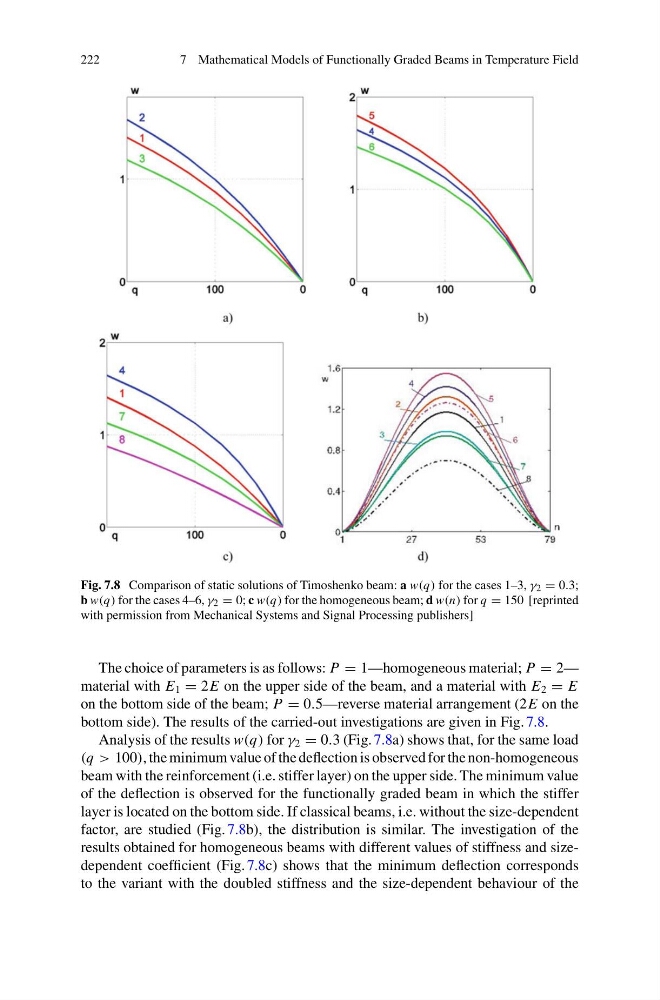
Fig. 7.8 Comparison of static solutions of Timoshenko beam: a w(q) for the cases 1–3, γ 2 = 0.3;
b w(q) for the cases 4–6, γ 2 = 0; c w(q) for the homogeneous beam; d w(n) for q = 150 [reprinted
with permission from Mechanical Systems and Signal Processing publishers]
The choice of parameters is as follows: P = 1—homogeneous material; P = 2—
material with E 1 = 2E on the upper side of the beam, and a material with E 2 = E
on the bottom side of the beam; P = 0.5—reverse material arrangement (2E on the
bottom side). The results of the carried-out investigations are given in Fig. 7.8.
Analysis of the results w(q) for γ 2 = 0.3 (Fig. 7.8a) shows that, for the same load
(q > 100), the minimum value of the deflection is observed for the non-homogeneous
beam with the reinforcement (i.e. stiffer layer) on the upper side. The minimum value
of the deflection is observed for the functionally graded beam in which the stiffer
layer is located on the bottom side. If classical beams, i.e. without the size-dependent
factor, are studied (Fig. 7.8b), the distribution is similar. The investigation of the
results obtained for homogeneous beams with different values of stiffness and sizedependent coefficient (Fig. 7.8c) shows that the minimum deflection corresponds
to the variant with the doubled stiffness and the size-dependent behaviour of the
7 Mathematical Models of Functionally Graded Beams in Temperature Field
Fig. 7.8 Comparison of static solutions of Timoshenko beam: a w(q) for the cases 1–3, γ 2 = 0.3;
b w(q) for the cases 4–6, γ 2 = 0; c w(q) for the homogeneous beam; d w(n) for q = 150 [reprinted
with permission from Mechanical Systems and Signal Processing publishers]
The choice of parameters is as follows: P = 1—homogeneous material; P = 2—
material with E 1 = 2E on the upper side of the beam, and a material with E 2 = E
on the bottom side of the beam; P = 0.5—reverse material arrangement (2E on the
bottom side). The results of the carried-out investigations are given in Fig. 7.8.
Analysis of the results w(q) for γ 2 = 0.3 (Fig. 7.8a) shows that, for the same load
(q > 100), the minimum value of the deflection is observed for the non-homogeneous
beam with the reinforcement (i.e. stiffer layer) on the upper side. The minimum value
of the deflection is observed for the functionally graded beam in which the stiffer
layer is located on the bottom side. If classical beams, i.e. without the size-dependent
factor, are studied (Fig. 7.8b), the distribution is similar. The investigation of the
results obtained for homogeneous beams with different values of stiffness and sizedependent coefficient (Fig. 7.8c) shows that the minimum deflection corresponds
to the variant with the doubled stiffness and the size-dependent behaviour of the