

214
7 Mathematical Models of Functionally Graded Beams in Temperature Field
acting on the axial cross section along the body axis O X. The resultant of the transverse stress acting on the upper side of the beam and the transverse volume forces
per unit beam length is denoted by q(x, t). The parameter C(x, t) presents the y
component of the resultant volume moment per unit beam length.
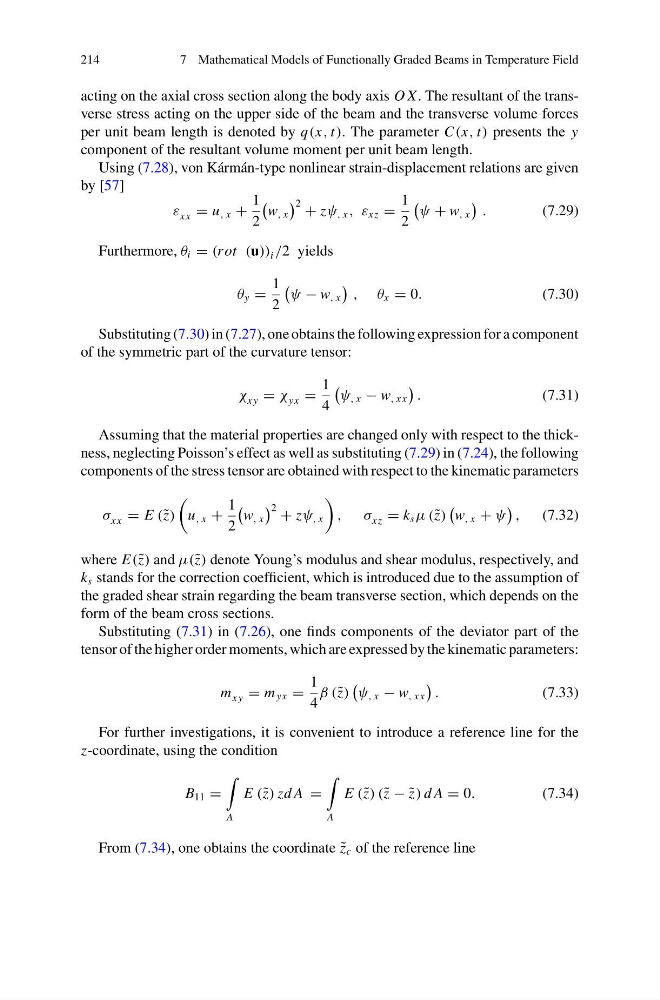
Using (7.28), von Kármán-type nonlinear strain-displacement relations are given
by [57]
ε xx = u , x +
1
2
w , x
2 + zψ , x , ε xz =
1
2
ψ + w , x
.
(7.29)
Furthermore, θ i = (rot (u)) i /2 yields
θ y =
1
2
ψ − w , x
, θ x = 0.
(7.30)
Substituting (7.30) in (7.27), one obtains the following expression for a component
of the symmetric part of the curvature tensor:
χ xy = χ yx =
1
4
ψ , x − w , xx
.
(7.31)
Assuming that the material properties are changed only with respect to the thickness, neglecting Poisson’s effect as well as substituting (7.29) in (7.24), the following
components of the stress tensor are obtained with respect to the kinematic parameters
σ xx = E (˜ z)
u , x +
1
2
w , x
2 + zψ , x
, σ xz = k s μ (˜ z)
w , x + ψ
, (7.32)
where E(˜ z) and μ(˜ z) denote Young’s modulus and shear modulus, respectively, and
k s stands for the correction coefficient, which is introduced due to the assumption of
the graded shear strain regarding the beam transverse section, which depends on the
form of the beam cross sections.
Substituting (7.31) in (7.26), one finds components of the deviator part of the
tensor of the higher order moments, which are expressed by the kinematic parameters:
m xy = m yx =
1
4
β (˜ z)
ψ , x − w , xx
.
(7.33)
For further investigations, it is convenient to introduce a reference line for the
z-coordinate, using the condition
B 11 =
A
E (˜ z) zd A =
A
E (˜ z) (˜ z − ˜
z) d A = 0.
(7.34)
From (7.34), one obtains the coordinate ˜
z c of the reference line
7 Mathematical Models of Functionally Graded Beams in Temperature Field
acting on the axial cross section along the body axis O X. The resultant of the transverse stress acting on the upper side of the beam and the transverse volume forces
per unit beam length is denoted by q(x, t). The parameter C(x, t) presents the y
component of the resultant volume moment per unit beam length.
Using (7.28), von Kármán-type nonlinear strain-displacement relations are given
by [57]
ε xx = u , x +
1
2
w , x
2 + zψ , x , ε xz =
1
2
ψ + w , x
.
(7.29)
Furthermore, θ i = (rot (u)) i /2 yields
θ y =
1
2
ψ − w , x
, θ x = 0.
(7.30)
Substituting (7.30) in (7.27), one obtains the following expression for a component
of the symmetric part of the curvature tensor:
χ xy = χ yx =
1
4
ψ , x − w , xx
.
(7.31)
Assuming that the material properties are changed only with respect to the thickness, neglecting Poisson’s effect as well as substituting (7.29) in (7.24), the following
components of the stress tensor are obtained with respect to the kinematic parameters
σ xx = E (˜ z)
u , x +
1
2
w , x
2 + zψ , x
, σ xz = k s μ (˜ z)
w , x + ψ
, (7.32)
where E(˜ z) and μ(˜ z) denote Young’s modulus and shear modulus, respectively, and
k s stands for the correction coefficient, which is introduced due to the assumption of
the graded shear strain regarding the beam transverse section, which depends on the
form of the beam cross sections.
Substituting (7.31) in (7.26), one finds components of the deviator part of the
tensor of the higher order moments, which are expressed by the kinematic parameters:
m xy = m yx =
1
4
β (˜ z)
ψ , x − w , xx
.
(7.33)
For further investigations, it is convenient to introduce a reference line for the
z-coordinate, using the condition
B 11 =
A
E (˜ z) zd A =
A
E (˜ z) (˜ z − ˜
z) d A = 0.
(7.34)
From (7.34), one obtains the coordinate ˜
z c of the reference line