

7.3 Laws of Properties Change of FGM
207
7.3.5 Homogenization of Properties of Graded Material
Based on Mori-Tanaka and Self-consistent Methods
Mori-Tanaka scheme belongs to one of the most commonly employed procedure
of homogenization of the material properties and in particular for quantifying the
effective properties of microbeams made from FGM. Owing to the scheme of MoriTanaka homogenization, formulas governing the effective elastic volume modulus
K e and the effective shear modulus G e are reported in [88, 89], and they have the
following form:
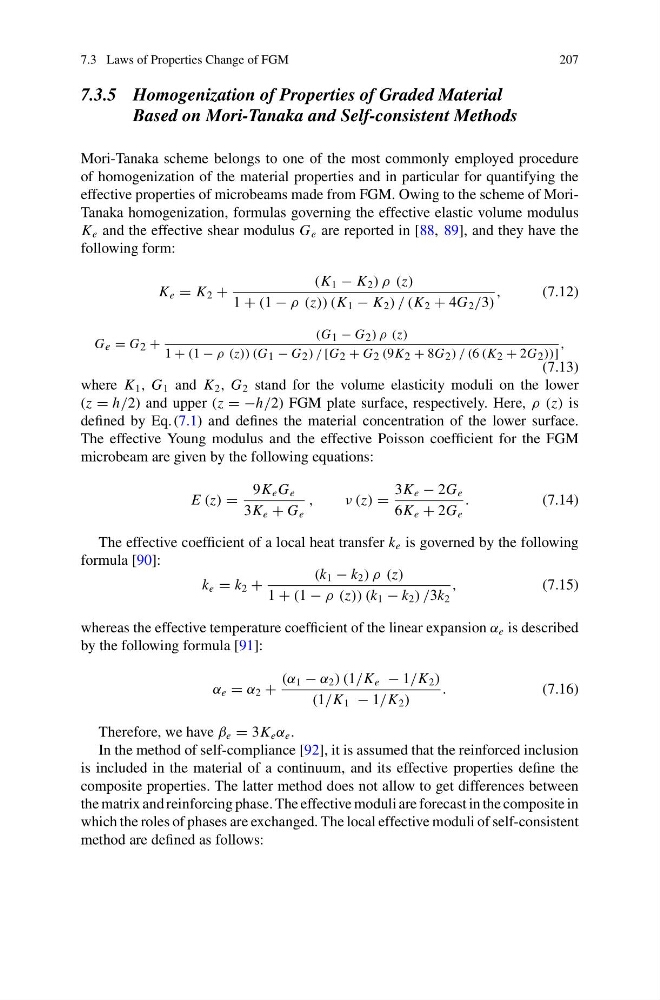
K e = K 2 +
(K 1 − K 2 ) ρ (z)
1 + (1 − ρ (z)) (K 1 − K 2 ) / (K 2 + 4G 2 /3)
,
(7.12)
G e = G 2 +
(G 1 − G 2 ) ρ (z)
1 + (1 − ρ (z)) (G 1 − G 2 ) / [G 2 + G 2 (9K 2 + 8G 2 ) / (6 (K 2 + 2G 2 ))]
,
(7.13)
where K 1 , G 1 and K 2 , G 2 stand for the volume elasticity moduli on the lower
(z = h/2) and upper (z = −h/2) FGM plate surface, respectively. Here, ρ (z) is
defined by Eq. (7.1) and defines the material concentration of the lower surface.
The effective Young modulus and the effective Poisson coefficient for the FGM
microbeam are given by the following equations:
E (z) =
9K e G e
3K e + G e
,
ν(z) =
3K e − 2G e
6K e + 2G e
.
(7.14)
The effective coefficient of a local heat transfer k e is governed by the following
formula [90]:
k e = k 2 +
(k 1 − k 2 ) ρ (z)
1 + (1 − ρ (z)) (k 1 − k 2 ) /3k 2
,
(7.15)
whereas the effective temperature coefficient of the linear expansion α e is described
by the following formula [91]:
α e = α 2 +
(α 1 − α 2 ) (1/K e − 1/K 2 )
(1/K 1 − 1/K 2 )
.
(7.16)
Therefore, we have β e = 3K e α e .
In the method of self-compliance [92], it is assumed that the reinforced inclusion
is included in the material of a continuum, and its effective properties define the
composite properties. The latter method does not allow to get differences between
the matrix and reinforcing phase. The effective moduli are forecast in the composite in
which the roles of phases are exchanged. The local effective moduli of self-consistent
method are defined as follows:
207
7.3.5 Homogenization of Properties of Graded Material
Based on Mori-Tanaka and Self-consistent Methods
Mori-Tanaka scheme belongs to one of the most commonly employed procedure
of homogenization of the material properties and in particular for quantifying the
effective properties of microbeams made from FGM. Owing to the scheme of MoriTanaka homogenization, formulas governing the effective elastic volume modulus
K e and the effective shear modulus G e are reported in [88, 89], and they have the
following form:
K e = K 2 +
(K 1 − K 2 ) ρ (z)
1 + (1 − ρ (z)) (K 1 − K 2 ) / (K 2 + 4G 2 /3)
,
(7.12)
G e = G 2 +
(G 1 − G 2 ) ρ (z)
1 + (1 − ρ (z)) (G 1 − G 2 ) / [G 2 + G 2 (9K 2 + 8G 2 ) / (6 (K 2 + 2G 2 ))]
,
(7.13)
where K 1 , G 1 and K 2 , G 2 stand for the volume elasticity moduli on the lower
(z = h/2) and upper (z = −h/2) FGM plate surface, respectively. Here, ρ (z) is
defined by Eq. (7.1) and defines the material concentration of the lower surface.
The effective Young modulus and the effective Poisson coefficient for the FGM
microbeam are given by the following equations:
E (z) =
9K e G e
3K e + G e
,
ν(z) =
3K e − 2G e
6K e + 2G e
.
(7.14)
The effective coefficient of a local heat transfer k e is governed by the following
formula [90]:
k e = k 2 +
(k 1 − k 2 ) ρ (z)
1 + (1 − ρ (z)) (k 1 − k 2 ) /3k 2
,
(7.15)
whereas the effective temperature coefficient of the linear expansion α e is described
by the following formula [91]:
α e = α 2 +
(α 1 − α 2 ) (1/K e − 1/K 2 )
(1/K 1 − 1/K 2 )
.
(7.16)
Therefore, we have β e = 3K e α e .
In the method of self-compliance [92], it is assumed that the reinforced inclusion
is included in the material of a continuum, and its effective properties define the
composite properties. The latter method does not allow to get differences between
the matrix and reinforcing phase. The effective moduli are forecast in the composite in
which the roles of phases are exchanged. The local effective moduli of self-consistent
method are defined as follows: