

208
7 Mathematical Models of Functionally Graded Beams in Temperature Field
δ
K e
=
ρ (z)
K e − K 1
+
1 − ρ (z)
K e − K 2
,
(7.17)
η
G e
=
ρ (z)
G e − G 1
+
1 − ρ (z)
G e − G 2
,
(7.18)
where
δ = 3 − 5η = K e /(K e + 4G e /3).
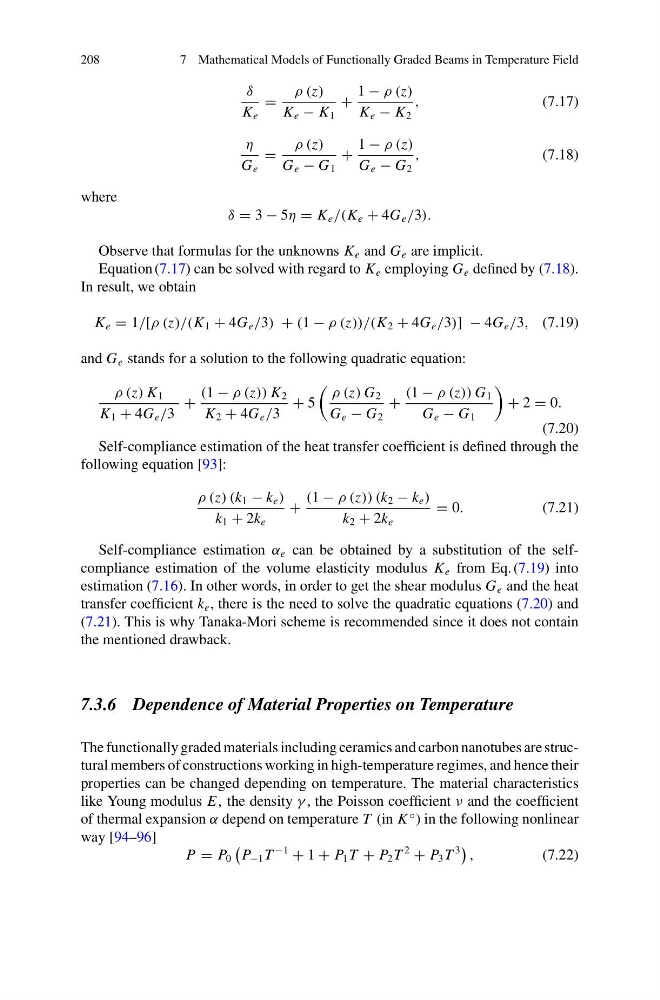
Observe that formulas for the unknowns K e and G e are implicit.
Equation (7.17) can be solved with regard to K e employing G e defined by (7.18).
In result, we obtain
K e = 1/[ρ (z)/(K 1 + 4G e /3) + (1 − ρ (z))/(K 2 + 4G e /3)] − 4G e /3, (7.19)
and G e stands for a solution to the following quadratic equation:
ρ (z) K 1
K 1 + 4G e /3
+
(1 − ρ (z)) K 2
K 2 + 4G e /3
+ 5
ρ (z) G 2
G e − G 2
+
(1 − ρ (z)) G 1
G e − G 1
+ 2 = 0.
(7.20)
Self-compliance estimation of the heat transfer coefficient is defined through the
following equation [93]:
ρ (z) (k 1 − k e )
k 1 + 2k e
+
(1 − ρ (z)) (k 2 − k e )
k 2 + 2k e
= 0.
(7.21)
Self-compliance estimation α e can be obtained by a substitution of the selfcompliance estimation of the volume elasticity modulus K e from Eq. (7.19) into
estimation (7.16). In other words, in order to get the shear modulus G e and the heat
transfer coefficient k e , there is the need to solve the quadratic equations (7.20) and
(7.21). This is why Tanaka-Mori scheme is recommended since it does not contain
the mentioned drawback.
7.3.6 Dependence of Material Properties on Temperature
The functionally graded materials including ceramics and carbon nanotubes are structural members of constructions working in high-temperature regimes, and hence their
properties can be changed depending on temperature. The material characteristics
like Young modulus E, the density γ , the Poisson coefficient ν and the coefficient
of thermal expansion α depend on temperature T (in K
◦ ) in the following nonlinear
way [94–96]
P = P 0
P −1 T
−1
+ 1 + P 1 T + P 2 T
2
+ P 3 T
3
,
(7.22)
7 Mathematical Models of Functionally Graded Beams in Temperature Field
δ
K e
=
ρ (z)
K e − K 1
+
1 − ρ (z)
K e − K 2
,
(7.17)
η
G e
=
ρ (z)
G e − G 1
+
1 − ρ (z)
G e − G 2
,
(7.18)
where
δ = 3 − 5η = K e /(K e + 4G e /3).
Observe that formulas for the unknowns K e and G e are implicit.
Equation (7.17) can be solved with regard to K e employing G e defined by (7.18).
In result, we obtain
K e = 1/[ρ (z)/(K 1 + 4G e /3) + (1 − ρ (z))/(K 2 + 4G e /3)] − 4G e /3, (7.19)
and G e stands for a solution to the following quadratic equation:
ρ (z) K 1
K 1 + 4G e /3
+
(1 − ρ (z)) K 2
K 2 + 4G e /3
+ 5
ρ (z) G 2
G e − G 2
+
(1 − ρ (z)) G 1
G e − G 1
+ 2 = 0.
(7.20)
Self-compliance estimation of the heat transfer coefficient is defined through the
following equation [93]:
ρ (z) (k 1 − k e )
k 1 + 2k e
+
(1 − ρ (z)) (k 2 − k e )
k 2 + 2k e
= 0.
(7.21)
Self-compliance estimation α e can be obtained by a substitution of the selfcompliance estimation of the volume elasticity modulus K e from Eq. (7.19) into
estimation (7.16). In other words, in order to get the shear modulus G e and the heat
transfer coefficient k e , there is the need to solve the quadratic equations (7.20) and
(7.21). This is why Tanaka-Mori scheme is recommended since it does not contain
the mentioned drawback.
7.3.6 Dependence of Material Properties on Temperature
The functionally graded materials including ceramics and carbon nanotubes are structural members of constructions working in high-temperature regimes, and hence their
properties can be changed depending on temperature. The material characteristics
like Young modulus E, the density γ , the Poisson coefficient ν and the coefficient
of thermal expansion α depend on temperature T (in K
◦ ) in the following nonlinear
way [94–96]
P = P 0
P −1 T
−1
+ 1 + P 1 T + P 2 T
2
+ P 3 T
3
,
(7.22)