

206
7 Mathematical Models of Functionally Graded Beams in Temperature Field
7.3.4 Properties of Porous Materials
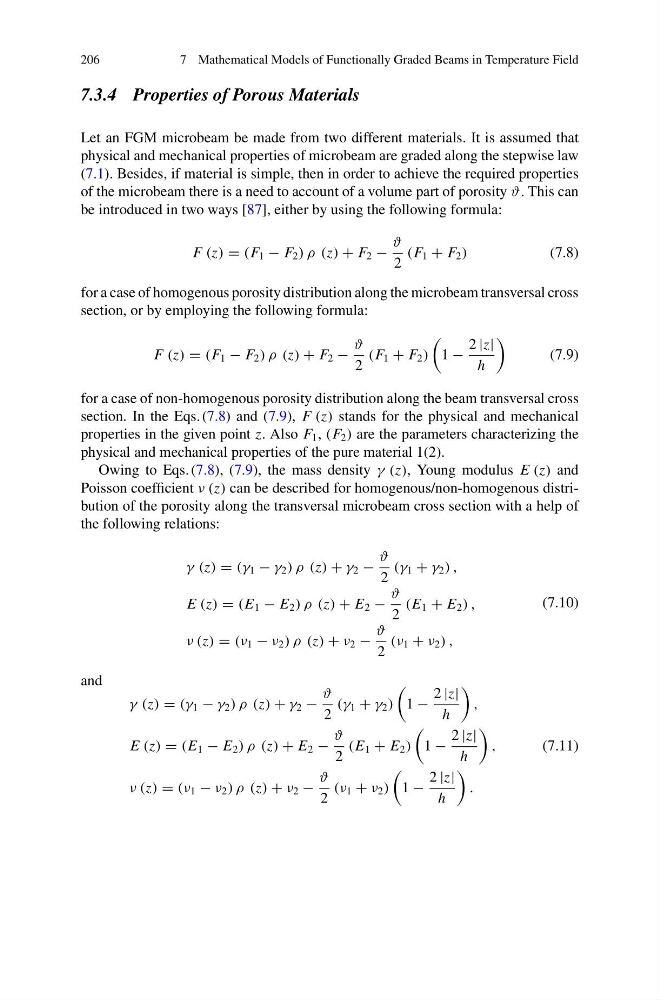
Let an FGM microbeam be made from two different materials. It is assumed that
physical and mechanical properties of microbeam are graded along the stepwise law
(7.1). Besides, if material is simple, then in order to achieve the required properties
of the microbeam there is a need to account of a volume part of porosity ϑ. This can
be introduced in two ways [87], either by using the following formula:
F (z) = (F 1 − F 2 ) ρ (z) + F 2 −
ϑ
2
(F 1 + F 2 )
(7.8)
for a case of homogenous porosity distribution along the microbeam transversal cross
section, or by employing the following formula:
F (z) = (F 1 − F 2 ) ρ (z) + F 2 −
ϑ
2
(F 1 + F 2 )
1 −
2 |z|
h
(7.9)
for a case of non-homogenous porosity distribution along the beam transversal cross
section. In the Eqs. (7.8) and (7.9), F (z) stands for the physical and mechanical
properties in the given point z. Also F 1 , (F 2 ) are the parameters characterizing the
physical and mechanical properties of the pure material 1(2).
Owing to Eqs. (7.8), (7.9), the mass density γ (z), Young modulus E (z) and
Poisson coefficient ν (z) can be described for homogenous/non-homogenous distribution of the porosity along the transversal microbeam cross section with a help of
the following relations:
γ (z) = (γ 1 − γ 2 ) ρ (z) + γ 2 −
ϑ
2
(γ 1 + γ 2 ) ,
E (z) = (E 1 − E 2 ) ρ (z) + E 2 −
ϑ
2
(E 1 + E 2 ) ,
ν (z) = (ν 1 − ν 2 ) ρ (z) + ν 2 −
ϑ
2
(ν 1 + ν 2 ) ,
(7.10)
and
γ (z) = (γ 1 − γ 2 ) ρ (z) + γ 2 −
ϑ
2
(γ 1 + γ 2 )
1 −
2 |z|
h
,
E (z) = (E 1 − E 2 ) ρ (z) + E 2 −
ϑ
2
(E 1 + E 2 )
1 −
2 |z|
h
,
ν (z) = (ν 1 − ν 2 ) ρ (z) + ν 2 −
ϑ
2
(ν 1 + ν 2 )
1 −
2 |z|
h
.
(7.11)
7 Mathematical Models of Functionally Graded Beams in Temperature Field
7.3.4 Properties of Porous Materials
Let an FGM microbeam be made from two different materials. It is assumed that
physical and mechanical properties of microbeam are graded along the stepwise law
(7.1). Besides, if material is simple, then in order to achieve the required properties
of the microbeam there is a need to account of a volume part of porosity ϑ. This can
be introduced in two ways [87], either by using the following formula:
F (z) = (F 1 − F 2 ) ρ (z) + F 2 −
ϑ
2
(F 1 + F 2 )
(7.8)
for a case of homogenous porosity distribution along the microbeam transversal cross
section, or by employing the following formula:
F (z) = (F 1 − F 2 ) ρ (z) + F 2 −
ϑ
2
(F 1 + F 2 )
1 −
2 |z|
h
(7.9)
for a case of non-homogenous porosity distribution along the beam transversal cross
section. In the Eqs. (7.8) and (7.9), F (z) stands for the physical and mechanical
properties in the given point z. Also F 1 , (F 2 ) are the parameters characterizing the
physical and mechanical properties of the pure material 1(2).
Owing to Eqs. (7.8), (7.9), the mass density γ (z), Young modulus E (z) and
Poisson coefficient ν (z) can be described for homogenous/non-homogenous distribution of the porosity along the transversal microbeam cross section with a help of
the following relations:
γ (z) = (γ 1 − γ 2 ) ρ (z) + γ 2 −
ϑ
2
(γ 1 + γ 2 ) ,
E (z) = (E 1 − E 2 ) ρ (z) + E 2 −
ϑ
2
(E 1 + E 2 ) ,
ν (z) = (ν 1 − ν 2 ) ρ (z) + ν 2 −
ϑ
2
(ν 1 + ν 2 ) ,
(7.10)
and
γ (z) = (γ 1 − γ 2 ) ρ (z) + γ 2 −
ϑ
2
(γ 1 + γ 2 )
1 −
2 |z|
h
,
E (z) = (E 1 − E 2 ) ρ (z) + E 2 −
ϑ
2
(E 1 + E 2 )
1 −
2 |z|
h
,
ν (z) = (ν 1 − ν 2 ) ρ (z) + ν 2 −
ϑ
2
(ν 1 + ν 2 )
1 −
2 |z|
h
.
(7.11)