

7.3 Laws of Properties Change of FGM
205
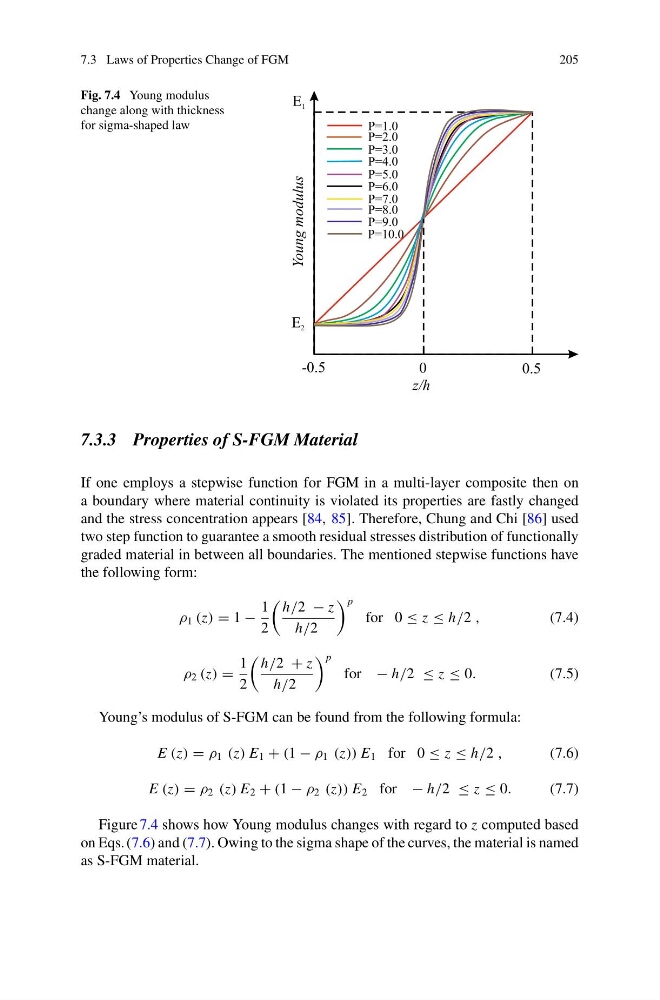
Fig. 7.4 Young modulus
change along with thickness
for sigma-shaped law
E 1
E 2
-0.5
0
0.5
z/h
Young modulus
P=1.0
P=3.0
P=4.0
P=5.0
P=7.0
P=8.0
P=9.0
P=2.0
P=10.0
P=6.0
7.3.3 Properties of S-FGM Material
If one employs a stepwise function for FGM in a multi-layer composite then on
a boundary where material continuity is violated its properties are fastly changed
and the stress concentration appears [84, 85]. Therefore, Chung and Chi [86] used
two step function to guarantee a smooth residual stresses distribution of functionally
graded material in between all boundaries. The mentioned stepwise functions have
the following form:
ρ 1 (z) = 1 −
1
2
h/2 − z
h/2
p
for 0 ≤ z ≤ h/2 ,
(7.4)
ρ 2 (z) =
1
2
h/2 + z
h/2
p
for − h/2 ≤ z ≤ 0.
(7.5)
Young’s modulus of S-FGM can be found from the following formula:
E (z) = ρ 1 (z) E 1 + (1 − ρ 1 (z)) E 1 for 0 ≤ z ≤ h/2 ,
(7.6)
E (z) = ρ 2 (z) E 2 + (1 − ρ 2 (z)) E 2 for − h/2 ≤ z ≤ 0.
(7.7)
Figure 7.4 shows how Young modulus changes with regard to z computed based
on Eqs. (7.6) and (7.7). Owing to the sigma shape of the curves, the material is named
as S-FGM material.
205
Fig. 7.4 Young modulus
change along with thickness
for sigma-shaped law
E 1
E 2
-0.5
0
0.5
z/h
Young modulus
P=1.0
P=3.0
P=4.0
P=5.0
P=7.0
P=8.0
P=9.0
P=2.0
P=10.0
P=6.0
7.3.3 Properties of S-FGM Material
If one employs a stepwise function for FGM in a multi-layer composite then on
a boundary where material continuity is violated its properties are fastly changed
and the stress concentration appears [84, 85]. Therefore, Chung and Chi [86] used
two step function to guarantee a smooth residual stresses distribution of functionally
graded material in between all boundaries. The mentioned stepwise functions have
the following form:
ρ 1 (z) = 1 −
1
2
h/2 − z
h/2
p
for 0 ≤ z ≤ h/2 ,
(7.4)
ρ 2 (z) =
1
2
h/2 + z
h/2
p
for − h/2 ≤ z ≤ 0.
(7.5)
Young’s modulus of S-FGM can be found from the following formula:
E (z) = ρ 1 (z) E 1 + (1 − ρ 1 (z)) E 1 for 0 ≤ z ≤ h/2 ,
(7.6)
E (z) = ρ 2 (z) E 2 + (1 − ρ 2 (z)) E 2 for − h/2 ≤ z ≤ 0.
(7.7)
Figure 7.4 shows how Young modulus changes with regard to z computed based
on Eqs. (7.6) and (7.7). Owing to the sigma shape of the curves, the material is named
as S-FGM material.