

204
7 Mathematical Models of Functionally Graded Beams in Temperature Field
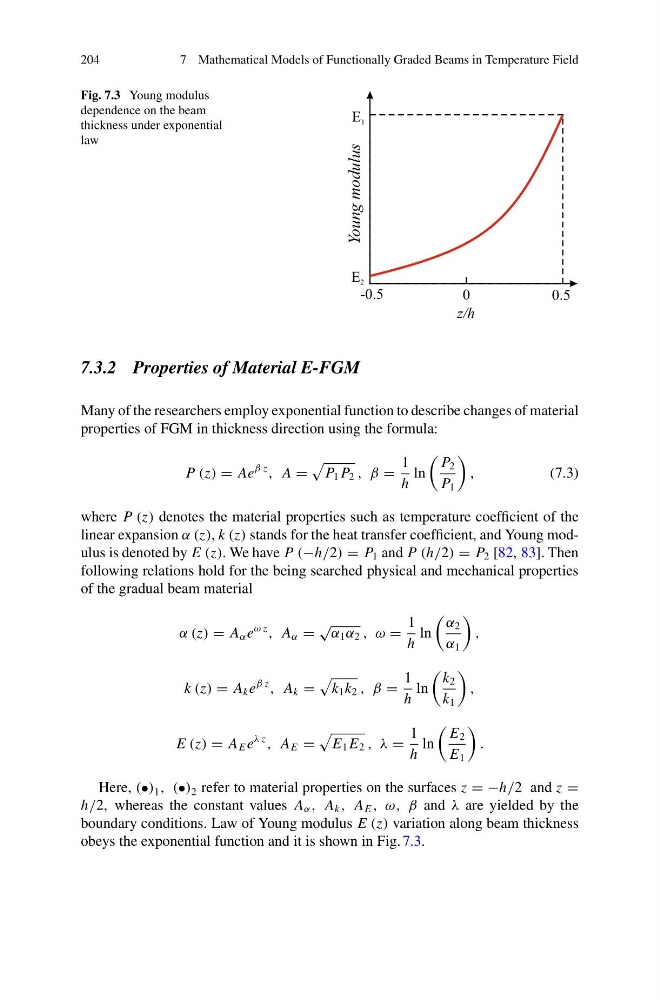
Fig. 7.3 Young modulus
dependence on the beam
thickness under exponential
law
E 1
E 2
-0.5
0
0.5
z/h
Young modulus
7.3.2 Properties of Material E-FGM
Many of the researchers employ exponential function to describe changes of material
properties of FGM in thickness direction using the formula:
P (z) = Ae
β z
, A =
P 1 P 2 , β =
1
h
ln
P 2
P 1
,
(7.3)
where P (z) denotes the material properties such as temperature coefficient of the
linear expansion α (z), k (z) stands for the heat transfer coefficient, and Young modulus is denoted by E (z). We have P (−h/2) = P 1 and P (h/2) = P 2 [82, 83]. Then
following relations hold for the being searched physical and mechanical properties
of the gradual beam material
α (z) = A α e
ω z
, A α =
√
α 1 α 2 , ω =
1
h
ln
α 2
α 1
,
k (z) = A k e
β z
, A k =
k 1 k 2 , β =
1
h
ln
k 2
k 1
,
E (z) = A E e
λ z
, A E =
E 1 E 2 , λ =
1
h
ln
E 2
E 1
.
Here, (•) 1 , (•) 2 refer to material properties on the surfaces z = −h/2 and z =
h/2, whereas the constant values A α , A k , A E , ω, β and λ are yielded by the
boundary conditions. Law of Young modulus E (z) variation along beam thickness
obeys the exponential function and it is shown in Fig. 7.3.
7 Mathematical Models of Functionally Graded Beams in Temperature Field
Fig. 7.3 Young modulus
dependence on the beam
thickness under exponential
law
E 1
E 2
-0.5
0
0.5
z/h
Young modulus
7.3.2 Properties of Material E-FGM
Many of the researchers employ exponential function to describe changes of material
properties of FGM in thickness direction using the formula:
P (z) = Ae
β z
, A =
P 1 P 2 , β =
1
h
ln
P 2
P 1
,
(7.3)
where P (z) denotes the material properties such as temperature coefficient of the
linear expansion α (z), k (z) stands for the heat transfer coefficient, and Young modulus is denoted by E (z). We have P (−h/2) = P 1 and P (h/2) = P 2 [82, 83]. Then
following relations hold for the being searched physical and mechanical properties
of the gradual beam material
α (z) = A α e
ω z
, A α =
√
α 1 α 2 , ω =
1
h
ln
α 2
α 1
,
k (z) = A k e
β z
, A k =
k 1 k 2 , β =
1
h
ln
k 2
k 1
,
E (z) = A E e
λ z
, A E =
E 1 E 2 , λ =
1
h
ln
E 2
E 1
.
Here, (•) 1 , (•) 2 refer to material properties on the surfaces z = −h/2 and z =
h/2, whereas the constant values A α , A k , A E , ω, β and λ are yielded by the
boundary conditions. Law of Young modulus E (z) variation along beam thickness
obeys the exponential function and it is shown in Fig. 7.3.