

7.3 Laws of Properties Change of FGM
203
Fig. 7.1 Geometry of a plate
made from FGM
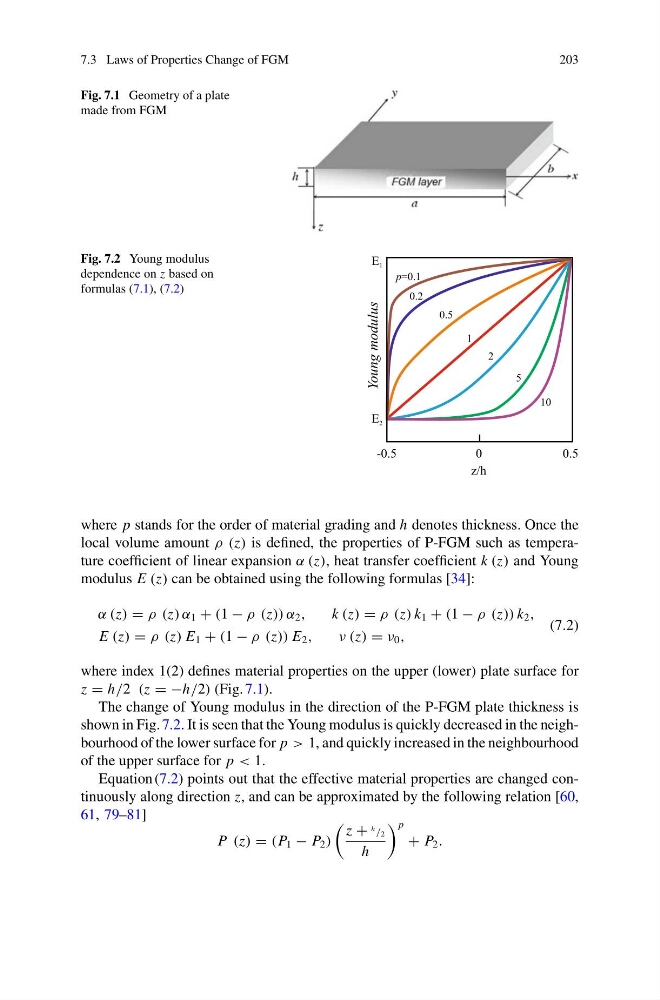
Fig. 7.2 Young modulus
dependence on z based on
formulas (7.1), (7.2)
E 1
E 2
-0.5
0
0.5
z/h
p=0.1
0.2
0.5
1
2
5
10
Young modulus
where p stands for the order of material grading and h denotes thickness. Once the
local volume amount ρ (z) is defined, the properties of P-FGM such as temperature coefficient of linear expansion α (z), heat transfer coefficient k (z) and Young
modulus E (z) can be obtained using the following formulas [34]:
α (z) = ρ (z) α 1 + (1 − ρ (z)) α 2 ,
k (z) = ρ (z) k 1 + (1 − ρ (z)) k 2 ,
E (z) = ρ (z) E 1 + (1 − ρ (z)) E 2 ,
ν(z) = ν 0 ,
(7.2)
where index 1(2) defines material properties on the upper (lower) plate surface for
z = h/2 (z = −h/2) (Fig. 7.1).
The change of Young modulus in the direction of the P-FGM plate thickness is
shown in Fig. 7.2. It is seen that the Young modulus is quickly decreased in the neighbourhood of the lower surface for p > 1, and quickly increased in the neighbourhood
of the upper surface for p < 1.
Equation (7.2) points out that the effective material properties are changed continuously along direction z, and can be approximated by the following relation [60,
61, 79–81]
P (z) = (P 1 − P 2 )
z +
h / 2
h
p
+ P 2 .
203
Fig. 7.1 Geometry of a plate
made from FGM
Fig. 7.2 Young modulus
dependence on z based on
formulas (7.1), (7.2)
E 1
E 2
-0.5
0
0.5
z/h
p=0.1
0.2
0.5
1
2
5
10
Young modulus
where p stands for the order of material grading and h denotes thickness. Once the
local volume amount ρ (z) is defined, the properties of P-FGM such as temperature coefficient of linear expansion α (z), heat transfer coefficient k (z) and Young
modulus E (z) can be obtained using the following formulas [34]:
α (z) = ρ (z) α 1 + (1 − ρ (z)) α 2 ,
k (z) = ρ (z) k 1 + (1 − ρ (z)) k 2 ,
E (z) = ρ (z) E 1 + (1 − ρ (z)) E 2 ,
ν(z) = ν 0 ,
(7.2)
where index 1(2) defines material properties on the upper (lower) plate surface for
z = h/2 (z = −h/2) (Fig. 7.1).
The change of Young modulus in the direction of the P-FGM plate thickness is
shown in Fig. 7.2. It is seen that the Young modulus is quickly decreased in the neighbourhood of the lower surface for p > 1, and quickly increased in the neighbourhood
of the upper surface for p < 1.
Equation (7.2) points out that the effective material properties are changed continuously along direction z, and can be approximated by the following relation [60,
61, 79–81]
P (z) = (P 1 − P 2 )
z +
h / 2
h
p
+ P 2 .