

6.3 Modified Couple Stress Theory of Thermoelastic Curvilinear Panels
137
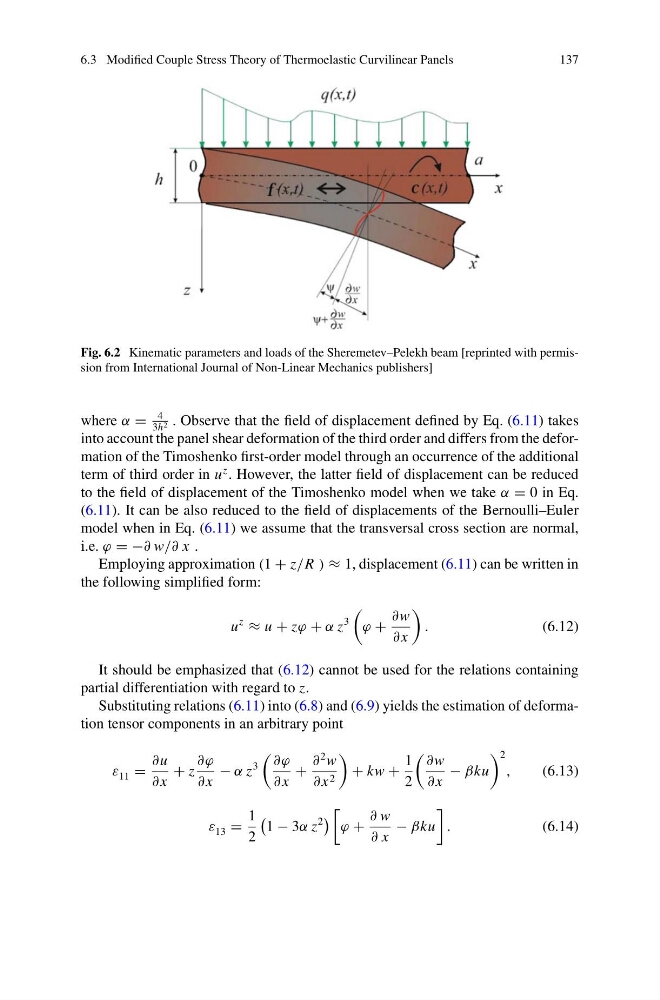
Fig. 6.2 Kinematic parameters and loads of the Sheremetev–Pelekh beam [reprinted with permission from International Journal of Non-Linear Mechanics publishers]
where α =
4
3h 2 . Observe that the field of displacement defined by Eq. (6.11) takes
into account the panel shear deformation of the third order and differs from the deformation of the Timoshenko first-order model through an occurrence of the additional
term of third order in u
z . However, the latter field of displacement can be reduced
to the field of displacement of the Timoshenko model when we take α = 0 in Eq.
(6.11). It can be also reduced to the field of displacements of the Bernoulli–Euler
model when in Eq. (6.11) we assume that the transversal cross section are normal,
i.e. ϕ = −∂ w/∂ x .
Employing approximation (1 + z/R ) ≈ 1, displacement (6.11) can be written in
the following simplified form:
u
z
≈ u + zϕ + α z
3
ϕ +
∂w
∂ x
.
(6.12)
It should be emphasized that (6.12) cannot be used for the relations containing
partial differentiation with regard to z.
Substituting relations (6.11) into (6.8) and (6.9) yields the estimation of deformation tensor components in an arbitrary point
ε 11 =
∂u
∂ x
+ z
∂ϕ
∂ x
− α z
3
∂ϕ
∂ x
+
∂
2 w
∂ x 2
+ kw +
1
2
∂w
∂ x
− βku
2
,
(6.13)
ε 13 =
1
2
1 − 3α z
2
ϕ +
∂ w
∂ x
− βku
.
(6.14)
137
Fig. 6.2 Kinematic parameters and loads of the Sheremetev–Pelekh beam [reprinted with permission from International Journal of Non-Linear Mechanics publishers]
where α =
4
3h 2 . Observe that the field of displacement defined by Eq. (6.11) takes
into account the panel shear deformation of the third order and differs from the deformation of the Timoshenko first-order model through an occurrence of the additional
term of third order in u
z . However, the latter field of displacement can be reduced
to the field of displacement of the Timoshenko model when we take α = 0 in Eq.
(6.11). It can be also reduced to the field of displacements of the Bernoulli–Euler
model when in Eq. (6.11) we assume that the transversal cross section are normal,
i.e. ϕ = −∂ w/∂ x .
Employing approximation (1 + z/R ) ≈ 1, displacement (6.11) can be written in
the following simplified form:
u
z
≈ u + zϕ + α z
3
ϕ +
∂w
∂ x
.
(6.12)
It should be emphasized that (6.12) cannot be used for the relations containing
partial differentiation with regard to z.
Substituting relations (6.11) into (6.8) and (6.9) yields the estimation of deformation tensor components in an arbitrary point
ε 11 =
∂u
∂ x
+ z
∂ϕ
∂ x
− α z
3
∂ϕ
∂ x
+
∂
2 w
∂ x 2
+ kw +
1
2
∂w
∂ x
− βku
2
,
(6.13)
ε 13 =
1
2
1 − 3α z
2
ϕ +
∂ w
∂ x
− βku
.
(6.14)