

138
6 Mathematical Models of Micro- and Nano-cylindrical Panels in Temperature Field
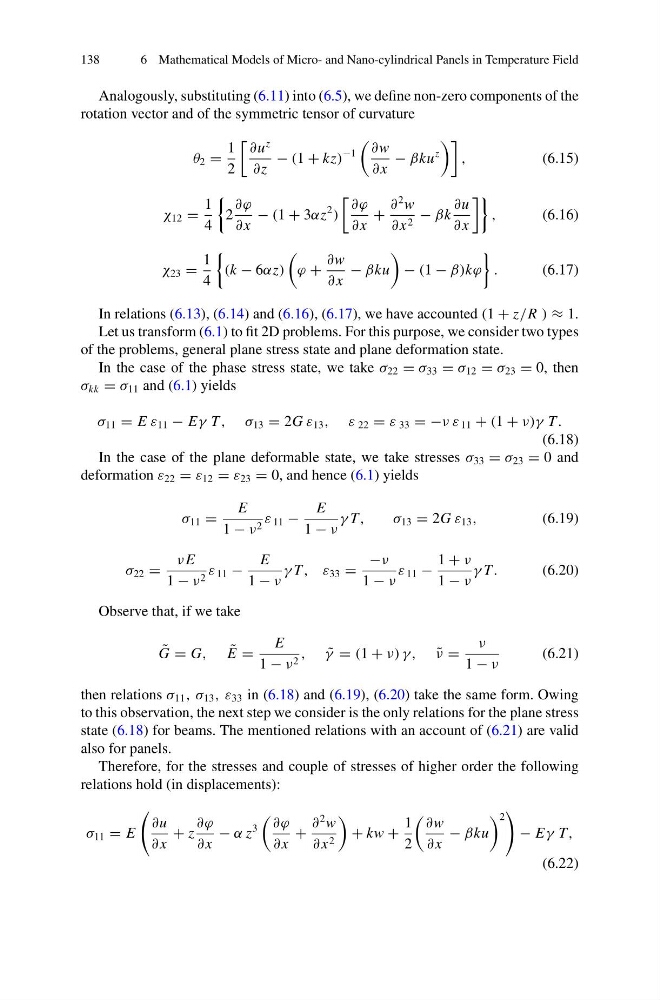
Analogously, substituting (6.11) into (6.5), we define non-zero components of the
rotation vector and of the symmetric tensor of curvature
θ 2 =
1
2
∂u
z
∂z
− (1 + kz)
−1
∂w
∂ x
− βku
z
,
(6.15)
χ 12 =
1
4
2
∂ϕ
∂ x
− (1 + 3αz
2
)
∂ϕ
∂ x
+
∂
2 w
∂ x 2 − βk
∂u
∂ x
,
(6.16)
χ 23 =
1
4
(k − 6αz)
ϕ +
∂w
∂ x
− βku
− (1 − β)kϕ
.
(6.17)
In relations (6.13), (6.14) and (6.16), (6.17), we have accounted (1 + z/R ) ≈ 1.
Let us transform (6.1) to fit 2D problems. For this purpose, we consider two types
of the problems, general plane stress state and plane deformation state.
In the case of the phase stress state, we take σ 22 = σ 33 = σ 12 = σ 23 = 0, then
σ kk = σ 11 and (6.1) yields
σ 11 = E ε 11 − Eγ T, σ 13 = 2G ε 13 , ε 22 = ε 33 = −ν ε 11 + (1 + ν)γ T.
(6.18)
In the case of the plane deformable state, we take stresses σ 33 = σ 23 = 0 and
deformation ε 22 = ε 12 = ε 23 = 0, and hence (6.1) yields
σ 11 =
E
1 − ν 2 ε 11 −
E
1 − ν
γ T,
σ 13 = 2G ε 13 ,
(6.19)
σ 22 =
ν E
1 − ν 2 ε 11 −
E
1 − ν
γ T, ε 33 =
−ν
1 − ν
ε 11 −
1 + ν
1 − ν
γ T.
(6.20)
Observe that, if we take
˜
G = G,
˜
E =
E
1 − ν 2 , ˜
γ = (1 + ν) γ, ˜
ν =
ν
1 − ν
(6.21)
then relations σ 11 , σ 13 , ε 33 in (6.18) and (6.19), (6.20) take the same form. Owing
to this observation, the next step we consider is the only relations for the plane stress
state (6.18) for beams. The mentioned relations with an account of (6.21) are valid
also for panels.
Therefore, for the stresses and couple of stresses of higher order the following
relations hold (in displacements):
σ 11 = E
∂u
∂ x
+ z
∂ϕ
∂ x
− α z
3
∂ϕ
∂ x
+
∂
2 w
∂ x 2
+ kw +
1
2
∂w
∂ x
− βku
2
− Eγ T,
(6.22)
6 Mathematical Models of Micro- and Nano-cylindrical Panels in Temperature Field
Analogously, substituting (6.11) into (6.5), we define non-zero components of the
rotation vector and of the symmetric tensor of curvature
θ 2 =
1
2
∂u
z
∂z
− (1 + kz)
−1
∂w
∂ x
− βku
z
,
(6.15)
χ 12 =
1
4
2
∂ϕ
∂ x
− (1 + 3αz
2
)
∂ϕ
∂ x
+
∂
2 w
∂ x 2 − βk
∂u
∂ x
,
(6.16)
χ 23 =
1
4
(k − 6αz)
ϕ +
∂w
∂ x
− βku
− (1 − β)kϕ
.
(6.17)
In relations (6.13), (6.14) and (6.16), (6.17), we have accounted (1 + z/R ) ≈ 1.
Let us transform (6.1) to fit 2D problems. For this purpose, we consider two types
of the problems, general plane stress state and plane deformation state.
In the case of the phase stress state, we take σ 22 = σ 33 = σ 12 = σ 23 = 0, then
σ kk = σ 11 and (6.1) yields
σ 11 = E ε 11 − Eγ T, σ 13 = 2G ε 13 , ε 22 = ε 33 = −ν ε 11 + (1 + ν)γ T.
(6.18)
In the case of the plane deformable state, we take stresses σ 33 = σ 23 = 0 and
deformation ε 22 = ε 12 = ε 23 = 0, and hence (6.1) yields
σ 11 =
E
1 − ν 2 ε 11 −
E
1 − ν
γ T,
σ 13 = 2G ε 13 ,
(6.19)
σ 22 =
ν E
1 − ν 2 ε 11 −
E
1 − ν
γ T, ε 33 =
−ν
1 − ν
ε 11 −
1 + ν
1 − ν
γ T.
(6.20)
Observe that, if we take
˜
G = G,
˜
E =
E
1 − ν 2 , ˜
γ = (1 + ν) γ, ˜
ν =
ν
1 − ν
(6.21)
then relations σ 11 , σ 13 , ε 33 in (6.18) and (6.19), (6.20) take the same form. Owing
to this observation, the next step we consider is the only relations for the plane stress
state (6.18) for beams. The mentioned relations with an account of (6.21) are valid
also for panels.
Therefore, for the stresses and couple of stresses of higher order the following
relations hold (in displacements):
σ 11 = E
∂u
∂ x
+ z
∂ϕ
∂ x
− α z
3
∂ϕ
∂ x
+
∂
2 w
∂ x 2
+ kw +
1
2
∂w
∂ x
− βku
2
− Eγ T,
(6.22)