

136
6 Mathematical Models of Micro- and Nano-cylindrical Panels in Temperature Field
is fixed by two parameters: coordinate ϑ and the length z (Fig. 6.1). Coordinate z
is positive if the point lies from the side of the centre of the negative curvature of
the middle curve. Otherwise, z is treated as negative. Observe that the 3D system of
curvilinear coordinate ϑ, y, z (Fig. 6.1) is orthogonal. Its Lamé coefficients are as
follows:
H 1 = R (1 + kz) , H 2 = 1 , H 3 = 1.
(6.6)
In what follows we define elongations and shears in the panel layer lying in
distance z from the middle surface. Assume displacement of an arbitrary point of the
equidistant surface is the following way:
u = u
z e ϑ + w e n .
(6.7)
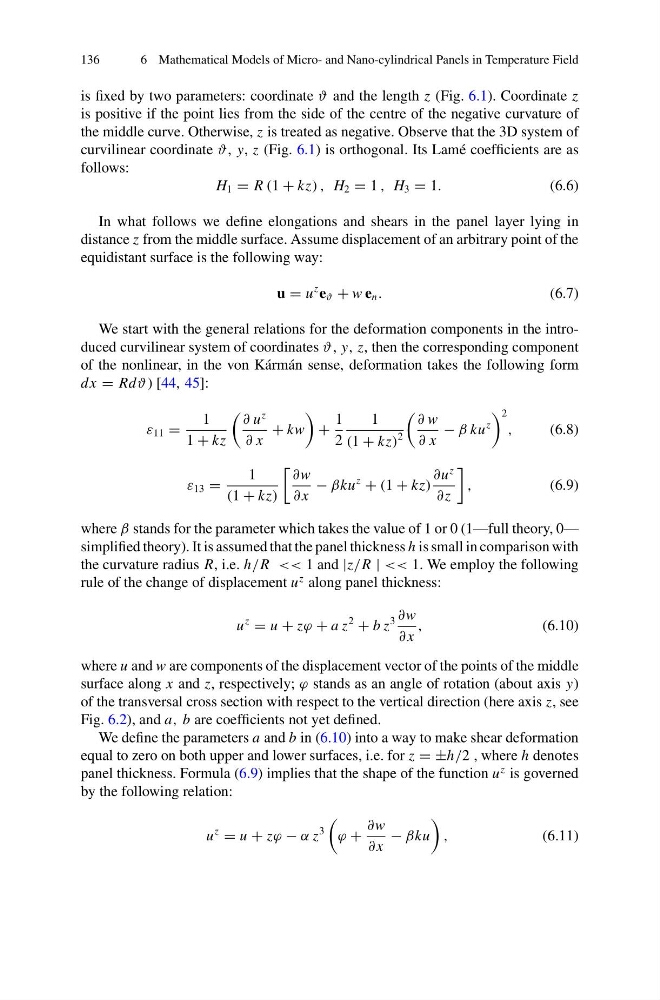
We start with the general relations for the deformation components in the introduced curvilinear system of coordinates ϑ, y, z, then the corresponding component
of the nonlinear, in the von Kármán sense, deformation takes the following form
dx = Rdϑ) [44, 45]:
ε 11 =
1
1 + kz
∂ u
z
∂ x
+ kw
+
1
2
1
(1 + kz)
2
∂ w
∂ x
− β ku
z
2
,
(6.8)
ε 13 =
1
(1 + kz)
∂w
∂ x
− βku
z
+ (1 + kz)
∂u
z
∂z
,
(6.9)
where β stands for the parameter which takes the value of 1 or 0 (1—full theory, 0—
simplified theory). It is assumed that the panel thickness h is small in comparison with
the curvature radius R, i.e. h/R << 1 and |z/R | << 1. We employ the following
rule of the change of displacement u
z along panel thickness:
u
z
= u + zϕ + a z
2
+ b z
3 ∂w
∂ x
,
(6.10)
where u and w are components of the displacement vector of the points of the middle
surface along x and z, respectively; ϕ stands as an angle of rotation (about axis y)
of the transversal cross section with respect to the vertical direction (here axis z, see
Fig. 6.2), and a, b are coefficients not yet defined.
We define the parameters a and b in (6.10) into a way to make shear deformation
equal to zero on both upper and lower surfaces, i.e. for z = ±h/2 , where h denotes
panel thickness. Formula (6.9) implies that the shape of the function u
z is governed
by the following relation:
u
z
= u + zϕ − α z
3
ϕ +
∂w
∂ x
− βku
,
(6.11)
6 Mathematical Models of Micro- and Nano-cylindrical Panels in Temperature Field
is fixed by two parameters: coordinate ϑ and the length z (Fig. 6.1). Coordinate z
is positive if the point lies from the side of the centre of the negative curvature of
the middle curve. Otherwise, z is treated as negative. Observe that the 3D system of
curvilinear coordinate ϑ, y, z (Fig. 6.1) is orthogonal. Its Lamé coefficients are as
follows:
H 1 = R (1 + kz) , H 2 = 1 , H 3 = 1.
(6.6)
In what follows we define elongations and shears in the panel layer lying in
distance z from the middle surface. Assume displacement of an arbitrary point of the
equidistant surface is the following way:
u = u
z e ϑ + w e n .
(6.7)
We start with the general relations for the deformation components in the introduced curvilinear system of coordinates ϑ, y, z, then the corresponding component
of the nonlinear, in the von Kármán sense, deformation takes the following form
dx = Rdϑ) [44, 45]:
ε 11 =
1
1 + kz
∂ u
z
∂ x
+ kw
+
1
2
1
(1 + kz)
2
∂ w
∂ x
− β ku
z
2
,
(6.8)
ε 13 =
1
(1 + kz)
∂w
∂ x
− βku
z
+ (1 + kz)
∂u
z
∂z
,
(6.9)
where β stands for the parameter which takes the value of 1 or 0 (1—full theory, 0—
simplified theory). It is assumed that the panel thickness h is small in comparison with
the curvature radius R, i.e. h/R << 1 and |z/R | << 1. We employ the following
rule of the change of displacement u
z along panel thickness:
u
z
= u + zϕ + a z
2
+ b z
3 ∂w
∂ x
,
(6.10)
where u and w are components of the displacement vector of the points of the middle
surface along x and z, respectively; ϕ stands as an angle of rotation (about axis y)
of the transversal cross section with respect to the vertical direction (here axis z, see
Fig. 6.2), and a, b are coefficients not yet defined.
We define the parameters a and b in (6.10) into a way to make shear deformation
equal to zero on both upper and lower surfaces, i.e. for z = ±h/2 , where h denotes
panel thickness. Formula (6.9) implies that the shape of the function u
z is governed
by the following relation:
u
z
= u + zϕ − α z
3
ϕ +
∂w
∂ x
− βku
,
(6.11)