

6.3 Modified Couple Stress Theory of Thermoelastic Curvilinear Panels
135
q
y
z
h
b
R
z
x
u
w
0
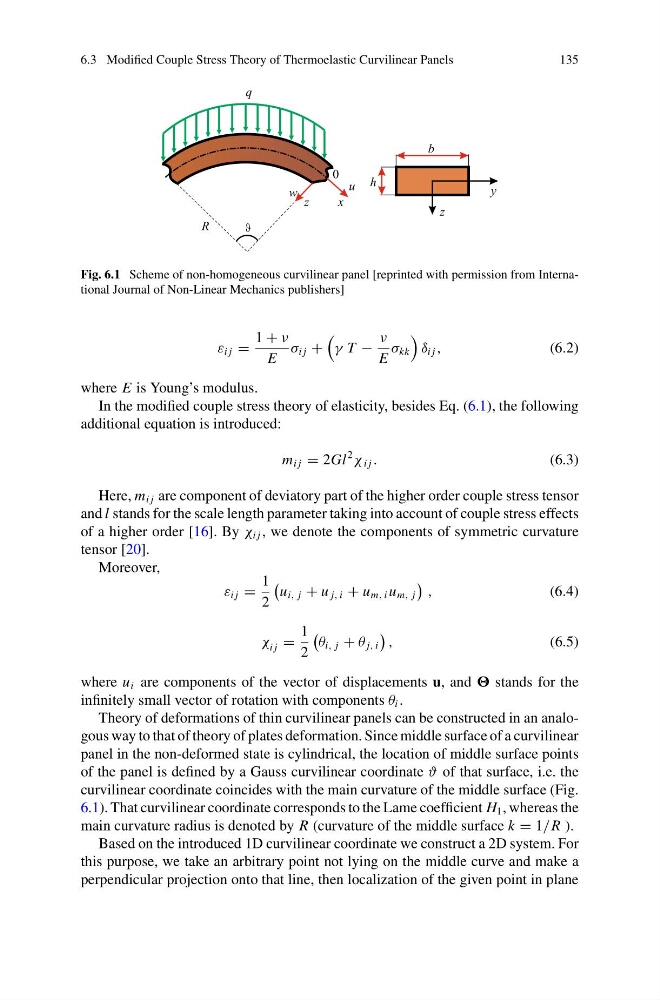
Fig. 6.1 Scheme of non-homogeneous curvilinear panel [reprinted with permission from International Journal of Non-Linear Mechanics publishers]
ε i j =
1 + ν
E
σ i j +
γ T −
ν
E
σ kk
δ i j ,
(6.2)
where E is Young’s modulus.
In the modified couple stress theory of elasticity, besides Eq. (6.1), the following
additional equation is introduced:
m i j = 2Gl
2
χ i j .
(6.3)
Here, m i j are component of deviatory part of the higher order couple stress tensor
and l stands for the scale length parameter taking into account of couple stress effects
of a higher order [16]. By χ i j , we denote the components of symmetric curvature
tensor [20].
Moreover,
ε i j =
1
2
u i, j + u j, i + u m, i u m, j
,
(6.4)
χ i j =
1
2
θ i, j + θ j, i
,
(6.5)
where u i are components of the vector of displacements u, and stands for the
infinitely small vector of rotation with components θ i .
Theory of deformations of thin curvilinear panels can be constructed in an analogous way to that of theory of plates deformation. Since middle surface of a curvilinear
panel in the non-deformed state is cylindrical, the location of middle surface points
of the panel is defined by a Gauss curvilinear coordinate ϑ of that surface, i.e. the
curvilinear coordinate coincides with the main curvature of the middle surface (Fig.
6.1). That curvilinear coordinate corresponds to the Lame coefficient H 1 , whereas the
main curvature radius is denoted by R (curvature of the middle surface k = 1/R ).
Based on the introduced 1D curvilinear coordinate we construct a 2D system. For
this purpose, we take an arbitrary point not lying on the middle curve and make a
perpendicular projection onto that line, then localization of the given point in plane
135
q
y
z
h
b
R
z
x
u
w
0
Fig. 6.1 Scheme of non-homogeneous curvilinear panel [reprinted with permission from International Journal of Non-Linear Mechanics publishers]
ε i j =
1 + ν
E
σ i j +
γ T −
ν
E
σ kk
δ i j ,
(6.2)
where E is Young’s modulus.
In the modified couple stress theory of elasticity, besides Eq. (6.1), the following
additional equation is introduced:
m i j = 2Gl
2
χ i j .
(6.3)
Here, m i j are component of deviatory part of the higher order couple stress tensor
and l stands for the scale length parameter taking into account of couple stress effects
of a higher order [16]. By χ i j , we denote the components of symmetric curvature
tensor [20].
Moreover,
ε i j =
1
2
u i, j + u j, i + u m, i u m, j
,
(6.4)
χ i j =
1
2
θ i, j + θ j, i
,
(6.5)
where u i are components of the vector of displacements u, and stands for the
infinitely small vector of rotation with components θ i .
Theory of deformations of thin curvilinear panels can be constructed in an analogous way to that of theory of plates deformation. Since middle surface of a curvilinear
panel in the non-deformed state is cylindrical, the location of middle surface points
of the panel is defined by a Gauss curvilinear coordinate ϑ of that surface, i.e. the
curvilinear coordinate coincides with the main curvature of the middle surface (Fig.
6.1). That curvilinear coordinate corresponds to the Lame coefficient H 1 , whereas the
main curvature radius is denoted by R (curvature of the middle surface k = 1/R ).
Based on the introduced 1D curvilinear coordinate we construct a 2D system. For
this purpose, we take an arbitrary point not lying on the middle curve and make a
perpendicular projection onto that line, then localization of the given point in plane