

134
6 Mathematical Models of Micro- and Nano-cylindrical Panels in Temperature Field
lems of statics and dynamics, in particular, problems related to chaos have not been
analysed.
This stands as motivation for us to study more deeply nonlinear deformations of
the size-dependent beams under static and dynamic loads. In order to study dynamics of the size-dependent beams, there is a must to employ apparatus of nonlinear
dynamics based on the Fourier and wavelet spectra, phase portraits, Poincré maps,
LLEs, autocorrelations function, etc. That apparatus has been earlier applied to investigate nonlinear dynamics of structural members including beams, plates and shells
[33–39]. The types of nonlinearities have been considered physical, geometric and
design (contact interaction in time). However, the results have been obtained based
on the classical theory of elasticity, without account of the size-dependent, behaviour
of the nano/microconstructions, and the construction material has been assumed to
be homogeneous.
This chapter is devoted to successive presentation of the fundamental steps of
theory of elastic curvilinear beams and cylindrical panels on the basis of the model
of third order (SP) which account of material gradients in two directions, the thermal
dependence of the material properties, and the modified theory of couple stresses
and nonlinear von Kármán-type deformations. In particular, we extend the modified
couple stress theory [40] into the case of functionally gradient cylindrical panels [41]
with the use of the third-order approximations and von Karman nonlinearity. The
governing PDEs are yielded by the Hamilton principle [40]. Since the majority of
nanosized devices include beam-like elements which can be functionally gradient and
exhibit rotations, then the Sheremetev–Pelekh theory further extended by LevinsonReddy can be used to explain the size-dependent effects for the functionally gradient
curvilinear microbeams and micropanels.
6.3 Modified Couple Stress Theory of Thermoelastic
Curvilinear Panels Based on the Third-Order
Sheremetev–Pelekh, Timoshenko and Bernoulli–Euler
Hypotheses
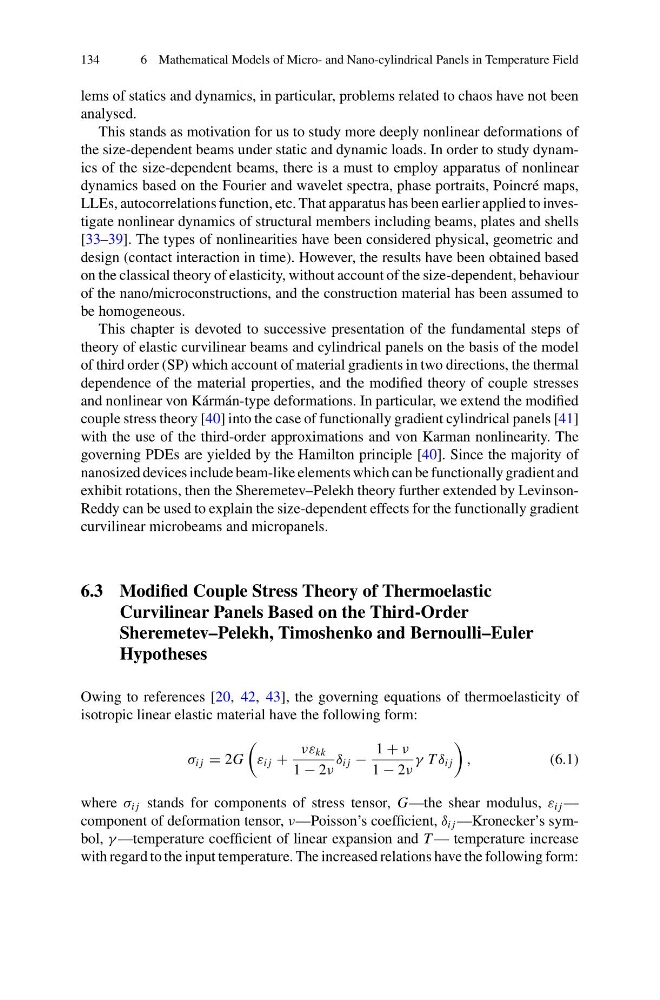
Owing to references [20, 42, 43], the governing equations of thermoelasticity of
isotropic linear elastic material have the following form:
σ i j = 2G
ε i j +
νε kk
1 − 2ν
δ i j −
1 + ν
1 − 2ν
γ T δ i j
,
(6.1)
where σ i j stands for components of stress tensor, G—the shear modulus, ε i j —
component of deformation tensor, ν—Poisson’s coefficient, δ i j —Kronecker’s symbol, γ —temperature coefficient of linear expansion and T — temperature increase
with regard to the input temperature. The increased relations have the following form:
6 Mathematical Models of Micro- and Nano-cylindrical Panels in Temperature Field
lems of statics and dynamics, in particular, problems related to chaos have not been
analysed.
This stands as motivation for us to study more deeply nonlinear deformations of
the size-dependent beams under static and dynamic loads. In order to study dynamics of the size-dependent beams, there is a must to employ apparatus of nonlinear
dynamics based on the Fourier and wavelet spectra, phase portraits, Poincré maps,
LLEs, autocorrelations function, etc. That apparatus has been earlier applied to investigate nonlinear dynamics of structural members including beams, plates and shells
[33–39]. The types of nonlinearities have been considered physical, geometric and
design (contact interaction in time). However, the results have been obtained based
on the classical theory of elasticity, without account of the size-dependent, behaviour
of the nano/microconstructions, and the construction material has been assumed to
be homogeneous.
This chapter is devoted to successive presentation of the fundamental steps of
theory of elastic curvilinear beams and cylindrical panels on the basis of the model
of third order (SP) which account of material gradients in two directions, the thermal
dependence of the material properties, and the modified theory of couple stresses
and nonlinear von Kármán-type deformations. In particular, we extend the modified
couple stress theory [40] into the case of functionally gradient cylindrical panels [41]
with the use of the third-order approximations and von Karman nonlinearity. The
governing PDEs are yielded by the Hamilton principle [40]. Since the majority of
nanosized devices include beam-like elements which can be functionally gradient and
exhibit rotations, then the Sheremetev–Pelekh theory further extended by LevinsonReddy can be used to explain the size-dependent effects for the functionally gradient
curvilinear microbeams and micropanels.
6.3 Modified Couple Stress Theory of Thermoelastic
Curvilinear Panels Based on the Third-Order
Sheremetev–Pelekh, Timoshenko and Bernoulli–Euler
Hypotheses
Owing to references [20, 42, 43], the governing equations of thermoelasticity of
isotropic linear elastic material have the following form:
σ i j = 2G
ε i j +
νε kk
1 − 2ν
δ i j −
1 + ν
1 − 2ν
γ T δ i j
,
(6.1)
where σ i j stands for components of stress tensor, G—the shear modulus, ε i j —
component of deformation tensor, ν—Poisson’s coefficient, δ i j —Kronecker’s symbol, γ —temperature coefficient of linear expansion and T — temperature increase
with regard to the input temperature. The increased relations have the following form: