

98
4 Reliability of Chaotic Vibrations of Euler-Bernoulli Beams with Clearance
In order to construct the mathematical model of contact interaction of two beams,
we introduce the following assumptions and hypotheses:
(i) each beam is composed of one layer;
(ii) the beams are isotropic, elastic and obey Hook’s law;
(iii) the longitudinal dimensions of beams are larger than their transverse dimensions and the beams have the unit thickness;
(iv) the axis of each of the beams is a straight line;
(v) the load acts in the direction of the O Z axis and the external forces do not
change their direction during the beam deformation;
(vi) contact pressure is estimated within the Kantor model [22];
(vii) normal stresses regarding the zones being parallel to the axis are small and
negligible;
(viii) geometric nonlinearity is taken in the von Kármán form [28].
In order to model the contact interaction of the beam within Kantor model, we
introduce the term (−1)
i K (w 1 − w 2 − h k )) into the equation governing the beams
vibrations. In the above term, “i” stands for the beam number and the function
is defined by the formula =
1
2
[1 + sign(w 1 − h k − w 2 )], i.e. if = 1, then the
beams are in contact w 1 > w 2 + h k , otherwise, there is no contact between beams
[22]. The coefficient K describes the beam transverse stiffness in a contact zone,
whereas h k represents the clearance between beams (see Fig. 4.1).
In order to keep clarity, in the further parts of the paper, by “beam 1”, we understand
the external beam loaded, whereas “beam 2” stands for the unloaded beam.
Equations of motion of beams with the account of hypotheses of the first order as
well as boundary and initial conditions are yielded from Hamilton energetic principle.
It should be noted that neglecting of von Kármán geometric nonlinearity does
not reduce the investigated problem to the linear one, since the design nonlinearity
implied by contact of two beams is also taken into account. We consider a small
clearance between beams, i.e. contact of beams occurs even for small deformations
of the beam 1, and the vibrations can be treated as linear only for w 1 ≤ 0.25. One of
our aims is to verify if the geometric nonlinearity needs to be taken into account due
to small amplitudes of vibrations.
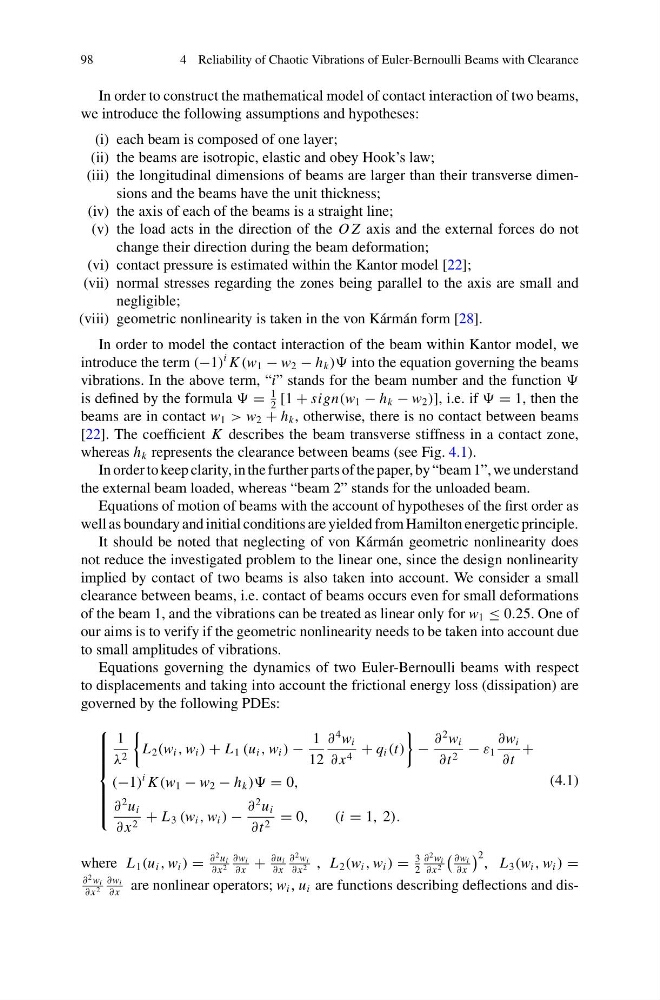
Equations governing the dynamics of two Euler-Bernoulli beams with respect
to displacements and taking into account the frictional energy loss (dissipation) are
governed by the following PDEs:
⎧
⎪ ⎪ ⎪ ⎪ ⎪ ⎨
⎪ ⎪ ⎪ ⎪ ⎪ ⎩
1
λ 2
L 2 (w i , w i ) + L 1 (u i , w i ) −
1
12
∂
4 w i
∂ x 4 + q i (t)
−
∂
2 w i
∂t 2 − ε 1
∂w i
∂t
+
(−1)
i K (w 1 − w 2 − h k )) = 0,
∂
2 u i
∂ x 2 + L 3 (w i , w i ) −
∂
2 u i
∂t 2 = 0,
(i = 1, 2).
(4.1)
where L 1 (u i , w i ) =
∂
2 u i
∂ x 2
∂w i
∂ x
+
∂u i
∂ x
∂
2 w i
∂ x 2 , L 2 (w i , w i ) =
3
2
∂
2 w i
∂ x 2
∂w i
∂ x
2 , L 3 (w i , w i ) =
∂
2 w i
∂ x 2
∂w i
∂ x
are nonlinear operators; w i , u i are functions describing deflections and dis-
4 Reliability of Chaotic Vibrations of Euler-Bernoulli Beams with Clearance
In order to construct the mathematical model of contact interaction of two beams,
we introduce the following assumptions and hypotheses:
(i) each beam is composed of one layer;
(ii) the beams are isotropic, elastic and obey Hook’s law;
(iii) the longitudinal dimensions of beams are larger than their transverse dimensions and the beams have the unit thickness;
(iv) the axis of each of the beams is a straight line;
(v) the load acts in the direction of the O Z axis and the external forces do not
change their direction during the beam deformation;
(vi) contact pressure is estimated within the Kantor model [22];
(vii) normal stresses regarding the zones being parallel to the axis are small and
negligible;
(viii) geometric nonlinearity is taken in the von Kármán form [28].
In order to model the contact interaction of the beam within Kantor model, we
introduce the term (−1)
i K (w 1 − w 2 − h k )) into the equation governing the beams
vibrations. In the above term, “i” stands for the beam number and the function
is defined by the formula =
1
2
[1 + sign(w 1 − h k − w 2 )], i.e. if = 1, then the
beams are in contact w 1 > w 2 + h k , otherwise, there is no contact between beams
[22]. The coefficient K describes the beam transverse stiffness in a contact zone,
whereas h k represents the clearance between beams (see Fig. 4.1).
In order to keep clarity, in the further parts of the paper, by “beam 1”, we understand
the external beam loaded, whereas “beam 2” stands for the unloaded beam.
Equations of motion of beams with the account of hypotheses of the first order as
well as boundary and initial conditions are yielded from Hamilton energetic principle.
It should be noted that neglecting of von Kármán geometric nonlinearity does
not reduce the investigated problem to the linear one, since the design nonlinearity
implied by contact of two beams is also taken into account. We consider a small
clearance between beams, i.e. contact of beams occurs even for small deformations
of the beam 1, and the vibrations can be treated as linear only for w 1 ≤ 0.25. One of
our aims is to verify if the geometric nonlinearity needs to be taken into account due
to small amplitudes of vibrations.
Equations governing the dynamics of two Euler-Bernoulli beams with respect
to displacements and taking into account the frictional energy loss (dissipation) are
governed by the following PDEs:
⎧
⎪ ⎪ ⎪ ⎪ ⎪ ⎨
⎪ ⎪ ⎪ ⎪ ⎪ ⎩
1
λ 2
L 2 (w i , w i ) + L 1 (u i , w i ) −
1
12
∂
4 w i
∂ x 4 + q i (t)
−
∂
2 w i
∂t 2 − ε 1
∂w i
∂t
+
(−1)
i K (w 1 − w 2 − h k )) = 0,
∂
2 u i
∂ x 2 + L 3 (w i , w i ) −
∂
2 u i
∂t 2 = 0,
(i = 1, 2).
(4.1)
where L 1 (u i , w i ) =
∂
2 u i
∂ x 2
∂w i
∂ x
+
∂u i
∂ x
∂
2 w i
∂ x 2 , L 2 (w i , w i ) =
3
2
∂
2 w i
∂ x 2
∂w i
∂ x
2 , L 3 (w i , w i ) =
∂
2 w i
∂ x 2
∂w i
∂ x
are nonlinear operators; w i , u i are functions describing deflections and dis-