

4.3 Mathematical Model
97
4. Since we would like to use chaos definition given by Gulick [6], we need to compute and estimate the sign of the spectrum of Lyapunov exponents. In this work,
the spectrum of Lyapunov exponents for all beam partitions has been estimated
using three methods based on Kantz [19], Wolf [20] and Rosenstein et al. [21]
algorithms. The final choice was made after obtaining a four-digit accuracy.
As it has been already mentioned, this paper is focused on the nonlinear dynamics
and the contact interaction of two beams with a small clearance, for the case when
one of the beams (beam 1) is subjected to the action of the transverse harmonic
load, causing movement of the second beam. The contact interaction between beams
follows Kantor and Bohatyrenko model [22].
In the literature, one can find numerous works devoted to the investigation of
beams, plates and shells in the frame of Euler-Bernoulli [23] and Kirchhoff-Love
[24, 25] models. The review of the state of the art in this field has been given by Alijani and Amabili [26]. In the majority of considered cases, the solutions were found
using simple models including a few degrees of freedom and eventually yielded
unreliable results [27]. This has been pointed out in the recent monograph [7], where
the problem of chaotic vibrations of beams, plates and shells has been studied treating the mentioned structural members as those of an infinite number of degrees of
freedom.
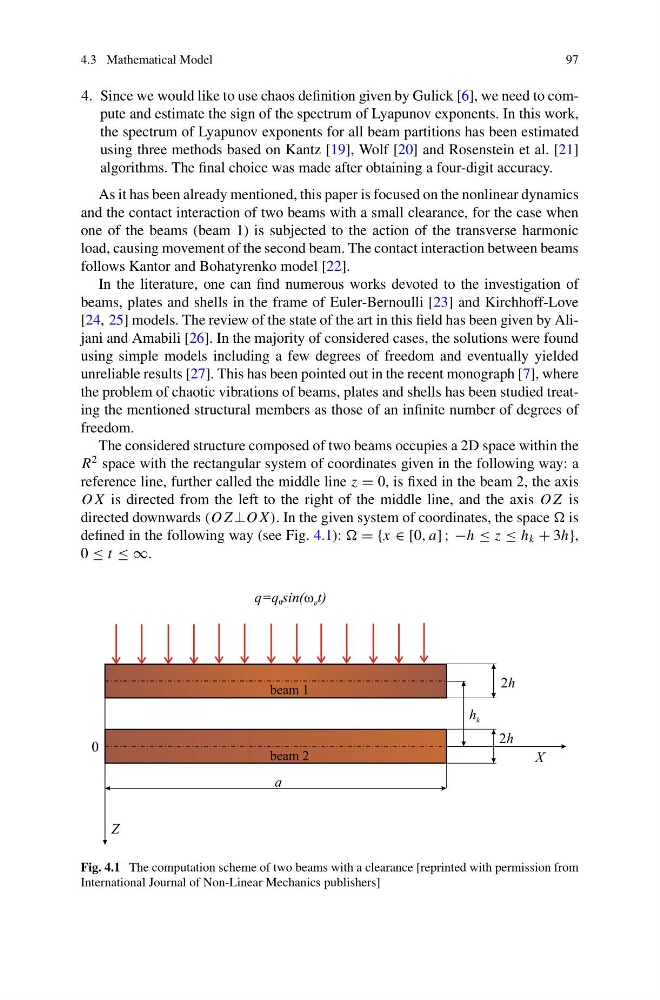
The considered structure composed of two beams occupies a 2D space within the
R
2 space with the rectangular system of coordinates given in the following way: a
reference line, further called the middle line z = 0, is fixed in the beam 2, the axis
O X is directed from the left to the right of the middle line, and the axis O Z is
directed downwards (O Z⊥O X). In the given system of coordinates, the space is
defined in the following way (see Fig. 4.1): = {x ∈ [0, a] ; −h ≤ z ≤ h k + 3h},
0 ≤ t ≤ ∞.
q=q sin( t)
0
p
2h
2h
h k
Z
X
beam 1
beam 2
a
0
Fig. 4.1 The computation scheme of two beams with a clearance [reprinted with permission from
International Journal of Non-Linear Mechanics publishers]
97
4. Since we would like to use chaos definition given by Gulick [6], we need to compute and estimate the sign of the spectrum of Lyapunov exponents. In this work,
the spectrum of Lyapunov exponents for all beam partitions has been estimated
using three methods based on Kantz [19], Wolf [20] and Rosenstein et al. [21]
algorithms. The final choice was made after obtaining a four-digit accuracy.
As it has been already mentioned, this paper is focused on the nonlinear dynamics
and the contact interaction of two beams with a small clearance, for the case when
one of the beams (beam 1) is subjected to the action of the transverse harmonic
load, causing movement of the second beam. The contact interaction between beams
follows Kantor and Bohatyrenko model [22].
In the literature, one can find numerous works devoted to the investigation of
beams, plates and shells in the frame of Euler-Bernoulli [23] and Kirchhoff-Love
[24, 25] models. The review of the state of the art in this field has been given by Alijani and Amabili [26]. In the majority of considered cases, the solutions were found
using simple models including a few degrees of freedom and eventually yielded
unreliable results [27]. This has been pointed out in the recent monograph [7], where
the problem of chaotic vibrations of beams, plates and shells has been studied treating the mentioned structural members as those of an infinite number of degrees of
freedom.
The considered structure composed of two beams occupies a 2D space within the
R
2 space with the rectangular system of coordinates given in the following way: a
reference line, further called the middle line z = 0, is fixed in the beam 2, the axis
O X is directed from the left to the right of the middle line, and the axis O Z is
directed downwards (O Z⊥O X). In the given system of coordinates, the space is
defined in the following way (see Fig. 4.1): = {x ∈ [0, a] ; −h ≤ z ≤ h k + 3h},
0 ≤ t ≤ ∞.
q=q sin( t)
0
p
2h
2h
h k
Z
X
beam 1
beam 2
a
0
Fig. 4.1 The computation scheme of two beams with a clearance [reprinted with permission from
International Journal of Non-Linear Mechanics publishers]