

4.3 Mathematical Model
99
placements of the upper and the lower beam, respectively; K stands for the coefficient
of transverse stiffness of the contact zone, and h k is the clearance between the beams.
We need to supplement the Eq. (4.1) by the boundary and initial conditions. Furthermore, in the case when the geometric nonlinearity is neglected, we need to take
L 1 = 0, L 2 = 0 , L 3 = 0.
The system of governing PDEs supplemented by boundary and initial conditions
is reduced to the counterpart dimensionless form using the following variables:
¯
w =
w
2h
, ¯
u =
ua
(2h)
2
, ¯
x =
x
a
, λ =
a
(2h)
, ¯
q = q
a
4
(1 − ν
2
)
(2h)
4 E
,
¯
t =
t
τ
, τ =
a
c
, c =
Eg
(1 − ν 2 )ρ
, ¯
ε 1 = ε 1
a
c
,
(4.2)
where E—Young’s modulus; g—gravity of Earth; ν—Poisson’s ratio; —density
of the beam material.
The system of nonlinear PDEs is reduced to the one of nonlinear ODEs by means
of the FDM of the second-order approximation O(c
2
), where c is a step regarding
the spatial coordinate.
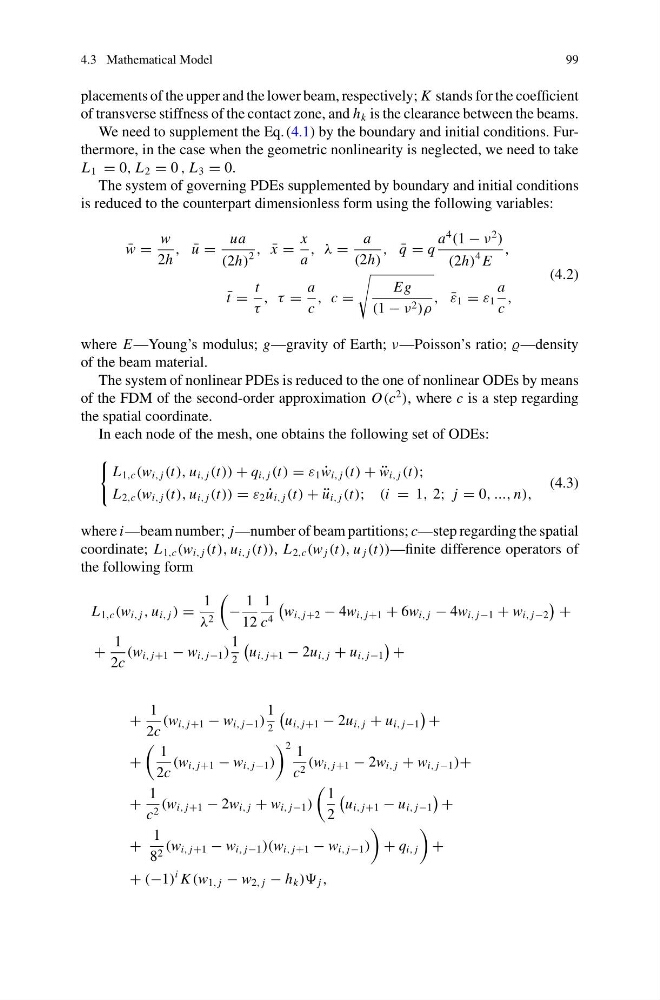
In each node of the mesh, one obtains the following set of ODEs:
L 1,c (w i, j (t), u i, j (t)) + q i, j (t) = ε 1 ˙
w i, j (t) + ¨
w i, j (t);
L 2,c (w i, j (t), u i, j (t)) = ε 2 ˙
u i, j (t) + ¨
u i, j (t); (i = 1, 2; j = 0, ..., n),
(4.3)
where i—beam number; j—number of beam partitions; c—step regarding the spatial
coordinate; L 1,c (w i, j (t), u i, j (t)), L 2,c (w j (t), u j (t))—finite difference operators of
the following form
L 1,c (w i, j , u i, j ) =
1
λ 2
−
1
12
1
c 4
w i, j+2 − 4w i, j+1 + 6w i, j − 4w i, j−1 + w i, j−2
+
+
1
2c
(w i, j+1 − w i, j−1 )
1
2
u i, j+1 − 2u i, j + u i, j−1
+
+
1
2c
(w i, j+1 − w i, j−1 )
1
2
u i, j+1 − 2u i, j + u i, j−1
+
+
1
2c
(w i, j+1 − w i, j−1 )
2 1
c 2 (w i, j+1 − 2w i, j + w i, j−1 )+
+
1
c 2 (w i, j+1 − 2w i, j + w i, j−1 )
1
2
u i, j+1 − u i, j−1
+
+
1
8 2 (w i, j+1 − w i, j−1 )(w i, j+1 − w i, j−1 )
+ q i, j
+
+ (−1)
i K (w 1, j − w 2, j − h k )) j ,
99
placements of the upper and the lower beam, respectively; K stands for the coefficient
of transverse stiffness of the contact zone, and h k is the clearance between the beams.
We need to supplement the Eq. (4.1) by the boundary and initial conditions. Furthermore, in the case when the geometric nonlinearity is neglected, we need to take
L 1 = 0, L 2 = 0 , L 3 = 0.
The system of governing PDEs supplemented by boundary and initial conditions
is reduced to the counterpart dimensionless form using the following variables:
¯
w =
w
2h
, ¯
u =
ua
(2h)
2
, ¯
x =
x
a
, λ =
a
(2h)
, ¯
q = q
a
4
(1 − ν
2
)
(2h)
4 E
,
¯
t =
t
τ
, τ =
a
c
, c =
Eg
(1 − ν 2 )ρ
, ¯
ε 1 = ε 1
a
c
,
(4.2)
where E—Young’s modulus; g—gravity of Earth; ν—Poisson’s ratio; —density
of the beam material.
The system of nonlinear PDEs is reduced to the one of nonlinear ODEs by means
of the FDM of the second-order approximation O(c
2
), where c is a step regarding
the spatial coordinate.
In each node of the mesh, one obtains the following set of ODEs:
L 1,c (w i, j (t), u i, j (t)) + q i, j (t) = ε 1 ˙
w i, j (t) + ¨
w i, j (t);
L 2,c (w i, j (t), u i, j (t)) = ε 2 ˙
u i, j (t) + ¨
u i, j (t); (i = 1, 2; j = 0, ..., n),
(4.3)
where i—beam number; j—number of beam partitions; c—step regarding the spatial
coordinate; L 1,c (w i, j (t), u i, j (t)), L 2,c (w j (t), u j (t))—finite difference operators of
the following form
L 1,c (w i, j , u i, j ) =
1
λ 2
−
1
12
1
c 4
w i, j+2 − 4w i, j+1 + 6w i, j − 4w i, j−1 + w i, j−2
+
+
1
2c
(w i, j+1 − w i, j−1 )
1
2
u i, j+1 − 2u i, j + u i, j−1
+
+
1
2c
(w i, j+1 − w i, j−1 )
1
2
u i, j+1 − 2u i, j + u i, j−1
+
+
1
2c
(w i, j+1 − w i, j−1 )
2 1
c 2 (w i, j+1 − 2w i, j + w i, j−1 )+
+
1
c 2 (w i, j+1 − 2w i, j + w i, j−1 )
1
2
u i, j+1 − u i, j−1
+
+
1
8 2 (w i, j+1 − w i, j−1 )(w i, j+1 − w i, j−1 )
+ q i, j
+
+ (−1)
i K (w 1, j − w 2, j − h k )) j ,