

392
D. M. Harwani et al.
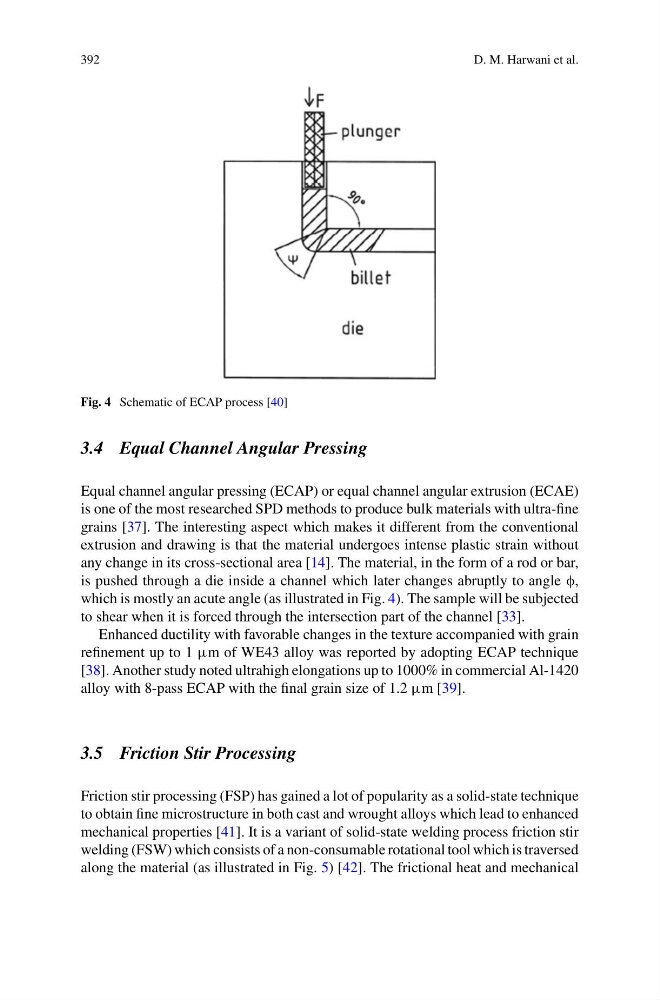
Fig. 4 Schematic of ECAP process [40]
3.4 Equal Channel Angular Pressing
Equal channel angular pressing (ECAP) or equal channel angular extrusion (ECAE)
is one of the most researched SPD methods to produce bulk materials with ultra-fine
grains [37]. The interesting aspect which makes it different from the conventional
extrusion and drawing is that the material undergoes intense plastic strain without
any change in its cross-sectional area [14]. The material, in the form of a rod or bar,
is pushed through a die inside a channel which later changes abruptly to angle φ,
which is mostly an acute angle (as illustrated in Fig. 4). The sample will be subjected
to shear when it is forced through the intersection part of the channel [33].
Enhanced ductility with favorable changes in the texture accompanied with grain
refinement up to 1 μm of WE43 alloy was reported by adopting ECAP technique
[38]. Another study noted ultrahigh elongations up to 1000% in commercial Al-1420
alloy with 8-pass ECAP with the final grain size of 1.2 μm [39].
3.5 Friction Stir Processing
Friction stir processing (FSP) has gained a lot of popularity as a solid-state technique
to obtain fine microstructure in both cast and wrought alloys which lead to enhanced
mechanical properties [41]. It is a variant of solid-state welding process friction stir
welding (FSW) which consists of a non-consumable rotational tool which is traversed
along the material (as illustrated in Fig. 5) [42]. The frictional heat and mechanical
D. M. Harwani et al.
Fig. 4 Schematic of ECAP process [40]
3.4 Equal Channel Angular Pressing
Equal channel angular pressing (ECAP) or equal channel angular extrusion (ECAE)
is one of the most researched SPD methods to produce bulk materials with ultra-fine
grains [37]. The interesting aspect which makes it different from the conventional
extrusion and drawing is that the material undergoes intense plastic strain without
any change in its cross-sectional area [14]. The material, in the form of a rod or bar,
is pushed through a die inside a channel which later changes abruptly to angle φ,
which is mostly an acute angle (as illustrated in Fig. 4). The sample will be subjected
to shear when it is forced through the intersection part of the channel [33].
Enhanced ductility with favorable changes in the texture accompanied with grain
refinement up to 1 μm of WE43 alloy was reported by adopting ECAP technique
[38]. Another study noted ultrahigh elongations up to 1000% in commercial Al-1420
alloy with 8-pass ECAP with the final grain size of 1.2 μm [39].
3.5 Friction Stir Processing
Friction stir processing (FSP) has gained a lot of popularity as a solid-state technique
to obtain fine microstructure in both cast and wrought alloys which lead to enhanced
mechanical properties [41]. It is a variant of solid-state welding process friction stir
welding (FSW) which consists of a non-consumable rotational tool which is traversed
along the material (as illustrated in Fig. 5) [42]. The frictional heat and mechanical