

Superplasticity: Recent Approaches and Trends
391
ductility with excellent strength was obtained by MAF in a Fe 3 Al-based intermetallic
alloy with average grain size of 2–3 μm after 40 passes when it was heated to 600 °C
[30].
3.3 Accumulated Roll Bonding
Accumulated roll bonding (ARB) is another SPD technique which is a unique combination of rolling and bonding processes. It was invented by N. Tsuji et al. to overcome
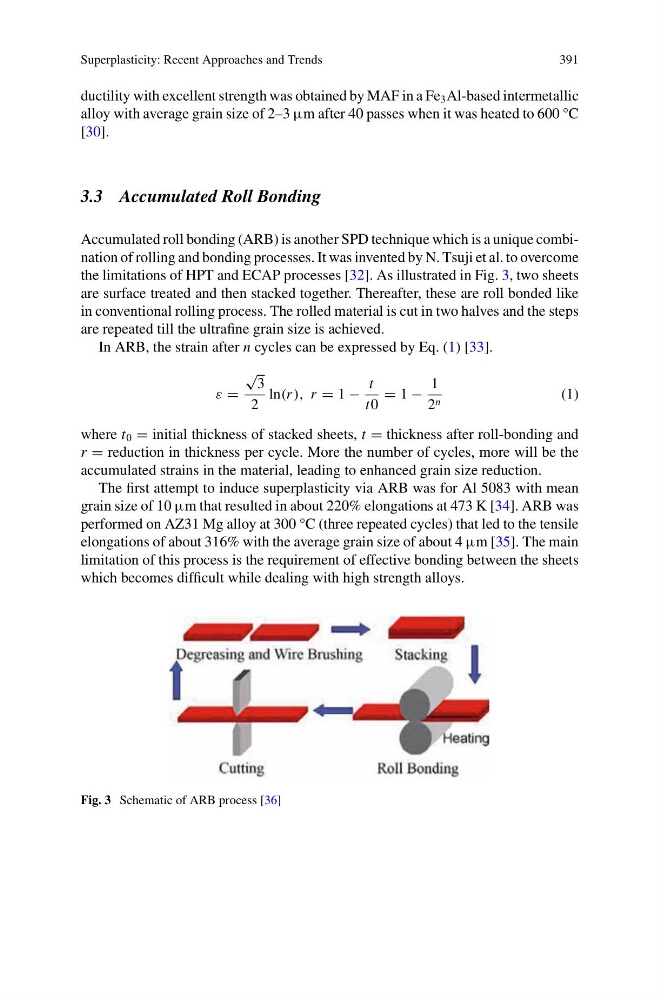
the limitations of HPT and ECAP processes [32]. As illustrated in Fig. 3, two sheets
are surface treated and then stacked together. Thereafter, these are roll bonded like
in conventional rolling process. The rolled material is cut in two halves and the steps
are repeated till the ultrafine grain size is achieved.
In ARB, the strain after n cycles can be expressed by Eq. (1) [33].
ε =
√
3
2
ln(r ), r = 1 −
t
t0
= 1 −
1
2 n
(1)
where t 0 = initial thickness of stacked sheets, t = thickness after roll-bonding and
r = reduction in thickness per cycle. More the number of cycles, more will be the
accumulated strains in the material, leading to enhanced grain size reduction.
The first attempt to induce superplasticity via ARB was for Al 5083 with mean
grain size of 10 μm that resulted in about 220% elongations at 473 K [34]. ARB was
performed on AZ31 Mg alloy at 300 °C (three repeated cycles) that led to the tensile
elongations of about 316% with the average grain size of about 4 μm [35]. The main
limitation of this process is the requirement of effective bonding between the sheets
which becomes difficult while dealing with high strength alloys.
Fig. 3 Schematic of ARB process [36]
391
ductility with excellent strength was obtained by MAF in a Fe 3 Al-based intermetallic
alloy with average grain size of 2–3 μm after 40 passes when it was heated to 600 °C
[30].
3.3 Accumulated Roll Bonding
Accumulated roll bonding (ARB) is another SPD technique which is a unique combination of rolling and bonding processes. It was invented by N. Tsuji et al. to overcome
the limitations of HPT and ECAP processes [32]. As illustrated in Fig. 3, two sheets
are surface treated and then stacked together. Thereafter, these are roll bonded like
in conventional rolling process. The rolled material is cut in two halves and the steps
are repeated till the ultrafine grain size is achieved.
In ARB, the strain after n cycles can be expressed by Eq. (1) [33].
ε =
√
3
2
ln(r ), r = 1 −
t
t0
= 1 −
1
2 n
(1)
where t 0 = initial thickness of stacked sheets, t = thickness after roll-bonding and
r = reduction in thickness per cycle. More the number of cycles, more will be the
accumulated strains in the material, leading to enhanced grain size reduction.
The first attempt to induce superplasticity via ARB was for Al 5083 with mean
grain size of 10 μm that resulted in about 220% elongations at 473 K [34]. ARB was
performed on AZ31 Mg alloy at 300 °C (three repeated cycles) that led to the tensile
elongations of about 316% with the average grain size of about 4 μm [35]. The main
limitation of this process is the requirement of effective bonding between the sheets
which becomes difficult while dealing with high strength alloys.
Fig. 3 Schematic of ARB process [36]