

390
D. M. Harwani et al.
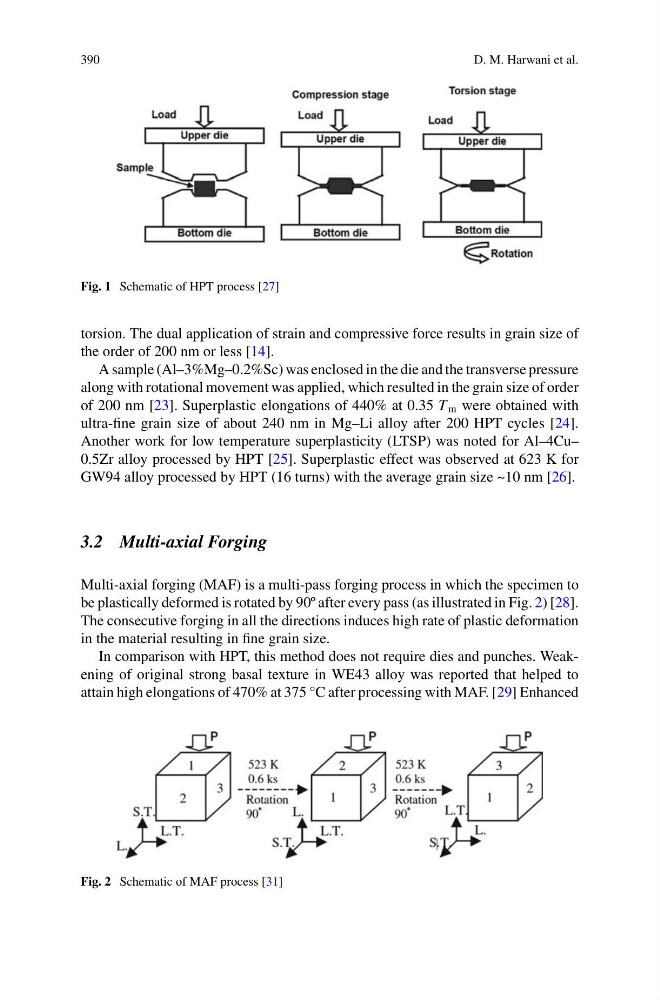
Fig. 1 Schematic of HPT process [27]
torsion. The dual application of strain and compressive force results in grain size of
the order of 200 nm or less [14].
A sample (Al–3%Mg–0.2%Sc) was enclosed in the die and the transverse pressure
along with rotational movement was applied, which resulted in the grain size of order
of 200 nm [23]. Superplastic elongations of 440% at 0.35 T m were obtained with
ultra-fine grain size of about 240 nm in Mg–Li alloy after 200 HPT cycles [24].
Another work for low temperature superplasticity (LTSP) was noted for Al–4Cu–
0.5Zr alloy processed by HPT [25]. Superplastic effect was observed at 623 K for
GW94 alloy processed by HPT (16 turns) with the average grain size ~10 nm [26].
3.2 Multi-axial Forging
Multi-axial forging (MAF) is a multi-pass forging process in which the specimen to
be plastically deformed is rotated by 90º after every pass (as illustrated in Fig. 2) [28].
The consecutive forging in all the directions induces high rate of plastic deformation
in the material resulting in fine grain size.
In comparison with HPT, this method does not require dies and punches. Weakening of original strong basal texture in WE43 alloy was reported that helped to
attain high elongations of 470% at 375 °C after processing with MAF. [29] Enhanced
Fig. 2 Schematic of MAF process [31]
D. M. Harwani et al.
Fig. 1 Schematic of HPT process [27]
torsion. The dual application of strain and compressive force results in grain size of
the order of 200 nm or less [14].
A sample (Al–3%Mg–0.2%Sc) was enclosed in the die and the transverse pressure
along with rotational movement was applied, which resulted in the grain size of order
of 200 nm [23]. Superplastic elongations of 440% at 0.35 T m were obtained with
ultra-fine grain size of about 240 nm in Mg–Li alloy after 200 HPT cycles [24].
Another work for low temperature superplasticity (LTSP) was noted for Al–4Cu–
0.5Zr alloy processed by HPT [25]. Superplastic effect was observed at 623 K for
GW94 alloy processed by HPT (16 turns) with the average grain size ~10 nm [26].
3.2 Multi-axial Forging
Multi-axial forging (MAF) is a multi-pass forging process in which the specimen to
be plastically deformed is rotated by 90º after every pass (as illustrated in Fig. 2) [28].
The consecutive forging in all the directions induces high rate of plastic deformation
in the material resulting in fine grain size.
In comparison with HPT, this method does not require dies and punches. Weakening of original strong basal texture in WE43 alloy was reported that helped to
attain high elongations of 470% at 375 °C after processing with MAF. [29] Enhanced
Fig. 2 Schematic of MAF process [31]