

Superplasticity: Recent Approaches and Trends
393
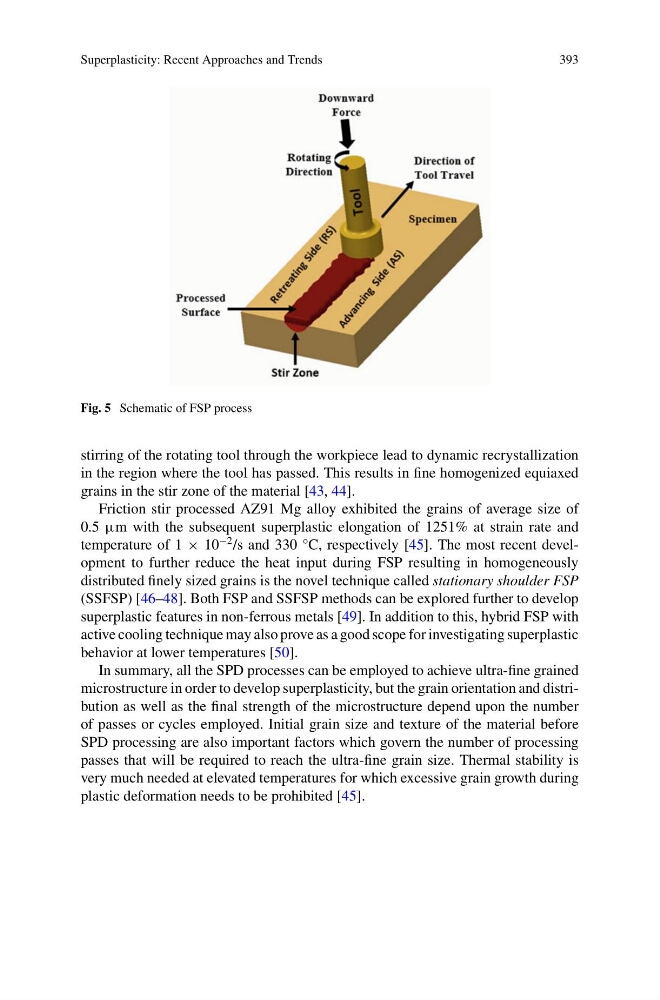
Fig. 5 Schematic of FSP process
stirring of the rotating tool through the workpiece lead to dynamic recrystallization
in the region where the tool has passed. This results in fine homogenized equiaxed
grains in the stir zone of the material [43, 44].
Friction stir processed AZ91 Mg alloy exhibited the grains of average size of
0.5 μm with the subsequent superplastic elongation of 1251% at strain rate and
temperature of 1 × 10
−2 /s and 330 °C, respectively [45]. The most recent development to further reduce the heat input during FSP resulting in homogeneously
distributed finely sized grains is the novel technique called stationary shoulder FSP
(SSFSP) [46–48]. Both FSP and SSFSP methods can be explored further to develop
superplastic features in non-ferrous metals [49]. In addition to this, hybrid FSP with
active cooling technique may also prove as a good scope for investigating superplastic
behavior at lower temperatures [50].
In summary, all the SPD processes can be employed to achieve ultra-fine grained
microstructure in order to develop superplasticity, but the grain orientation and distribution as well as the final strength of the microstructure depend upon the number
of passes or cycles employed. Initial grain size and texture of the material before
SPD processing are also important factors which govern the number of processing
passes that will be required to reach the ultra-fine grain size. Thermal stability is
very much needed at elevated temperatures for which excessive grain growth during
plastic deformation needs to be prohibited [45].
393
Fig. 5 Schematic of FSP process
stirring of the rotating tool through the workpiece lead to dynamic recrystallization
in the region where the tool has passed. This results in fine homogenized equiaxed
grains in the stir zone of the material [43, 44].
Friction stir processed AZ91 Mg alloy exhibited the grains of average size of
0.5 μm with the subsequent superplastic elongation of 1251% at strain rate and
temperature of 1 × 10
−2 /s and 330 °C, respectively [45]. The most recent development to further reduce the heat input during FSP resulting in homogeneously
distributed finely sized grains is the novel technique called stationary shoulder FSP
(SSFSP) [46–48]. Both FSP and SSFSP methods can be explored further to develop
superplastic features in non-ferrous metals [49]. In addition to this, hybrid FSP with
active cooling technique may also prove as a good scope for investigating superplastic
behavior at lower temperatures [50].
In summary, all the SPD processes can be employed to achieve ultra-fine grained
microstructure in order to develop superplasticity, but the grain orientation and distribution as well as the final strength of the microstructure depend upon the number
of passes or cycles employed. Initial grain size and texture of the material before
SPD processing are also important factors which govern the number of processing
passes that will be required to reach the ultra-fine grain size. Thermal stability is
very much needed at elevated temperatures for which excessive grain growth during
plastic deformation needs to be prohibited [45].