

380
A. Talli and A. C. Giriyapur
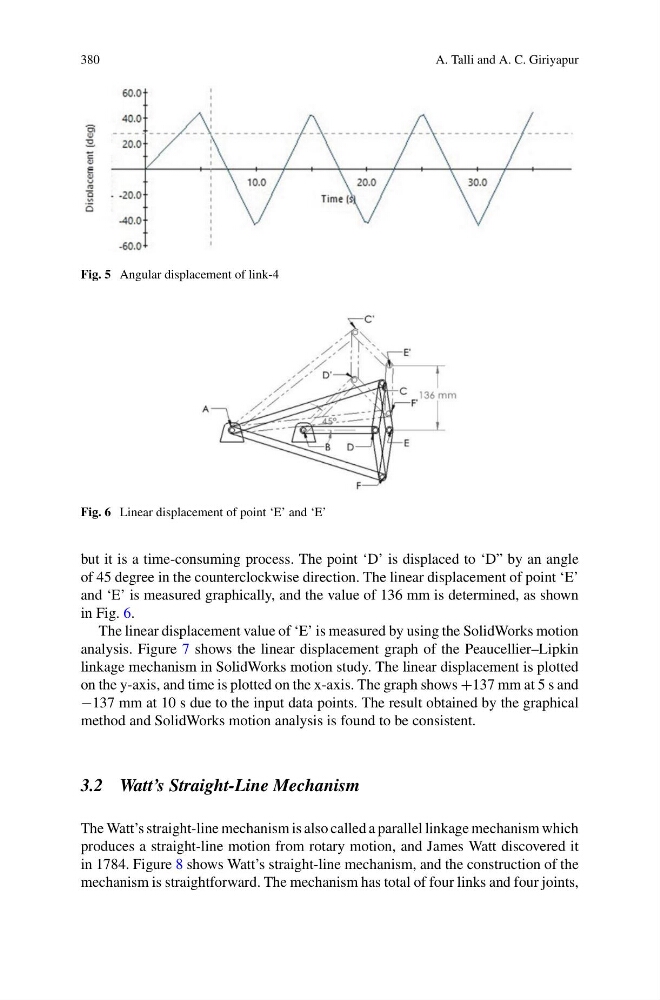
Fig. 5 Angular displacement of link-4
Fig. 6 Linear displacement of point ‘E’ and ‘E’
but it is a time-consuming process. The point ‘D’ is displaced to ‘D” by an angle
of 45 degree in the counterclockwise direction. The linear displacement of point ‘E’
and ‘E’ is measured graphically, and the value of 136 mm is determined, as shown
in Fig. 6.
The linear displacement value of ‘E’ is measured by using the SolidWorks motion
analysis. Figure 7 shows the linear displacement graph of the Peaucellier–Lipkin
linkage mechanism in SolidWorks motion study. The linear displacement is plotted
on the y-axis, and time is plotted on the x-axis. The graph shows +137 mm at 5 s and
−137 mm at 10 s due to the input data points. The result obtained by the graphical
method and SolidWorks motion analysis is found to be consistent.
3.2 Watt’s Straight-Line Mechanism
The Watt’s straight-line mechanism is also called a parallel linkage mechanism which
produces a straight-line motion from rotary motion, and James Watt discovered it
in 1784. Figure 8 shows Watt’s straight-line mechanism, and the construction of the
mechanism is straightforward. The mechanism has total of four links and four joints,
A. Talli and A. C. Giriyapur
Fig. 5 Angular displacement of link-4
Fig. 6 Linear displacement of point ‘E’ and ‘E’
but it is a time-consuming process. The point ‘D’ is displaced to ‘D” by an angle
of 45 degree in the counterclockwise direction. The linear displacement of point ‘E’
and ‘E’ is measured graphically, and the value of 136 mm is determined, as shown
in Fig. 6.
The linear displacement value of ‘E’ is measured by using the SolidWorks motion
analysis. Figure 7 shows the linear displacement graph of the Peaucellier–Lipkin
linkage mechanism in SolidWorks motion study. The linear displacement is plotted
on the y-axis, and time is plotted on the x-axis. The graph shows +137 mm at 5 s and
−137 mm at 10 s due to the input data points. The result obtained by the graphical
method and SolidWorks motion analysis is found to be consistent.
3.2 Watt’s Straight-Line Mechanism
The Watt’s straight-line mechanism is also called a parallel linkage mechanism which
produces a straight-line motion from rotary motion, and James Watt discovered it
in 1784. Figure 8 shows Watt’s straight-line mechanism, and the construction of the
mechanism is straightforward. The mechanism has total of four links and four joints,