

378
A. Talli and A. C. Giriyapur
3 Kinematic Analysis of Planar Mechanisms
3.1 Peaucellier–Lipkin Linkage
The Peaucellier–Lipkin linkage is a planar mechanism which produces a straightline motion from rotary input [9]. The planar mechanism works in a two-dimensional
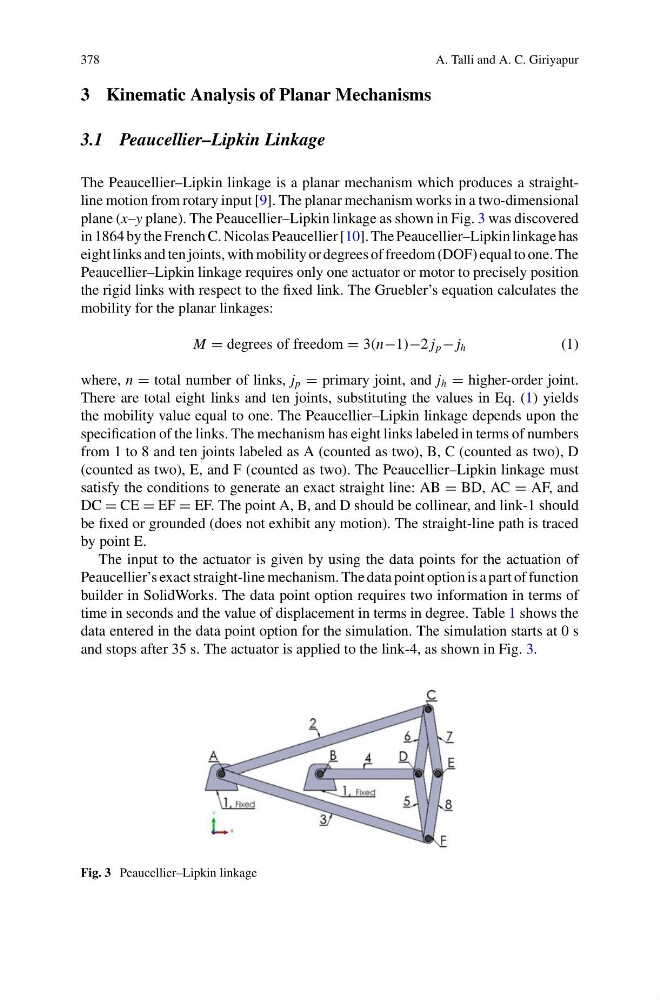
plane (x–y plane). The Peaucellier–Lipkin linkage as shown in Fig. 3 was discovered
in 1864 by the French C. Nicolas Peaucellier [10]. The Peaucellier–Lipkin linkage has
eight links and ten joints, with mobility or degrees of freedom (DOF) equal to one. The
Peaucellier–Lipkin linkage requires only one actuator or motor to precisely position
the rigid links with respect to the fixed link. The Gruebler’s equation calculates the
mobility for the planar linkages:
M = degrees of freedom = 3(n−1)−2 j p − j h
(1)
where, n = total number of links, j p = primary joint, and j h = higher-order joint.
There are total eight links and ten joints, substituting the values in Eq. (1) yields
the mobility value equal to one. The Peaucellier–Lipkin linkage depends upon the
specification of the links. The mechanism has eight links labeled in terms of numbers
from 1 to 8 and ten joints labeled as A (counted as two), B, C (counted as two), D
(counted as two), E, and F (counted as two). The Peaucellier–Lipkin linkage must
satisfy the conditions to generate an exact straight line: AB = BD, AC = AF, and
DC = CE = EF = EF. The point A, B, and D should be collinear, and link-1 should
be fixed or grounded (does not exhibit any motion). The straight-line path is traced
by point E.
The input to the actuator is given by using the data points for the actuation of
Peaucellier’s exact straight-line mechanism. The data point option is a part of function
builder in SolidWorks. The data point option requires two information in terms of
time in seconds and the value of displacement in terms in degree. Table 1 shows the
data entered in the data point option for the simulation. The simulation starts at 0 s
and stops after 35 s. The actuator is applied to the link-4, as shown in Fig. 3.
Fig. 3 Peaucellier–Lipkin linkage
A. Talli and A. C. Giriyapur
3 Kinematic Analysis of Planar Mechanisms
3.1 Peaucellier–Lipkin Linkage
The Peaucellier–Lipkin linkage is a planar mechanism which produces a straightline motion from rotary input [9]. The planar mechanism works in a two-dimensional
plane (x–y plane). The Peaucellier–Lipkin linkage as shown in Fig. 3 was discovered
in 1864 by the French C. Nicolas Peaucellier [10]. The Peaucellier–Lipkin linkage has
eight links and ten joints, with mobility or degrees of freedom (DOF) equal to one. The
Peaucellier–Lipkin linkage requires only one actuator or motor to precisely position
the rigid links with respect to the fixed link. The Gruebler’s equation calculates the
mobility for the planar linkages:
M = degrees of freedom = 3(n−1)−2 j p − j h
(1)
where, n = total number of links, j p = primary joint, and j h = higher-order joint.
There are total eight links and ten joints, substituting the values in Eq. (1) yields
the mobility value equal to one. The Peaucellier–Lipkin linkage depends upon the
specification of the links. The mechanism has eight links labeled in terms of numbers
from 1 to 8 and ten joints labeled as A (counted as two), B, C (counted as two), D
(counted as two), E, and F (counted as two). The Peaucellier–Lipkin linkage must
satisfy the conditions to generate an exact straight line: AB = BD, AC = AF, and
DC = CE = EF = EF. The point A, B, and D should be collinear, and link-1 should
be fixed or grounded (does not exhibit any motion). The straight-line path is traced
by point E.
The input to the actuator is given by using the data points for the actuation of
Peaucellier’s exact straight-line mechanism. The data point option is a part of function
builder in SolidWorks. The data point option requires two information in terms of
time in seconds and the value of displacement in terms in degree. Table 1 shows the
data entered in the data point option for the simulation. The simulation starts at 0 s
and stops after 35 s. The actuator is applied to the link-4, as shown in Fig. 3.
Fig. 3 Peaucellier–Lipkin linkage