

294
S. Chourasia et al.
as shown in the combustion analysis. This improves the burning of the fuel and
hence causes uniform and complete burning of fuel particles, which in turn reduces
the amount of soot formation. The higher temperatures at higher loads significantly
improve the combustion and the micro-explosion processes, which enhances the
burning quality of fuel and thereby reducing the HC emissions [12]. The emission
(NO x + HC) of the existing engine is found to be 2.95 g/kWh, which is more than two
times lower than maximum allowable limit BS-4 norms (NO x + HC) 7.5 g/kWh.
Figure 6c shows the variation of smoke density with engine load. Lower smoke
density is reported at higher water percentage due to better combustion efficiency.
The possible reason might be due to the richness of fuel, high viscosity due to the
addition of water and due to lower fuel volatility, which eventually leads to slower
combustion of emulsified fuel in contrast to diesel [13].
3.5 Selection Parameters
The result includes different parameters and having different measuring units, so a
direct comparison of these parameters is not possible. Therefore, percentage weightage has been given to different parameters as per the current objective of the paper.
The parameters are NO x , HC, SD, BSFC, BTE, DP and P max . These seven parameters are sorted into three major groups, such as engine performance, combustion and
emission. Based on the importance, the weightage of these groups has been decided.
The objective of this paper is to reduce emissions, so 50% weightage has been
allocated to engine emission and 25% to engine performance and combustion each.
As in real world during the entire life of CI engine, it is not continuously operated at
its full rated load (100%) so to get results near to real-life scenario, all the results are
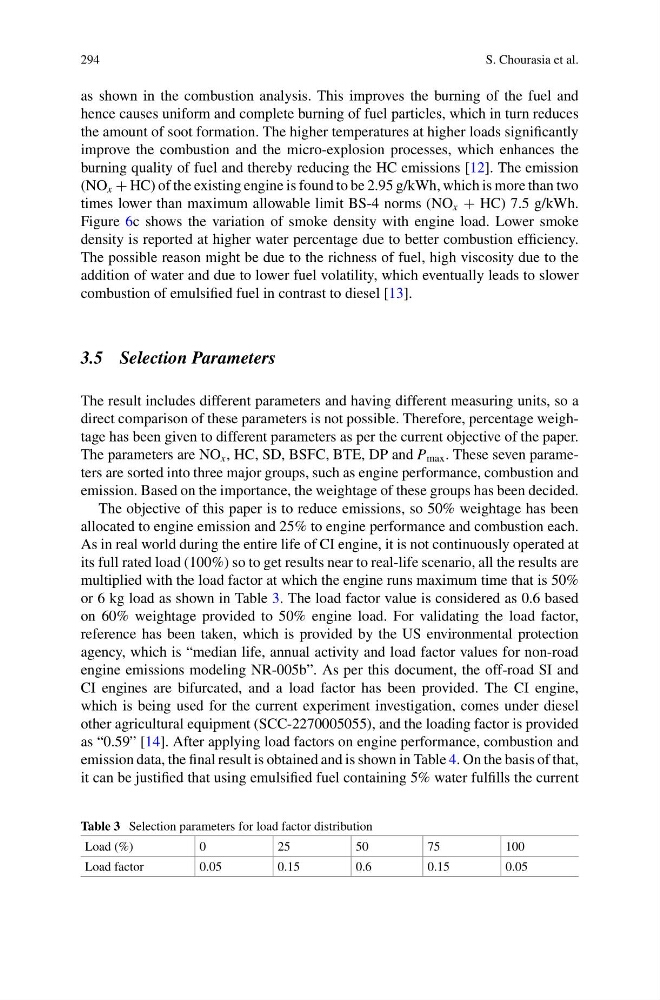
multiplied with the load factor at which the engine runs maximum time that is 50%
or 6 kg load as shown in Table 3. The load factor value is considered as 0.6 based
on 60% weightage provided to 50% engine load. For validating the load factor,
reference has been taken, which is provided by the US environmental protection
agency, which is “median life, annual activity and load factor values for non-road
engine emissions modeling NR-005b”. As per this document, the off-road SI and
CI engines are bifurcated, and a load factor has been provided. The CI engine,
which is being used for the current experiment investigation, comes under diesel
other agricultural equipment (SCC-2270005055), and the loading factor is provided
as “0.59” [14]. After applying load factors on engine performance, combustion and
emission data, the final result is obtained and is shown in Table 4. On the basis of that,
it can be justified that using emulsified fuel containing 5% water fulfills the current
Table 3 Selection parameters for load factor distribution
Load (%)
0
25
50
75
100
Load factor
0.05
0.15
0.6
0.15
0.05
S. Chourasia et al.
as shown in the combustion analysis. This improves the burning of the fuel and
hence causes uniform and complete burning of fuel particles, which in turn reduces
the amount of soot formation. The higher temperatures at higher loads significantly
improve the combustion and the micro-explosion processes, which enhances the
burning quality of fuel and thereby reducing the HC emissions [12]. The emission
(NO x + HC) of the existing engine is found to be 2.95 g/kWh, which is more than two
times lower than maximum allowable limit BS-4 norms (NO x + HC) 7.5 g/kWh.
Figure 6c shows the variation of smoke density with engine load. Lower smoke
density is reported at higher water percentage due to better combustion efficiency.
The possible reason might be due to the richness of fuel, high viscosity due to the
addition of water and due to lower fuel volatility, which eventually leads to slower
combustion of emulsified fuel in contrast to diesel [13].
3.5 Selection Parameters
The result includes different parameters and having different measuring units, so a
direct comparison of these parameters is not possible. Therefore, percentage weightage has been given to different parameters as per the current objective of the paper.
The parameters are NO x , HC, SD, BSFC, BTE, DP and P max . These seven parameters are sorted into three major groups, such as engine performance, combustion and
emission. Based on the importance, the weightage of these groups has been decided.
The objective of this paper is to reduce emissions, so 50% weightage has been
allocated to engine emission and 25% to engine performance and combustion each.
As in real world during the entire life of CI engine, it is not continuously operated at
its full rated load (100%) so to get results near to real-life scenario, all the results are
multiplied with the load factor at which the engine runs maximum time that is 50%
or 6 kg load as shown in Table 3. The load factor value is considered as 0.6 based
on 60% weightage provided to 50% engine load. For validating the load factor,
reference has been taken, which is provided by the US environmental protection
agency, which is “median life, annual activity and load factor values for non-road
engine emissions modeling NR-005b”. As per this document, the off-road SI and
CI engines are bifurcated, and a load factor has been provided. The CI engine,
which is being used for the current experiment investigation, comes under diesel
other agricultural equipment (SCC-2270005055), and the loading factor is provided
as “0.59” [14]. After applying load factors on engine performance, combustion and
emission data, the final result is obtained and is shown in Table 4. On the basis of that,
it can be justified that using emulsified fuel containing 5% water fulfills the current
Table 3 Selection parameters for load factor distribution
Load (%)
0
25
50
75
100
Load factor
0.05
0.15
0.6
0.15
0.05