

286
S. Chourasia et al.
such as PM, CO 2 , NO x , HC and CO [1–4]. NO x is mainly produced due to high peak
temperatures during the combustion. To reduce the effect of this on environment,
various researchers are trying to reduce the peak temperature at which N 2 and O 2
react to form the NO x . Exhaust gas recirculation can reduce NO x emission, but it
increases PM emission, and oxygen enrichment reduces PM emissions but increases
NO x emission. For the fulfillment of the latest European emission norms and to keep
the environment safe, further reduction in NO x is needed which is being obtained
by the use of biodiesel–diesel blend, and this can be reduced by the addition of
water in fuel as an additive. Emulsification is the method in which two or more
immiscible fluids (polar and non-polar) are mixed to form a homogeneous mixture
in the presence of active surface agents known as surfactants or emulsifiers using
externally applied force. This force is applied using mechanical work, humanizer,
ultrasonic and supersonic vibrations, etc. These fluids are thermodynamically stable.
Prof. B. Hopkins proposes the introduction of water inside the engine for the
enhancement of BTE and the reduction of toxic emissions. There are three methods
by which water can be introduced in the system: Preparing water–oil emulsion, fumigating water into intake of air and direct injection into the combustion chamber with
the help of injector [5]. Water can be added to the engine without any modification.
The addition of water into the fuel is one of the methods of reducing the NO x emission
and PM without affecting the performance of the engine [6, 7]. With the emulsified
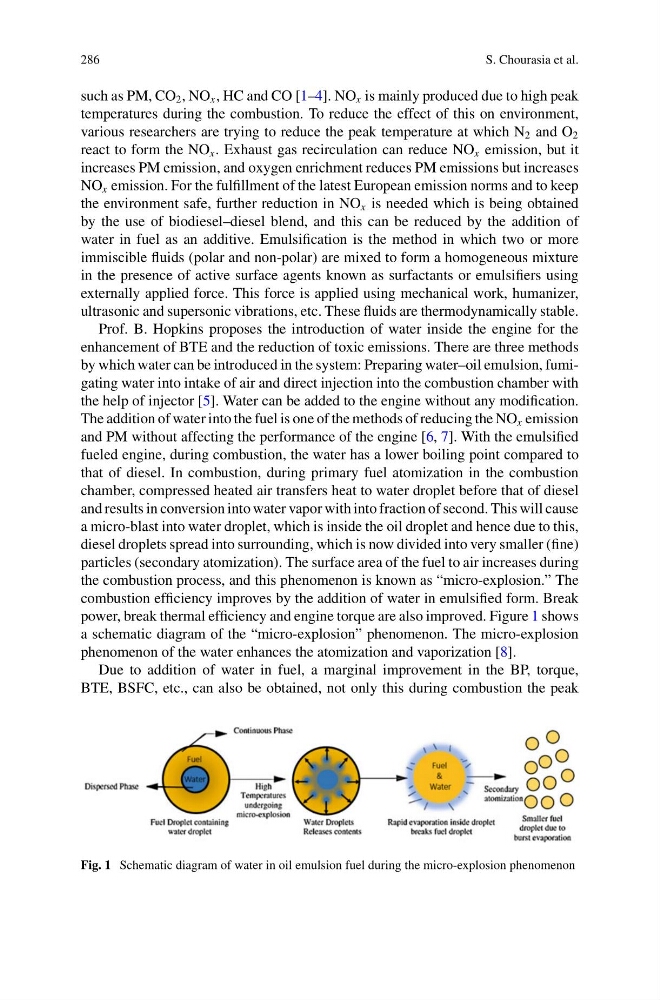
fueled engine, during combustion, the water has a lower boiling point compared to
that of diesel. In combustion, during primary fuel atomization in the combustion
chamber, compressed heated air transfers heat to water droplet before that of diesel
and results in conversion into water vapor with into fraction of second. This will cause
a micro-blast into water droplet, which is inside the oil droplet and hence due to this,
diesel droplets spread into surrounding, which is now divided into very smaller (fine)
particles (secondary atomization). The surface area of the fuel to air increases during
the combustion process, and this phenomenon is known as “micro-explosion.” The
combustion efficiency improves by the addition of water in emulsified form. Break
power, break thermal efficiency and engine torque are also improved. Figure 1 shows
a schematic diagram of the “micro-explosion” phenomenon. The micro-explosion
phenomenon of the water enhances the atomization and vaporization [8].
Due to addition of water in fuel, a marginal improvement in the BP, torque,
BTE, BSFC, etc., can also be obtained, not only this during combustion the peak
Fig. 1 Schematic diagram of water in oil emulsion fuel during the micro-explosion phenomenon
S. Chourasia et al.
such as PM, CO 2 , NO x , HC and CO [1–4]. NO x is mainly produced due to high peak
temperatures during the combustion. To reduce the effect of this on environment,
various researchers are trying to reduce the peak temperature at which N 2 and O 2
react to form the NO x . Exhaust gas recirculation can reduce NO x emission, but it
increases PM emission, and oxygen enrichment reduces PM emissions but increases
NO x emission. For the fulfillment of the latest European emission norms and to keep
the environment safe, further reduction in NO x is needed which is being obtained
by the use of biodiesel–diesel blend, and this can be reduced by the addition of
water in fuel as an additive. Emulsification is the method in which two or more
immiscible fluids (polar and non-polar) are mixed to form a homogeneous mixture
in the presence of active surface agents known as surfactants or emulsifiers using
externally applied force. This force is applied using mechanical work, humanizer,
ultrasonic and supersonic vibrations, etc. These fluids are thermodynamically stable.
Prof. B. Hopkins proposes the introduction of water inside the engine for the
enhancement of BTE and the reduction of toxic emissions. There are three methods
by which water can be introduced in the system: Preparing water–oil emulsion, fumigating water into intake of air and direct injection into the combustion chamber with
the help of injector [5]. Water can be added to the engine without any modification.
The addition of water into the fuel is one of the methods of reducing the NO x emission
and PM without affecting the performance of the engine [6, 7]. With the emulsified
fueled engine, during combustion, the water has a lower boiling point compared to
that of diesel. In combustion, during primary fuel atomization in the combustion
chamber, compressed heated air transfers heat to water droplet before that of diesel
and results in conversion into water vapor with into fraction of second. This will cause
a micro-blast into water droplet, which is inside the oil droplet and hence due to this,
diesel droplets spread into surrounding, which is now divided into very smaller (fine)
particles (secondary atomization). The surface area of the fuel to air increases during
the combustion process, and this phenomenon is known as “micro-explosion.” The
combustion efficiency improves by the addition of water in emulsified form. Break
power, break thermal efficiency and engine torque are also improved. Figure 1 shows
a schematic diagram of the “micro-explosion” phenomenon. The micro-explosion
phenomenon of the water enhances the atomization and vaporization [8].
Due to addition of water in fuel, a marginal improvement in the BP, torque,
BTE, BSFC, etc., can also be obtained, not only this during combustion the peak
Fig. 1 Schematic diagram of water in oil emulsion fuel during the micro-explosion phenomenon