

Selection of Optimum Castor–Rapeseed Emulsified Fuel …
287
temperature of combustion chamber also reduces because the water droplets absorb
the heat (acts as an intercooler of gas). It also provides better burning efficiency
resulting in the NO x emission which reduces due to the reduction of peak temperature
at which N 2 and O 2 react to form the NO x .
2 Experimental Setup and Methodology
2.1 Experimental Setup
All the experiments were carried on an automatic computerized CI engine test rig
fitted with mono cylinder, four-stoke, multi-fuel, direct injection, water cooling CI
engine having 110 mm stroke and 87.5 mm bore made by Kirloskar India. The
computerized test rig is equipped with crank angle encoder that can measure up to
5500 rpm (TDC pulse), water-cooled eddy current dynamometer for load measurement, K type load cell for load measurement (0–50 kg), piezo sensor having max
capacity of 5000 PSI equipped with optical low noise cable for pressure measurement,
RTD-type thermocouple temperature measurement sensor, rotameter for water flow
measurement, 16 lit fuel tank capacity, etc. The test rig can record BP, BSFC, BTE,
ME, NHR, etc., using NI USB-6210 data acquisition system. The engine compression ratio can be adjusted between 12 and 18. Fuel injection can also vary from 0–25°
BTDC. For the measurement of engine emission, gas analyzer and smoke density
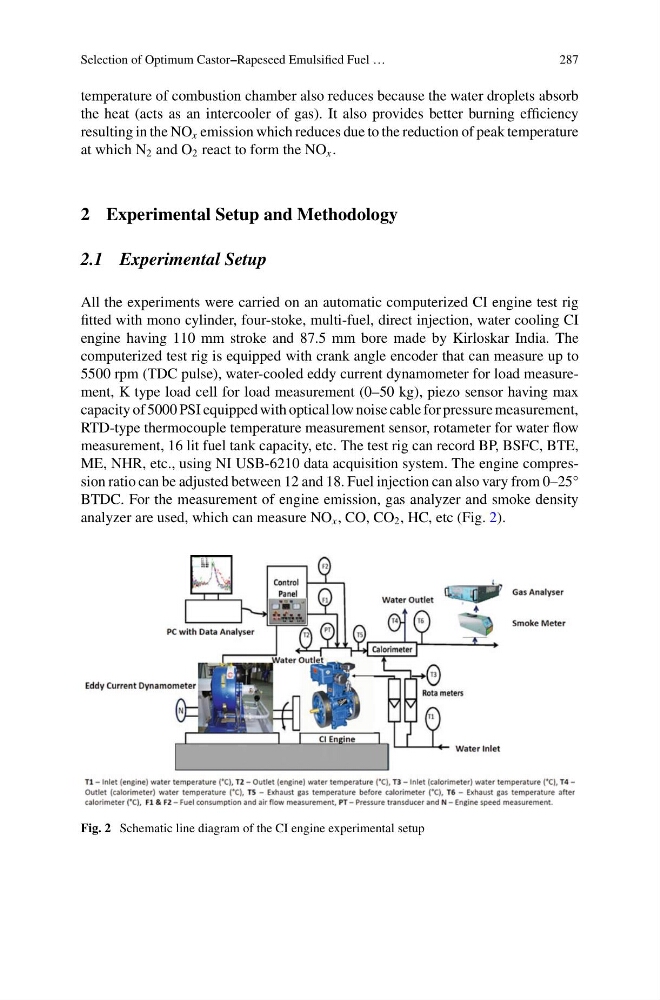
analyzer are used, which can measure NO x , CO, CO 2 , HC, etc (Fig. 2).
Fig. 2 Schematic line diagram of the CI engine experimental setup
287
temperature of combustion chamber also reduces because the water droplets absorb
the heat (acts as an intercooler of gas). It also provides better burning efficiency
resulting in the NO x emission which reduces due to the reduction of peak temperature
at which N 2 and O 2 react to form the NO x .
2 Experimental Setup and Methodology
2.1 Experimental Setup
All the experiments were carried on an automatic computerized CI engine test rig
fitted with mono cylinder, four-stoke, multi-fuel, direct injection, water cooling CI
engine having 110 mm stroke and 87.5 mm bore made by Kirloskar India. The
computerized test rig is equipped with crank angle encoder that can measure up to
5500 rpm (TDC pulse), water-cooled eddy current dynamometer for load measurement, K type load cell for load measurement (0–50 kg), piezo sensor having max
capacity of 5000 PSI equipped with optical low noise cable for pressure measurement,
RTD-type thermocouple temperature measurement sensor, rotameter for water flow
measurement, 16 lit fuel tank capacity, etc. The test rig can record BP, BSFC, BTE,
ME, NHR, etc., using NI USB-6210 data acquisition system. The engine compression ratio can be adjusted between 12 and 18. Fuel injection can also vary from 0–25°
BTDC. For the measurement of engine emission, gas analyzer and smoke density
analyzer are used, which can measure NO x , CO, CO 2 , HC, etc (Fig. 2).
Fig. 2 Schematic line diagram of the CI engine experimental setup